Breaking

Showing posts with label AMD. Show all posts

Thursday, September 17, 2020

9/17/2020 04:02:00 PM

Processor: AMD boasts that Ryzen 4000 CPUs are going to be ‘tremendously powerful’

Processor: AMD boasts that Ryzen 4000 CPUs are going to be ‘tremendously powerful’


Zen 3 goes to blow you away by all accounts…

AMD’s Ryzen 4000 desktop processors are going to be ‘tremendously powerful’ because of the main advancements within the Zen 3 architecture they’re built on, a corporation executive recently boasted.

The comment was made by Forrest Norrod, AMD’s senior vice chairman, during the Deutsche Bank 2020 call, as reported by Seeking Alpha.

Norrod said: “So you recognize that first Zen 1 Core was great and hugely cored, but Zen2 was also. And Zen 3, that’s at the guts of our next-generation products is additionally a tremendously powerful architecture and you recognize right the trajectory that we would have liked to get on .”

Certainly, there’s no mistaking the arrogance behind the strong choice of wording for exactly how powerful Zen 3 is going to be, and thus the type of power we will expect from next-gen Ryzen 4000 chips.

AMD recently allow us to know that there'll be an initial reveal of Zen 3 desktop processors on October 8, so we should always know tons more about Ryzen 4000 CPUs very soon. That’ll be followed by another event on October 28 where AMD will unveil Big Navi graphics cards.

A big leap in performance

Of course, with the launch just a couple of weeks away now, it is sensible that AMD would be beginning to crank up the hype machine for Ryzen 4000. We expect something sort of a 15% uplift in terms of IPC (instructions per clock), or even even more, with the rumor mill also mentioning up to twenty gains as an opportunity.

A big leap in performance is predicted, then, and a fresh leak of the purported AMD Ryzen 9 4950X is additionally caused for concern for Intel, with this 16-core processor hitting 4.8GHz boost – with potentially faster speeds to return, as that’s (allegedly) an early engineering sample.

The existing 3950X offers a 4.7GHz boost – and remember, any clock speed improvements are going to be approaching the top of these major architectural gains, for a double whammy for Intel.

Source URL

Wednesday, June 24, 2020

6/24/2020 03:30:00 AM

Is Nvidia performing on new budget graphics cards to hit AMD where it hurts?

Is Nvidia performing on new budget graphics cards to hit AMD where it hurts?


Budget battlefield

While we’re all eagerly awaiting the reveal of the high-end Nvidia RTX 3080 graphics card, which can likely blow us all away later this year, it seems that Nvidia is additionally planning on updating its GTX 1650 range of affordable cards – likely during a bid to attack arch-rival AMD during a market it’s usually strongest in.

You see, while Nvidia is that the undisputed king of high-end and enthusiast GPUs, when it involves budget and cheaper graphics cards, AMD is gaining market share. The budget and mid-range markets are huge, so it is sensible that Nvidia wouldn’t want to neglect them and permit AMD to dominate there.

The rumors emerge from a post on the AIDA64 website which mentions to previously-unannounced variants of the affordable Nvidia GTX 1650 – the GeForce GTX 1650 TU116 and GeForce GTX 1650 TU106.

These would apparently join last year’s GeForce GTX 1650 and therefore the GeForce GTX 1650 GDDR6.

New silicone

If the post is correct, it means Nvidia might be getting to release a GTX 1650 using the TU116 die, which is found within the likes of the GTX 1650 Super and GTX 1660 Super. this might bring a transistor count of 6.6 billion, compared to the 4.7 billion of the prevailing GTX 1650 GPUs.

Meanwhile, the second new GTX 1650 will apparently use the TU106 die, which is especially interesting as that’s the die found within the likes of the RTX 2060 Super and RTX 2070 – two costlier GPUs from Nvidia that feature Tensor and RT cores for advanced ray tracing lighting effects, which are usually exclusive to Nvidia’s RTX 20-series GPUs.

If there's getting to be a GTX 1650 model with the TU106 die, does meaning Nvidia is bringing ray tracing to a reasonable GTX GPU?


We’re not too sure, but stranger things have happened. If these rumors are true, then as Tom’s Hardware points out, it might be Nvidia clearing out excess dies and leftover silicone.

If Nvidia can use those dies to return up with products to hit AMD where it hurts – within the budget and affordable market – then all the higher.


Source URL

Thursday, June 27, 2019

6/27/2019 09:00:00 PM

Microsoft could make AMD-powered Surface devices after falling out with Intel

Microsoft and Intel’s relationship on “shaky ground”


A new report suggests that Microsoft could be considering moving from Intel to AMD to power its next lineup of the Surface device after apparently becoming increasingly disappointed by Intel’s products.

This move would be a major blow for Intel – and a big win for its competitor AMD. For the past five years, all of Microsoft’s Surface products have run on Intel processors, but as Brad Sams – noted Microsoft expert at Petri.com – alleges, insiders at Microsoft have described the company’s relationship with Intel as “being on shaky ground,” leading to the company looking to “diversify away from a purely-Intel lineup” for its next-generation Surface products.

According to Sams, Microsoft is experimenting with using AMD and ARM chips, with prototype devices having already been made.

A prototype Surface Laptop is apparently using a 12nm AMD Picasso SoC (system on chip). Meanwhile, a new Surface Pro prototype is said to be using a Qualcomm Snapdragon chip.

It seems that Microsoft is working with Qualcomm to build its own ARM chip, code-named Excalibur, that is said to work better on Windows 10.

This sounds similar to the situation with Apple, which is said to be dropping Intel in favor of its own ARM-based processors.

The rumors – and remember, these are just rumors at the moment – do make sense. Microsoft has established relationships with both AMD and Qualcomm – the former making the chips for the upcoming Xbox Scarlett console, the latter working with Microsoft on Windows on Snapdragon devices – so it’s not unthinkable that the company would be looking to work with them on new Surface devices.

Falling out with Intel

The fact that Microsoft is apparently looking at other CPU makers after falling out with Intel is something we suggested might happen after a string of bad news about Intel.

According to Sams, the reason why Microsoft and Intel’s relationship has soured is because of disappointing product releases by Intel.

As Sams states, “With Skylake, Microsoft got burned by the immaturity between Windows and the chips which resulted in faulty hardware and a serious black eye to the brand’s high-quality reputation.” Skylake is the name for Intel’s sixth-generation Core processors, and while they generally performed well, they were also victim to high-profile security flaws, including Meltdown and Spectre.

However, Microsoft won’t be completely dropping Intel from its devices, according to Sams. Intel’s brand power is still strong enough to shift products, and it looks like there will be an Intel-powered Surface Pro 7, as well as new versions of the Surface Book and as well.


READ MORE:

Monday, February 11, 2019

2/11/2019 10:36:00 PM

Graphic Card: AMD’s Navi graphics cards may not arrive until October

New rumor puts paid to older speculation of a summer launch


A new report alleges that AMD’s next-gen 7nm Navi GPUs won’t emerge until October of this year, which is later than the previous speculation that pointed to a summer release.

You may recall that last month, references to Navi graphics cards were uncovered in the source code of macOS, and this underlined previous buzz from the graphics grapevine which was hopeful for a July launch.

That said, going back further to a leaked roadmap from AMD, this suggested that Navi would pitch up in the second half of 2019, so October is still in line with this.


  • Here’s our full AMD Radeon VII review
  • Or should you upgrade to a GeForce RTX 2080?
  • And don’t forget that Intel may soon jump into the GPU arena


The October date comes from sources who apparently spoke to French tech site Cowcotland, not the most renowned source of accurate rumors – although it did recently chip in with some interesting info on the availability of the Radeon VII in France. Still, we should take this speculation with a very hefty pinch of the white stuff.

However, it does make some kind of sense, and not just because it ties up with the aforementioned leaked roadmap.

We just mentioned the availability of the Radeon VII, which is AMD’s first 7nm graphics card – though note that it’s still based on the current-gen Vega architecture, not Navi – and stock of that GPU is very thin on the ground, at least going by what we heard during the launch last week, and from what we can observe now.

For example, in the UK, there are still some Radeon VII cards available at the main stockist, Overclockers UK, but the caveat is the remaining Gigabyte and MSI models are priced at an eye-watering £799.99 – so it seems that folks aren’t quite prepared to pay this much.

All the other cheaper cards – pitched as low as £649.99 in the case of Sapphire – sold out within a few hours of the launch (we were watching, and indeed that Sapphire Radeon VII was sold out almost immediately).

Pop on over to Newegg in the US and every single Radeon VII GPU is sold out (they are all priced at the same $699.99, which is the recommended price tag).

By all accounts, there were only 20 Radeon VII cards in the whole of France at launch, as Cowcotland reported last week.

Production problems?

Anyway, the point to bear in mind here is that there are seemingly clear issues with Radeon VII production, and a lot of that may be down to the Lunar New Year holiday in China, which sees the big manufacturing factories close.

And catching up with rebalancing Radeon VII supply and demand could take its toll on the production schedule for next-gen Navi graphics cards. Particularly when there’s another potential force to consider here, namely that Navi GPUs may also be used outside of the PC arena in next-gen consoles (according to the rumor mill, anyway), thus exerting more pressure on the supply chain.

As ever, we will just have to see how things pan out, although, given all this, it wouldn’t be surprising to see the rumored Navi GPUs which are in the pipeline get delayed until much later in 2019.

Note that the Navi graphics cards we are expecting to see this year will be more budget-friendly mid-range models, with the high-end efforts aimed at the likes of enthusiasts and hardcore gamers not expected to turn up until 2020.

We are expecting to see four models later this year – Navi 16, Navi 12, Navi 10 and Navi 9 – according to the info turned up by digging through the macOS Mojave source code.


READ MORE:

Monday, December 31, 2018

12/31/2018 09:45:00 PM

AMD Ryzen Threadripper 3rd Generation release date, news, and rumors

AMD’s next HEDT chips


Now that AMD is on the verge of revealing its 7nm next-generation processors, what will the future look like for Threadripper 3rd Generation – its next line of HEDT processors?

Now that AMD Ryzen is nearly two years old at this point, and we’ve seen Team Red come out with winning CPU after winning CPU, we’ve been asking ourselves where things go from here.

AMD is on the verge of launching its 7nm Zen 2 architecture, according to its own roadmap and CES 2019 plans, which should drastically improve both performance and efficiency and deliver some of the best processors we’ve seen yet. And, while this is definitely exciting news for users looking for the Ryzen 3rd Generation processors, we’re more interested in the next line of Threadripper chips.

With chips like the AMD Ryzen Threadripper 2990WX, AMD blew the lid off of what to expect from HEDT – or high-end desktop – processors. With AMD Ryzen Threadripper 3rd Generation, we’re expecting to see even more cores, performance and value.

Cut to the chase


  • What is it? AMD’s next line of HEDT processors 
  • When is it out? Likely Summer 2019
  • What will it cost? TBD


AMD Ryzen Threadripper 3rd Generation release date

While AMD hasn’t come out and announced the release date for its next Threadripper chips, the last two Threadripper generations have been pretty consistent, so we have a basis for speculation.

Both the original Threadripper and Threadripper 2nd Generation launched in August of 2017 and 2018, respectively. We’re fairly sure that AMD is going to follow the same general release schedule this time around, but, obviously, we don’t know that for sure.

AMD’s latest roadmap shows its Zen 2 architecture launching in 2019 – with a likely reveal at CES 2019. If AMD does reveal Zen 2, along with Ryzen 3rd Generation at CES, it’s likely that we’ll see Threadripper 3rd Generation at Computex 2019, with a release date following in the following months.

We’ll update this article as soon as we hear more substantial rumors about the release date.

AMD Ryzen Threadripper 3rd Generation

Now, so far ahead of AMD Ryzen Threadripper 3rd Generation’s launch, we don’t have any official pricing information, but we can look at past generations to get an idea of what AMD’s next HEDT chips will cost.

The original lineup of Threadripper topped out with the $999 (£999, AU$1,439) AMD Ryzen Threadripper 1950X, but the second generation introduced surprisingly lower priced replacements. There were also two higher specced – and higher priced – additions. We believe Threadripper 3rd Generation will follow the latter model.

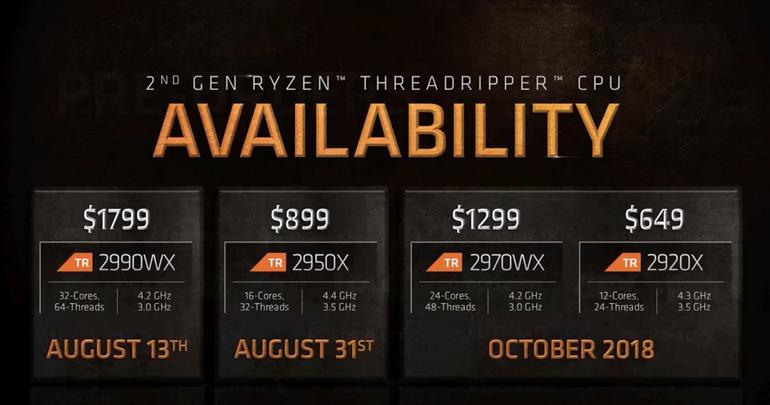
The prices of AMD Ryzen Threadripper 2nd Generation chips are as follows: 


  • Ryzen Threadripper 2990WX: $1,799 (£1,639, AU$2,679)
  • Ryzen Threadripper 2970WX: $1,299 (£1,159, AU$2,039)
  • Ryzen Threadripper 2950X: $899 (£809, AU$1,415)
  • Ryzen Threadripper 2920X: $649 (£583, AU$1,019)


AMD could very well surprise us and introduce an even higher-end SKU, but we don’t think that’s likely. Stay tuned, and we’ll update this page as soon as we hear any Threadripper 3rd Generation price information.

AMD Ryzen Threadripper 3rd Generation specs


With AMD Ryzen Threadripper 3rd Generation, we expect to see a huge bump in core counts, efficiency and per-core performance with Threadripper 3rd Generation. If you need a refresher on last year’s Threadripper lineup’s specs they’re as follows:


  • Ryzen Threadripper 2920X: 12-cores, 24-threads, clocked at 3.5GHz to 4.3GHz
  • Ryzen Threadripper 2950X: 16-cores, 32-threads, clocked at 3.5GHz to 4.4GHz
  • Ryzen Threadripper 2970WX: 24-cores, 48-threads, clocked at 3.0GHz to 4.2GHz
  • Ryzen Threadripper 2990WX: 32-cores, 64-threads, clocked at 3.0GHz to 4.2GHz


We’re sure that with the move to 7nm, AMD is going to massively improve specs. But, with Threadripper 3rd Generation, or Castle Peak, rumors are thin on the ground. However, there is plenty of buzz about the AMD Ryzen 3000 series, not to mention the 64-core AMD Epyc server CPU.

There is already speculation that suggests there will be a 16-core, 32-thread Ryzen 3000 CPU, with higher instructions per clock (IPC) than previous processors. That’s double what the Ryzen 7 2700X features, and if AMD is able to do the same with Threadripper – we could see a 64-core HEDT chip.

It wouldn’t even be the first 64-core processor in AMD’s lineup. AMD recently showed off its latest Epyc processors, based off its Rome microarchitecture, with up to 64-cores.

If AMD is able to bring those high core counts to Castle Peak HEDT processors, we could see AMD absolutely dominate Intel’s Basin Falls Refresh. And, if Intel can’t answer with anything but 14nm silicon, AMD might claim the HEDT throne like it did when it topped Intel’s mainstream sales.


SOURCE:

Sunday, December 16, 2018

12/16/2018 10:59:00 PM

Next-gen mobile AMD Ryzen processors spotted in laptop benchmarks

Five new CPUs listed so far


On top of a full range of Ryzen 3rd Generation desktop processors, it looks like AMD already has a few mobile CPUs inside upcoming laptops.

Hexus spotted Geekbench results for three different AMD Ryzen 3000 Series Picasso APUs fitted inside two classified HP laptops. First up is the HP Laptop 17-ca1xxx equipped with an AMD Ryzen 5 3500U, which is listed as a 2.1GHz quad-core processor featuring eight threads and Radeon Vega Mobile Gfx integrated graphics.

A second HP Laptop 17-ca1xxx showed up in GeekBench’s records twice but equipped with a different AMD Ryzen 3 3300U CPU. It seems to be a small step behind the chip listed above as it only has 4-cores, 4-threads running at 2.1GHz with Radeon Vega Mobile Gfx integrated graphics.

Lastly, the HP Laptop 14-cm1xxx showed up with a 2.6GHz MD Ryzen 3 3200U that appears to be a dual-core processor featuring 4 threads and Radeon Vega Mobile Gfx integrated graphics.

Geekbench results are always a little shaky, but TUM_APISAK also corroborated the report by tweeting out the same processor names along with a two additional chips.

Interestingly, the serial leaker noted there will be a high-end Ryzen 7 3700U CPU equipped with 4-cores, 8-threads running between 2.2GHz and 3.8GHz base and boost frequencies, respectively. The 300U was also listed as an extremely low-end 300U chip that might be destined for the first AMD-powered Chromebooks.

Digging into the details listed on the GeekBench results seem to reveal that upcoming Picasso APUs will pair 12nm FinFET Raven Ridge CPUs with Vega GPUs. So these chips may technically be part of an extended Ryzen 2nd Generation family due to its use of the 12nm Zen+ architecture.

At CES 2019, we fully expect AMD will announce its hotly anticipated 7nm Zen 2 architecture that should be the foundation of the company’s next Ryzen 3rd Generation and Ryzen Threadripper 3rd Generation processors.

Meanwhile, Intel just announced its 10nm Sunny Cove architecture


Thursday, December 13, 2018

12/13/2018 10:30:00 PM

AMD’s latest graphics card software lets you stream VR games to your phone

Radeon Software’s biggest upgrade in years


AMD Radeon Software has seen several annual updates over the last few years, however, Adrenalin 2019 Edition is bringing some of the biggest and most unique features we’ve seen yet, particularly introducing VR and game streaming to your phone.

AMD Radeon Software Adrenalin 2019 Edition’s single biggest feature has to be ReLive for VR, which essentially lets players stream VR games running on their PC to a phone-powered VR headset (i.e. Google Daydream View and Samsung Gear VR) and standalone VR headsets (i.e. the Oculus Quest and HTC Vive Focus).

This all might sound bananas, but it really works well. During a short demo, we hardly experienced any lag or slowdown in frame rate that would have caused us a bout of nausea. Instead, we were able to freely look around just as if we were playing VR games with a traditional headset hooked up directly to a PC.


By linking AMD’s Radeon Software on PCs with the Radeon ReLive VR app on phones and standalone VR headsets, players can access their full catalog of Steam VR games.

Of course, visuals take a small tick down, as they’re tuned for low-latency and to ensure a seamless experience. At the same time, the program utilizes low-level hardware acceleration to optimize streaming from your PC to a mobile VR headset.

Not only does this give users a great way of experiencing completely wireless VR, they can also experience more high-end VR games that were typically locked to the PC. It’s especially important to give PC-based VR games another place to live, as there seems to be no new Oculus Rift in sight and companies are now focused on introducing more standalone headsets.

The AMD Link app will only initially available on the Google Play Store and HTC Viveport marketplace, but AMD also plans to release its app on the Oculus Store soon.


Game streaming finally arrives

At long last, Adrenalin 2019 Edition also introduces game streaming. Players will now be able to use their AMD Link app on iOS and Android smartphones to play games running on their PC through their phone.

What’s more, players can expect up to 4K resolutions at 60 frames per second (fps) with low-latency while gaming on their tablets and phones. AMD claims its game streaming solution is even up to 44% faster than (unspecified) competitive solutions.

To get started, users simply need to pair up the AMD Link app with their PC and – presto – they’ll be able to launch games with just a tap. The interface will introduce on-screen controls, but users will also be able to hook up their phone to a Bluetooth controller.

Outside of gaming, AMD Link will also allow users to streaming their PC desktop, which will come in handy if you ever need to remote into your PC or just stream 4K video from your PC.


Live streaming for pros

Aside from VR and game streaming, Adrenalin 2019 Edition is also enhancing the way you can live stream broadcast to an audience. To this end, AMD is introducing a new Scene Editor to ReLive that allows users to pull in multiple recording sources and add graphics to create a dynamic streaming overlay. With the added ability to transition between scenes using hotkeys or the Radeon Overlay, this is essentially AMD’s version of OBS or XSplit for the Twitch broadcasters out there.

ReLive has also received a few other smaller improvements including high-quality audio recording with support for multi-channel audio (i.e. all your teammates talking), in-game replay as well as easy GIF creation and sharing.

Everything else

There are almost too many Adrenalin 2019 Edition improvements to mention, and as much as we’d like to spend all day writing about them, here's a list of the rest of the most important upgrades:


  • Installer: streamlined with a simple one-click install process.
  • Project ReSX: delivers improved FPS performance and 99th percentile frame times for popular PC eSports games to ensure a faster click-to-response time.
  • Game Advisor: in-game performance testing that recommends quality setting changes to improve the performance or increase image quality.
  • Radeon Wittman: improved performance with auto-GPU overclocking and undervolting, memory overclocking and application-bound tuning. fan speed control and unlocked DPM state customization for Radeon RX Vega-series graphics cards.
  • Radeon Chill: up to 20% greater power savings in games such as Fortnite, Overwatch and PUBG.
  • FreeSync 2 HDR: improved auto-tone mapping for a more detailed picture across the frame and different levels of lighting across the frame.
  • Virtual Super Resolution: enhanced detail on ultra-wide 21:9 monitors
  • Radeon Overlay: added WattMan access while in-game and expanded performance metrics display.
  • AMD Link: added voice control, Radeon WattMan access, Enhanced Performance Metrics access and live stream editing to create playback videos.
  • Up until now, we've always felt that AMD's Radeon Software had it bit more polish than Nvidia's GeForce Experience – but not nearly as many features. With Adrenalin 2019 Edition, it now seems AMD may have even surpassed Nvidia's software suite for the time being.

Meanwhile, the war of the best graphics cards rages on.


SOURCE:

Thursday, November 8, 2018

11/08/2018 09:29:00 PM

Amd Epyc 'rome' to Feature Up to 64 Zen 2 Cores

AMD made huge waves in the server market with EPYC. Now the company has officially lifted the lid on the next-generation of EPYC processors featuring the Zen 2 microarchitecture. And they're processing monsters.


AMD has officially unveiled the next-generation of EPYC processors featuring the Zen 2 microarchitecture, and they look set to transform the server market once again.

AMD EPYC "Rome" processors will feature up to 64 Zen 2 cores by combining up to eight 7-nanometer chips with a 14-nanometer I/O die. According to AMD, these new chips will bring twice the performance and four times the floating-point power per socket compared to the current-generation EPYC chips.

This will make EPYC "Rome" the world's first 7-nanometer datacenter processor.

Along with up to twice the cores, EPYC "Rome" will be the first PCIe 4.0 capable x86 server CPU featuring 128 lanes allowing it to make full use of next-generation accelerators such as the Radeon Instinct MI60, hardware that's built around the Vega 7-nanometer GPU.


The new chips will also come with an eight-channel DDR4 memory controller capable of supporting up to 4TB of DRAM per socket.

Now, you might be thinking that all these improvements will require a socket upgrade. Fear not, because not only will the EPYC "Rome" chips be socket compatible with existing EPYC "Naples" silicon, but it will also be forward compatible with AMD's "Milan" CPUs that will use the Zen 3 microarchitecture.

This, AMD hopes, will ease the workload that both customers and server makers have to do to make the switch to the new silicon.

AMD is currently sampling EPYC "Rome" chips with customers, with the chips expected to launch sometime in 2019.

Build a monster $5,100 AMD Ryzen Threadrip


SOURCE:

Saturday, August 25, 2018

8/25/2018 11:39:00 PM

AMD Raven Ridge APUs for laptops teased for 2018 release

The next generation of APUs is coming

AMD Raven Ridge

AMD may have just teased its next Raven Ridge APU for high-end notebooks. We have already seen the benefit that these APUs can offer – allowing for 1080p gaming without discrete graphics, as long as you’re comfortable dialing back some of the detail settings. 

The Ryzen 7 2800H was hinted at in a slide during AMD’s Hot Chips presentation, where the company was detailing its progress on the ‘25x20’ initiative. This will see the chip manufacturer boost the energy efficiency of all chips 25 times by 2020. 

More information about the mobile chip showed up on HP’s website, as reported by Tom’s Hardware. This Raven Ridge APU will supposedly be a quad-core chip and will rock a 3.35GHz base frequency with a 3.8GHz boost – beefy for a mobile chip.  This high-end mobile chip was teased next to a Ryzen 5 2600H, as well. 

Future spec 

AMD’s focus on boosting energy efficiency every year might see this new APU manufactured on a smaller process. The slides AMD showed off already mentioned that these next-generation Raven Ridge chips will have a smaller die size, so it’s within the realm of possibility to move to a 12-nanometer (nm) process. 

This might push AMD Ryzen mobile chips ahead of Intel’s offerings – especially considering that Intel has been stuck on a 14nm process for a while now. Maybe some of the best Ultrabooks of 2018 will have AMD instead of Intel Inside.


Wednesday, August 8, 2018

8/08/2018 10:35:00 PM

AMD’s 32-Core Threadripper 2990WX Sets a Remarkable CPU Bbenchmark Record with 5.1GHz to Overclock

Overturns Intel’s prototype 28-core monster, albeit not on a level playing field

AMD’s 32-Core
AMD’s 32-Core
AMD’s Ryzen Threadripper 2990WX has set a new record Cinebench score (for a single-socket processor) which beat the result that Intel’s as yet unreleased 28-core monster CPU (clocked at 5GHz) managed to achieve at Computex.

The prototype Intel processor hit a Cinebench R15 multi-core score of 7,344, whereas the Threadripper 2990WX managed to outstrip it with a score of 7,618, as reported by Tom’s Hardware.

That said, note that this isn’t a level playing field – both benchmarks were conducted under different conditions and obviously in different rigs. With its Computex benchmark, Intel used an industrial-grade water cooler, whereas AMD’s benchmark of the 2990WX was fuelled by more effective liquid nitrogen cooling (allowing for the processor to be overclocked to 5.1GHz across all 32-cores).

So we can’t draw any concrete conclusions about the relative performance merits of the CPUs, but it’s clear that AMD has come up with something special in this Threadripper offering.

Money talks

What you have to bear in mind is that even if this is an unfair benchmark comparison for Intel, its 28-core processor is expected to cost many thousands of pounds – perhaps even 10 grand according to recent speculation – whereas AMD’s 2990WX nestles in far more affordable territory.

As we saw yesterday, this 32-core (64-thread) AMD processor with a base clock speed of 3.0GHz (and boost to 4.2GHz) will retail at $1799 (about £1,380, AU$2,430), a fraction of the likely price tag on Intel’s effort.

Indeed, AMD’s 2990WX is cheaper than Intel’s Core i9-7980XE, an 18-core processor which costs $1,999 (about £1540, AU$2,700) – and in Cinebench R15, AMD’s CPU is over 50% faster than the Core i9-7980XE.

So, for those who need a really chunky many-core processor – creative types engaged in the likes of heavyweight video editing – the Threadripper 2990WX seems to be a highly compelling offering, to say the least.

The 2990WX is actually the only one of the four freshly-revealed Ryzen Threadripper 2nd Generation processors which is now available to pre-order, with the product set to ship very shortly on August 13.

There’s also the 24-core Ryzen Threadripper 2970X which is due in October, the 16-core 2950X which is scheduled to appear on August 31, and finally, the 12-core 2920X which will pitch up in October alongside the 2970X.


Tuesday, August 7, 2018

8/07/2018 09:31:00 PM

AMD Unveils 'World Record-Breaking' Intel-Beating 2nd-Generation Ryzen Threadripper Processors

Starting today you can pre-order AMD's flagship Intel-beating 32-core, 64-thread 2nd-gen Ryzen Threadripper 2990WX from over 80 system integrators and retailers -- but it will cost you!

AMD

Want to get your hands on AMD's "world record-breaking" 32-core, 64-thread 2nd-generation Ryzen Threadripper 2990WX? You can pre-order starting today, but the chip will set you back a cool $1,799.

AMD has unveiled four 2nd-gen Threadripper chips, which will launch over August and September.

AMD Ryzen Threadripper 2990WX

  1. 32 cores/64 threads
  2. 4.2GHz boost/3.0GHz base
  3. 64MB L3 cache
  4. 250W TDP
  5. 64 PCIe Gen 3.0 lanes
  6. Price: $1,799
  7. Availability: Aug 13, 2018


AMD Ryzen Threadripper 2970WX

  1. 24 cores/48 threads
  2. 4.2GHz boost/3.0GHz base
  3. 64MB L3 cache
  4. 250W TDP
  5. 64 PCIe Gen 3.0 lanes
  6. Price: $1,299
  7. Availability: Oct 2018


AMD Ryzen Threadripper 2950X

  1. 16 cores/32 threads
  2. 4.4GHz boost/3.5GHz base
  3. 32MB L3 cache
  4. 180W TDP
  5. 64 PCIe Gen 3.0 lanes
  6. Price: $899
  7. Availability: Aug 31, 2018


AMD Ryzen Threadripper 2920X

  1. 12 cores/24 threads
  2. 4.3GHz boost/3.5GHz base
  3. 32MB L3 cache
  4. 180W TDP
  5. 64 PCIe Gen 3.0 lanes
  6. Price: $649
  7. Availability: Oct 2018


The X series processors are aimed at gamers and enthusiasts, while the WX (which stands for workstation) is aimed squarely at the creators and innovators (people who make money from their PCs).

AMD 2nd-gen Ryzen Threadripper line

While that $1,799 price tag might seem high at first blush, you're getting a chip that easily beats the $1,999 Intel Core i9-7980XE, so if you are in the market for a serious chip that costs serious money, the smart money goes to AMD.

Threadripper 2990WX vs. Core i9-7980XE
All four 2nd-generation Threadripper chips -- which are about as big and heavy as an iPhone 5 -- are built using the 12-nanometer "Zen+" core architecture, and feature 2nd-gen AMD Ryzen processor feature set.

The processors are also compatible with existing and new X399 Socket TR4 motherboards.

What makes the Threadripper 2990WX 'world record-breaking'? The chip achieved a world-record Cinebench R15 multi-threaded CPU test scores in the single-socket desktop processor category, making it a great -- albeit pricey -- choice for professional content creators, developers, and PC enthusiasts.

The 2nd-gen Threadripper is also highly overclockable. The AMD's overclocking team managed to take the Threadripper 2990WX CPU to over 5.1GHz using liquid nitrogen cooling, achieving a record-breaking Cinebench R15 multi-threaded CPU test score of 7,618, comfortably beating the current single socket record set by Intel's Core i9-7980XE CPU at 5,828 points.

Overclocking is carried out using the free Ryzen Master Software utility.

"We created a new standard for the HEDT (High-End Desktop) market when we launched our first Ryzen Threadripper processors a year ago, delivering a ground-breaking level of computing power for the world's most demanding PC users," said Jim Anderson, senior vice president and general manager, Computing and Graphics Business Group, AMD. "Our goal with 2nd Gen Ryzen Threadripper processors was to push the performance boundaries even further and continue innovating at the bleeding edge. Beginning on August 13, creators, enthusiasts, and gamers everywhere will get to experience the benefits of these new products."

2nd-gen Ryzen Threadripper availability


Thursday, June 7, 2018

6/07/2018 04:08:00 AM

AMD details next-generation 7nm Radeon Instinct graphics

A teeny-tiny GPU architecture


Back at CES 2018, AMD only teased the future of Radeon RX Vega graphics but at Computex 2018, the chipmaker further detailed what we can expect from its next generation of GPUs.

While you might be hoping for some mainstream GPU news, AMD actually showed off its next-generation 7nm Radeon Instinct chip meant for deep-learning applications. That said, Radeon Instinct 7nm still looks very exciting as it packs a whopping 32 GB HBM2 video memory.

According to AMD, the miniaturized process brings forth 35% more over last generation 14nm nodes. All the while power efficiency has been doubled, so it can theoretically do the same amount of work now with half the wattage.

Ultimately, all the work being done on 7nm Radeon Instinct graphics will trickle down to improve the forthcoming generation of 7nm Radeon Vega GPUs.

AMD’s 7nm Radeon Instinct GPU is already in sampling stage right now and the company expects it to launch in the second half of this year.

Tuesday, May 15, 2018

5/15/2018 04:06:00 PM

AMD integrates Ryzen PRO and Radeon Vega graphics in next-generation APUs

AMD unveils seven new Ryzen PRO APUs, three for mobile space and four for the desktop, for the commercial users.


AMD continues with its Ryzen momentum by unveiling new Ryzen PRO parts with integrated Radeon Vega graphics for commercial customers.


These new Ryzen PRO parts build on the work that AMD did earlier integrating Vega Graphics with Ryzen processors, now it is bringing Vega Graphics to its commercial chips.

Seven new Ryzen PRO with Radeon Vega Graphics APUs are being unveiled today, three for mobile space and four for the desktop.

Mobile

  • Ryzen 7 PRO 2700U - 4C/8T, 10CUs, 3.8/2.2GHz, 12-25W
  • Ryzen 5 PRO 2500U - 4C/8T, 8CUs, 3.6/2.0GHz, 12-25W
  • Ryzen 3 PRO 2300U - 4C/4T, 6CUs, 3.4/2.5GHz, 12-25W


Desktop

  • Ryzen 5 PRO 2400G - 4C/8T, 11CUs, 3.9/3.6GHz, 65W
  • Ryzen 5 PRO 2400GE - 4C/8T, 11CUs, 3.8/3.2GHz, 65W
  • Ryzen 3 PRO 2200G - 4C/4T, 8CUs, 3.7/3.5GHz, 35W
  • Ryzen 3 PRO 2200GE - 4C/4T, 8CUs, 3.6/3.2GHz, 35W


AMD Ryzen PRO with Radeon Vega Graphics lineup

Ryzen PRO has been built from the ground up to focus on three pillars - power, security and reliability. Built-in security means integrated GuardMI technology, an AES 128-bit encryption engine, Windows 10 Enterprise Security support, and support for fTPM/TPM 2.0 Trusted Platform Module.

GuardMI technology consists of four features:

  • Transparent secure memory encryption that's OS and application independent, requires no software modifications and has minimal performance overhead
  • Secure boot process hardware-based root-of-trust
  • Trusted application support, including real-time intrusion detection, whitelisted application support, and fTPM/TPM 2.0 support
  • Secure production environment extending to the assembly line, along with tests to confirm the integrity of the hardware and software chain


One of the features of Ryzen PRO that AMD hopes will appeal to commercial users is the enterprise-grade reliability that the chips come backed with, everything from 18-months of planned software availability, 24-months processor availability, a commercial-grade QA process, 36-month warranty, and enterprise-class manageability.


There are no worries on the performance front either, with the Ryzen PRO with Vega Graphics being the world's fastest processor currently available for ultrathin commercial notebooks, with the AMD Ryzen 7 PRO 2700U offering up to 22 percent more productivity performance than Intel's 8th-generation Core i7-8550U in testing carried out by AMD.


AMD has also designed the Ryzen PRO processors to be energy-efficient, enabling up to 16 hours of battery life in devices, or 10.5 hours of video playback.

The Ryzen PRO with Vega Graphics desktop processors are also no slouches, opening up a significant performance gap when compared to Intel Core i5 8400 and Core i3 8100 parts.


When it comes to hardware device portfolio, the new Ryzen PRO with Vega Graphics chips comprises of AMD's largest commercial portfolio ever, with devices targeted across the market, with devices from makers such as Dell, HP, and Lenovo.


Thursday, April 26, 2018

4/26/2018 09:10:00 PM

AMD Q1 rides Ryzen, Radeon, EPYC wave, ups outlook

AMD's first quarter highlights some major traction in the chipmaker's core markets.


AMD reported a strong first quarter and raised its outlook amid strong sales of its Radeon and Ryzen chips.

The chipmaker reported first-quarter net income of $81 million, or 8 cents a share, on revenue of $1.65 billion, up 40 percent from a year ago. Non-GAAP earnings for the first quarter of 11 cents a share.

Wall Street was expecting AMD to report first-quarter earnings of 9 cents a share on revenue of $1.56 billion.

AMD's 2nd-generation Ryzen - The ultimate desktop processor | Cray and AMD EPYC join forces for new supercomputer product line | First look: 2nd generation AMD Ryzen processors | AMD Ryzen - One year on, and what a year it has been | Build a budget AMD Ryzen PC for under $450 | AMD debuts embedded EPYC and Ryzen processors | Build yourself a high-performance AMD Ryzen 7 PC

CEO Dr. Lisa Su said the company saw strong gains in its PC, gaming, and data center markets. Indeed, gross margins for the first quarter were 36 percent, up from 32 percent a year ago. AMD is also being helped by the cryptocurrency mining boom, which inflates demand for graphics processors.

She added that Ryzen Pro commercial notebooks will land in the second quarter from Dell, HP, and Lenovo. AMD will have 60 Ryzen-based systems on the market by the end of 2018.

Commenting on the enterprise, Su highlighted machine learning efforts and servers.

Our machine learning strategy continues to gain momentum. Mega datacenter partners are validating and testing our Radeon Instinct MI25 for deep learning applications, and we introduced our Radeon Open Compute Ecosystem (ROCm) 1.7, a top-to-bottom open-solution software stack for machine learning. I am also happy to report that our next generation 7nm Radeon Instinct product, optimized for machine learning workloads, is running in our labs and we remain on track to provide samples to customers later this year.

For servers, AMD saw EPYC processor unit shipments more than double from the previous quarter. Su added:

To date, there are more than 40 EPYC-based platforms in the market, and we are actively working with OEMs, system integrators, and channel partners to increase deployment to end customers. We remain focused on achieving mid-single digit server unit share by the end of 2018.
Patrick Moorhead, principal of Moor Insights & Strategy, said:

AMD had a blowout revenue quarter, beating guidance and growing 40% year on year which would make it the third straight quarter of double-digit YoY revenue growth. The growth was led by sales of AMD's Ryzen client CPU and APU product line in desktops and notebooks. I expect AMD to show even more gains next quarter based on channel fill of second-generation Ryzen desktop CPU, increased distribution of Ryzen mobile notebooks and the continued ramp of EPYC server deployments.

Key items:

Computing and graphics revenue was $1.12 billion, up 95 percent from a year ago.
AMD saw average selling prices increase for client and graphics processors.

Enterprise, embedded and semi-custom revenue fell 12 percent in the quarter, but declines were offset in part by AMD's EPYC server processor sales.

As for the outlook, AMD said it expects second-quarter revenue of $1.725 billion, up 50 percent from a year ago. Wall Street was looking for second-quarter sales of $1.57 billion.

AMD had a big quarter rolling out its Ryzen desktop processors, landing server partnerships for EPYC with Dell EMC as well as Cray and updating its Radeon gaming efforts.


Friday, April 20, 2018

4/20/2018 07:05:00 PM

Cray and AMD EPYC join forces for new supercomputer product line

AMD EPYC 7000 processors get a home inside Cray's new CS500 cluster systems.


Global supercomputer leader Cray is turning to AMD's EPYC 7000 series processors to power the new Cray CS500 cluster high-performance computing (HPC) systems.

The Cray CS500 cluster systems with AMD EPYC 7000 processors will come with four dual-socket nodes packed into a standard 2U chassis, with each node supporting two PCIe Gen3 x16 slots offering 200Gb network capability, along with a selection of storage options.

AMD EPYC 7000 processors support up to 32 cores and eight DDR4 memory channels per socket, which according to Cray make it ideally suited to HPC applications that demand high density and large memory bandwidths, applications such as computational fluid dynamics (CFD).

Flexibility is at the heart of the Cray CS500 design. At the system level, the CS500 cluster offers multiple chassis, blade and node options, multiple interconnect topology options, local storage and network-attached file system options, and system-management capabilities matched to the needs of a large-scale HPC cluster. It is to expand this flexibility that Cray is adding AMD EPYC processors to the CS500 offering.

Cray Cluster software stack

"Our decision to offer AMD EPYC processors in our CS500 product line is emblematic of Cray's commitment to the community to deliver a comprehensive line of high-density systems with an optimized programming environment to deliver the required performance and scalability," said Fred Kohout, senior vice president of products and chief marketing officer at Cray.


"Cray's leadership in supercomputing is well known and AMD is thrilled to be working with them on the CS500 cluster system," said Scott Aylor, corporate vice president and general manager, datacenter and embedded solutions, AMD. "Cray is the first system vendor to offer an optimized programming environment for AMD EYPC processors, which is a distinct advantage. Combining AMD EPYC processors with Cray's supercomputing expertise opens new opportunities for both companies to grow."

Earlier this month Yahoo Japan became the first Japanese ISP to deploy single-socket PowerEdge servers powered by AMD's EPYC processors. Earlier this year Dell EMC unveiled a line of single-and dual-socket EPYC-powered PowerEdge servers, which offered 20 percent lower total cost of ownership and 25 percent more HPC performance.

In December of 2017 Baidu, the Chinese internet search provider and leader in artificial intelligence announced the availability of AMD EPYC-powered AI, big data, and cloud computing (ABC) services.

The same month saw Microsoft become the first global cloud provider to use EPYC processors in its data centers. And in November of the same year, the new EPYC-powered Hewlett Packard Enterprise (HPE) ProLiant DL385 Gen10 server set new world records.

The Cray CS500 system featuring AMD EPYC processors will be offered alongside Intel Xeon offerings and will become available summer 2018.


Tuesday, April 17, 2018

4/17/2018 10:32:00 PM

Best motherboard 2018: the top Intel and AMD motherboards we've seen

The best motherboards to house your precious components.


While not as exciting as the best processors or graphics cards, the best motherboards arguably carry more weight than any other component in your system. Not only do they serve as the backbone of your PC, but the best motherboards also feature the latest technologies behind all of the best PCs. These features will help your computer reach its full potential by fully utilizing your hardware. They can even give your CPU more overclocking headroom, further expanding your potential performance.

However, because of the vital importance the best motherboards carry, it's absolutely necessary to ensure you get one that will last. If you try to cut corners and pick up an unreliable motherboard it may eventually fail, and when that happens you’ll have to deal with the literal nightmare of having to replace it. To replace a malfunctioning motherboard, you’ll have to pull your entire PC apart and rebuild it from scratch – it’s not like upgrading to the best graphics card. At the end of the day, you should do yourself a favor and get one of the best motherboards today so you won’t have to replace it tomorrow.

Luckily, if you pick up a new Coffee Lake CPU you’ll no longer be stuck with the expensive Z370 chipset, as Intel has announced the much cheaper H370, H310, Q370 and B360 chipsets. As such, you won’t have to empty your savings to buy a Coffee-Lake compatible motherboard anymore. 

That’s why we created this list to help you find the best motherboard for your needs in 2018. Every single motherboard here has been tested by the TechRadar editorial staff and has earned our seal of approval. Not only will the motherboards on this list do everything you need them to do and more, they are built to last. And, considering how many different kinds of motherboards are out there, it’s important to know exactly what to look for.

Best Intel motherboard: Z370 Aorus Gaming 7
Find the top of your game


Form Factor: ATX | Socket: LGA-1151 (8th-gen only) | Chipset: Intel Z370 | Memory support: 4 x DIMM sockets (up to 64GB) | Multi-GPU support: Nvidia 2- and 4-way GPU SLI, AMD 2-, 3- and 4-way CrossFire | Features: 3 x PCIe M.2 (Key M)


₹15783.63  VIEW AT AMAZON INDIA

  • Flashy design
  • A-1 overclocker
  • No Thunderbolt 3
  • Expensive


If money isn’t an issue, the Z370 Aorus Gaming 7 from Gigabyte literally shines. Packed with more RGB lighting than you can shake a stick at, its the best way to celebrate Intel’s 8th-generation Coffee Lake Processors in an ATX tower case. It’s also an overclocking champion – its only limits are the restraints of your other components. You can reasonably expect upwards of 5GHz consistently with this motherboard. We’re not joking. 

Best budget Intel motherboard: MSI B250M Gaming Pro
Light things up with this low-cost motherboard from MSI.


Form Factor: Micro ATX | Socket: LGA-1151 (7th-gen and earlier) | Chipset: Intel B250 | Memory Support: Dual-Channel 2 x DDR4 2400MHz (up to 32GB) | Multi-GPU support: No | Features: 1 x PCIe M.2 (32-110mm), Intel Optane Memory Ready


  • Micro ATX form factor
  • Inexpensive
  • Not much room for expansion 
  • only 2 RAM slots


You don't need to break the bank to get your computer off on the right footing. This board from MSI is a great, inexpensive solution. It's limited in options for future expansions, so it's ideal for a one-and-done build. Since it's a gaming motherboard it has support for things like "Mystic Light Sync," which lets you synchronize all your RGB lighting with a single click.  

Best Intel Micro ATX motherboard: ASRock B250M Pro4
A smaller form-factor with some room for you to improve


Form Factor: Micro ATX | Socket: LGA-1151 (7th-gen and earlier) | Chipset: Intel B250 | Memory Support: Dual-Channel 4 x DDR4 2400MHz (up to 64GB) | Multi-GPU support: 2-Way SLI, AMD Quad CrossFire X | Features: 1 x U.2, 1 x M.2 (Key M), Intel Optane Memory Ready


  • Onboard video support
  • Supports 7.1 channel surround 
  • Limited PCIe expansion


This Micro ATX motherboard from ASRock packs a lot of features into a smaller form factor. You lose out on the possibility of extra PCIe slots, but there are 4 memory slots to upgrade to a maximum 64GB DDR4 RAM. It also has support for onboard graphics, so if you're building a computer piecemeal, you can still use it before buying a dedicated graphics card.

Best Intel Mini-ITX motherboard: Asus ROG Strix Z370-I Gaming
This small form factor motherboard is lit


Form factor: Mini-ITX | Socket: LGA-1151 (8th-gen only) | Chipset: Intel Z370 | Memory Support: Dual-Channel 2 x DDR4 4,333MHz | Multi-GPU support: No | Features: Aura Sync RGB lighting, onboard M.2 heatsink, 5-way optimization, USB 3.1 Gen 2, Gigabit Ethernet with LANGuard, GameFirst, 2x2 802.11ac Wi-Fi and MU-MIMO support


  • Flashy looks
  • Wi-Fi antennas included
  • Lacks SLI/Crossfire support


The best Intel Mini-ITX motherboard on this list kicks things off by being one of the best Z370 motherboards you can buy today. Featuring the chipset behind Intel’s 8th-generation Coffee Lake processors, the Asus ROG Strix Z370-I Gaming will support everything from the Core i7-8700K all the way down to the Core i3-8100. While it may lack support for Nvidia SLI and AMD Crossfire, it does ship with an included Asus 2 x 2 Wi-Fi adapter. 

Best AMD motherboard: Gigabyte X470 Aorus Gaming 7 Wi-Fi
Bright and beautiful


Form Factor: ATX | Socket: AM4 | Chipset: AMD X470 | Memory Support: Dual-Channel 4 x DDR4 3,600MHz (up to 64GB) | Multi-GPU support: Quad-GPU SLI, CrossFire | Features: 2 x M.2 (Key M), Q-Flash, Multi Zone RGB lighting

  • Amazing looking motherboard
  • Great expandability
  • Expensive


With the X470 Aorus Gaming 7 Wi-Fi, Gigabyte further illustrates its mastery of motherboard design. Rocking the new AMD X470 chipset, allowing full support of the new AMD Ryzen 2nd Generation processors, this is the best motherboard if you’re looking to side with Team Red. What’s more, it supports Quad-GPU SLI and extremely fast RAM (up to 3,600 MHz) for peerless expandability, and thanks to its multi-zone RGB lighting, it looks good while it does it. 

Best budget AMD motherboard: MSI X470 Gaming Plus
Game in style


Form Factor: ATX | Socket: AMD AM4 | Chipset: AMD X470 | Memory Support: Dual-Channel 4 x DDR4 3,466MHz (up to 64GB) | Multi-GPU support: Crossfire | Features: 2 x PCIe M.2 (Key M)

  • Great price 
  • Great expansion 
  • Need a larger case

For years, AMD has been the reigning champion of budget builds, and in 2018 that doesn’t seem to be changing. Marketed exclusively to gamers, the MSI X470 Gaming Plus is loaded front to back with features like 2 PCIe M.2 slots and quick performance tweaking buttons to make sure you’re on top of the game at all times. And, since it’s a gaming-centric motherboard, you can expect it to have all kinds of flashy RGB lighting that you can even customize from your smartphone. 

Best AMD Micro ATX motherboard: ASRock AB350M Pro4
Nothing flashy, but plenty of performance to love


Form Factor: Micro ITX | Socket: AMD AM4 | Chipset: AMD Promontory B350 | Memory Support: Dual-Channel 4 x DDR4 3,200MHz (up to 64GB) | Multi-GPU support: 2-Way SLI, AMD Quad CrossFireX | Features: 1 x PCIe M.2 (Key M)


  • Excellent price 
  • supports RAM overclocked to 3200MHz 
  • Not flashy or exciting


If you want to get where you need to go, and you don't care about things like fancy RGB lighting or eye-catching, futuristic-looking heat dissipators, the AB350M Pro4 is the motherboard for you. In spite of its plain-Jane looks and no-frills aesthetic, this is a solid motherboard with plenty of room to expand and grow with your computer needs.

Best AMD Mini-ITX motherboard: ASUS ROG Strix X470-I
Small size, huge performance


Form Factor: Mini-ITX | Socket: AMD AM4 | Chipset: AMD X470 | Memory Support: Dual-Channel 2 x DDR4 3,466MHz (up to 32GB) | Multi-GPU support: No | Features: 1 x PCIe M.2 (Key M)


  • Dual-channel RAM support
  • M.2 compatibility 
  • RAM tops out at 32GB


Big things come in small packages – a fact that ASUS aims to prove with the ROG Strix X470-I. Supporting the latest AMD chipset, everything in this tiny board is designed with performance in mind. Even down to the BIOS, where you can find a stress-test for overclocks before you boot into Windows. This board even elevates beyond the constraints of the Mini-ITX form factor by including an M.2 Audio Combo riser, so that you can install your M.2 NVMe drive without getting in the way of other components. 

Best Intel Core X-Series motherboard: ASRock X299 Taichi
This one goes up to 11, but more accurately, 4400MHz memory


Form Factor: ATX | Socket: LGA-2066 | Chipset: Intel X299 | Memory Support: Quad-Channel 8 x DDR4 4,400MHz (up to 128GB) | Multi-GPU support: Nvidia 3-Way SLI, AMD 3-Way CrossFireX | Features: 3 x PCIe M.2 (Key M)


  • Gigantic memory support 
  • slots for 8 RAM modules
  • High price


The X-series processors are here and they're spectacular, so if you want to take advantage of all they have to offer, you need an X-series motherboard. This ASRock X299 is an excellent choice, with support for overclocked memory speeds up to 4400MHz(!!!) and 8 different slots for memory modules. It also supports up to 128GB of RAM, so with an X-series processor and a good graphics card (or 3…) this thing will absolutely tear apart anything you throw at it.

Best AMD Ryzen Threadripper motherboard: ASRock X399 Professional Gaming sTR4
This is the motherboard AMD dreams are made of


Form Factor: ATX | Socket: sTR4 | Chipset: AMD X399 | Memory Support: Dual -Channel 4 x DDR4 3,200MHz (up to 128GB) | Multi-GPU support: 4-Way SLI, AMD Quad CrossFireX | Features: 1 x U.2, 3 x PCIe M.2 (Key M)


  • 4-way SLI or Crossfire support
  • Awesome RGB lighting 
  • Really expensive


If you're the type of builder with lots of cash to burn and an ‘everything and the kitchen sink’ build-method, this Ryzen Threadripper board is certainly for you. It supports 4-way SLI or Crossfire configurations, so you can just empty your bank account in the name of PC glory. All that graphical horsepower can be supported by as much as 128GB DDR4 memory, and it even features some flashy RGB lighting to let everyone know what they’re looking at. 

Coming to terms

If you’re unfamiliar with what makes the best motherboards, well, the best, we would like to include a bit of a primer for anyone who might not know what to look for. Motherboards are available in a range of different form factors, most commonly ATX and micro ATX. However, there are plenty of more esoteric form factors including the recent mini ITX. Don’t worry though, because most of the time PC cases will support one or both of these form factors.

Moreover, in our rundown of the best motherboards, we detailed the socket type that each mobo adheres to. For those not in the know, the socket is the part on the motherboard that the CPU locks into. Typically, newer Intel processors use either LGA 1151 or 2066 while the latest AMD Ryzen architecture is designed for the AM4 chipset.