Breaking

Showing posts with label Data Center. Show all posts

Thursday, November 22, 2018

11/22/2018 07:05:00 PM

Google to Open a €600m Data Center in Denmark

The new facility is expected to come online in 2021 and to employ between 150 and 250 people.


Google will open a new data center on the coast of Denmark, its fifth such facility in Europe.

Google has selected a location just outside of Fredericia, a town on the eastern coast of the Jutland Peninsula west of Denmark's capital Copenhagen.

Google's new Danish data center will be a few hours drive from Apple's two data centers on the same peninsula.

Apple announced its first Danish data center in Jutland in 2015 and has since built a second data center in Aabenraa, near the Danish-German border, which is expected to come online in the next few months.

Google plans to offset its carbon footprint by investing in Power Purchase Agreements (PPAs), which allow it to buy electricity from renewable energy projects on the same grid the data center is located.

The company is looking to create PPAs with Danish offshore wind, onshore wind, and solar energy renewable projects.

Google has previously locked in PPAs backing Swedish wind farms that indirectly supply power to its data center in Finland.

The company this year also announced investments in new undersea cables for its cloud computing platform, including the Havfrue link connecting the US to Denmark and Ireland. It's expected to come online in late 2019.

The Denmark facility is timetabled to be complete in 2021 and will be Google's fifth European data center, joining others in Belgium, Finland, Ireland, and the Netherlands.

Citing forecasts from a Danish economic consultancy, Google says it expects to create 1,450 construction jobs per year between 2018 and 2021. Once the site is operational it will employ from 150 to 250 people.


SOURCE ZDNet:

Tuesday, October 23, 2018

10/23/2018 09:31:00 PM

Alibaba just Opened Two London Cloud Data Centers - here's Why?

New availability centers as Chinese cloud giant expands in Europe.


Alibaba Cloud has opened two new data centers in the UK as it aims to extend further into Europe.

The cloud computing arm of the Chinese retail giant already opened data centers in Frankfurt and Dubai in 2016. The new London data centers will offer services including elastic computing, storage, database, network, application services, and big data analytics, Alibaba said, and are a response to demand for local facilities in Europe, said Alibaba. It will be seen as a pre-Brexit vote of confidence in the strength of the UK tech industry which has worried about levels of investment in the run-up to leaving the European Union.

Alibaba is either the third or fourth biggest cloud computing provider depending on which data set you're looking at. It's the largest provider of public cloud services in China -- a tough market for foreign tech companies, which are not allowed to run cloud computing infrastructure themselves. Last year Amazon Web Services sold some of its Chinese infrastructures to a local partner to comply with local law.

Alibaba said it now has 52 availability zones (which are made up of one or more data centers equipped with independent power, cooling, and networking) in 19 regions around the world. By spanning businesses from retail to logistics, IoT, entertainment and cloud computing, the company is in many ways very similar to that other retail-to-cloud giant, Amazon.

The company's first customers in Europe wanted to use it as a route into China, helping them to navigate through the system to get their businesses up and running. Chinese companies wanting to do business in Europe also used Alibaba.

But increasingly cloud vendors are looking to have a distinctive selling point: Google Cloud is trying to position itself as the cloud for artificial intelligence and machine learning; Alibaba Cloud wants to be known as a vertical industry expert, adding business savvy in areas like retail and finance on top of cloud technologies.

"I believe this will drive our growth in this mature market. Today people expect not only IT infrastructure migration but more business value," said Yeming Wang, Alibaba Cloud European general manager.


SOURCE ZDNet:

Tuesday, September 11, 2018

9/11/2018 09:23:00 PM

Facebook building its first Asia data center in Singapore

To be operational in 2022, the new facility will span 11 stories and see the social media company invest S$1.4 billion (US$1.02 billion) in the country.


Facebook is finally building its own data center in Asia, located in Singapore, where it is investing more than S$1.4 billion (US$1.02 billion) in the facility.

Spanning 170,000 square meters, the new site will rise 11 stories and be the social media company's only owned and constructed data center in the region, where it primarily has leased or operated from points of presence. It runs 15 other data centers worldwide, mostly in the US and European markets such as Ireland and Sweden.

The Singapore site would be its first to feature the StatePoint Liquid Cooling system, which was co-developed by Facebook and Nortek Air Solutions, and touted to minimize water and energy consumption. In climates such as Singapore's, Facebook said, the technology was estimated to slash the amount of groundwater used by 20 percent.

Like its global counterparts, the local data center will be fully powered by renewable energy and also is expected to clock an annual Power Usage Effectiveness (PUE) of 1.19, which assesses how much electricity used at a site ends up powering its servers.

The building will comprise the perforated material to ease air flow, said Facebook, which has engaged Fortis Construction as the general contractor.

Expected to be operational from 2022, the Singapore data center will host the videos and photos Facebook users see on their feed each day, according to Thomas Furlong, Facebook's vice president of infrastructure data centers.

Construction would continue after the first phase in 2022 and likely take several more years to fully complete, depending on how fast construction work was, said Furlong, who was speaking at the launch Thursday.


He said the site would begin operations at 30 megawatts and continue to expand its capacity in a "phased approach" towards its peak of 150 megawatts.

While Facebook's data centers did not necessarily serve consumers specific to where these facilities were located, typically, they would support users nearest to its location, he noted.

He added that there currently were no plans to build other sites in Asia, but said the company continuously was assessing such needs based on infrastructure requirements.

Furlong said "thousands of construction" jobs would be involved to build the Singapore data center as well as "hundreds of operators" required to maintain the local facility, including technical, logistics, and security administrators.

The new site is at Tanjong Kling, located in the western part of Singapore, and in an area formerly known as Data Centre Park.

Describing the move as a "significant milestone" for Singapore, Minister for Trade and Industry Chan Chun Sing said Facebook's investment was indicative of the city-state's ability to "transcend" constraints related to its size and geographical location.

Chan said the country had addressed these challenges by building up its connectivity to the rest of the world, previously focusing on boosting traditional transport links of air, land, and sea. With technology, this had expanded to "non-physical dimensions" to include finance and data, he said, pointing to the need to support key data components such as storage, analytics, processing, security, and intellectual property rights protection.

Specifically, in terms of data storage, the Singapore minister noted that the country neither had the land nor energy that other cities could offer. This underscored the importance of attaining higher efficiencies in operations and power consumption, he added, lauding Facebook's focus on minimizing its data center's use of energy, water, and land.

According to Furlong, Singapore was selected for its robust infrastructure, access to fiber connectivity, business-friendly environment, and local talent.

Google just last month revealed it was building its third data center in Singapore to support growing online consumption in Southeast Asia. The move pushed its overall investment in such facilities in the country to US$850 million.

Asia currently is home to Facebook's largest user population, totaling an estimated 828 million monthly active users. Globally, it has 2.23 billion monthly active users.

In March this year, Facebook was amongst several social media and tech companies questioned by a Singapore parliamentary committee over their policies and role in managing "deliberate online falsehoods". The social media company's Asia-Pacific vice-president of public policy, Simon Milner, described the session as a "tough Q&A" with Singapore's Home Affairs and Law Minister K. Shanmugam.

In the weeks following the Cambridge Analytics scandal, Facebook said some 1.17 million Facebook accounts in the Philippines and 1.1 million in Indonesia were amongst those which data might have been inappropriately shared. The two Asian countries were the top three, including the US, most affected in the global breach, during which another 532,455 in India, 427,446 in Vietnam, and 311,127 in Australia were impacted.


Saturday, August 4, 2018

8/04/2018 07:26:00 PM

Google building third Singapore data center

Estimated to cost US$350 million, the new facility will support Southeast Asia's growing online consumption and tap machine learning technology to reduce energy use, Google says.

Google Data Center
Google Data Center
Google is building a third data center in Singapore to support growing online consumption in Southeast Asia, pushing its overall investment in such facilities in the country to US$850 million.

More than 70 million consumers in the region had come online for the first time over the last three years, which meant its total online population of more than 300 million was larger than the United States, said Google's vice president of data centers Joe Kava, in a blog post-Wednesday.

A growing number of businesses also were heading online, Kava said, adding that this momentum was fuelling demand for its Google Cloud Platform (GCP) services.

The vendor launched its first GCP region in Singapore last year, which currently had a clientele that included Singapore Airlines, Carousel, Ninjavan, MyRepublic, and Wego. The third data center would help meet such growing demand, he said.

Located in Jurong West, the new site was within the same vicinity as the vendor's first two data centers and would cost an estimated US$300 million. This would push the total investment in building out its data center footprint here to US$850 million, following its first such facility in 2011 and second in 2015. Google had said, during the launch of the second data center that its investment, thus far, had been US$500 million.

Kava added that the third, multi-storey site would tap machine learning technology to reduce energy consumption as well as recycled water, which meant it would not contribute any waste to landfill.

Google Cloud's Asia-Pacific Japan managing director Rick Harshman said: "Over the last two years, Google Cloud has expanded its footprint in Asia and this growth has helped power what we recently announced at Alphabet earnings--Google Cloud making over US$1 billion in revenue per quarter globally."

Harshman pointed to the establishment of its first Cloud Platform Region as well as the third Cloud Platform Zone in Singapore.

Google in April launched a local version of its online store, offering a range of its hardware products including Google Home and Home Mini.


Friday, July 20, 2018

7/20/2018 09:21:00 PM

Intuit sells its largest data center amid a move to AWS

Intuit said it is selling its largest data center and recording an operating loss on the infrastructure sale.


Intuit is among the higher profile software vendors moving to Amazon Web Services. Intuit noted that AWS was able to handle peak tax season traffic and that gave it confidence to get out of the data center business.

Related: The data science life: Intuit's Ashok Srivastava on AI, machine learning, and diversity of thought | Intuit to use AWS as its standard artificial intelligence platform

According to the company, the data center sale will result in an operating loss of $75 million to $85 million. The hit to earnings will be offset by tax benefits from the sale.

The company also revised its fourth quarter operating income outlook, but reiterated its previous outlook. Intuit sees fourth quarter revenue of $940 million to $960 million with non-GAAP earnings of 22 cents a share to 24 cents a share.

For fiscal 2018, Intuit is projecting revenue of $5.91 billion to $5.93 billion with non-GAAP earnings of $5.51 to $5.53 a share.


Thursday, June 21, 2018

6/21/2018 10:18:00 PM

Samsung launches 8TB NF1 SSD for data centers

Samsung's 8 terabyte (TB) solid state drive (SSD) is based on next-generation small form factor (NF1) and 72 of them can be combined to offer 576TB in 2U servers.


Samsung Electronics has launched an 8TB SSD based on the NF1 standard that will allow enterprise data centers to pack more memory in less space.

The 8TB NVMe NF1 SSD is built with 16 of the South Korean tech giant's 512-GB NAND packages each stacked in 16 layers of 256 Gb 3-bit V-NAND chips.

This allows the 8TB density in a footprint of just 11cm x 3.05cm. It is twice the capacity offered by the previous M.2 standard.

NF1 SSD will easily replace conventional 2.5-inch NVMe SSDs and allow three times the system density in existing server infrastructure, Samsung said. 72 of them will offer 576TB of storage in the latest 2U rack servers.

The NF1 SSD has sequential read speeds of 3,100 megabytes per second (MB/s) and write speeds of 2,000MB/s. Random speeds are at 500,000 IOPS for read operations and 50,000 IOPS for writes. A server system can perform over 1 million IOPS in a 2U rack space. It also has an endurance level of 1.3 drive write per day.

Samsung said it will launch a 512Gb version in the second half of this year for even faster processing power.

The company earlier this month launched a 16Gb monolithic 64GB DDR4 memory solution aimed at big data, deep learning, AI, and cloud-native technologies.

Its memory business is enjoying unprecedented high demand, helping the conglomerate post consecutive record profits.


Wednesday, June 20, 2018

6/20/2018 10:27:00 PM

Lenovo bets big on liquid cooling going mainstream launches Neptune

Liquid cooling in the data center was usually reserved for supercomputing. Lenovo is betting that cooling techniques will go mainstream.


Liquid cooling in the data center has typically been reserved for high-performance computing, but Lenovo is making a bet--via a set of technologies called Neptune--that it'll go mainstream.

Neptune represents Lenovo's approach to liquid cooling and include a variety of approaches. The techniques include using Rear Door Heat Exchangers, Direct to Node liquid cooling as well as hybrid cooling that mixes air and liquid.

Scott Tease, executive director of Lenovo's HPC and AI units, said the company has worked on liquid cool systems for supercomputers for years and is now on its fourth generation of technologies. As TPUs, GPUs are added to increasingly dense and converged racks, it's getting harder to cool systems used for analytics and artificial intelligence. "Given the changes in processing and density it will become far more mainstream to use water cooling," said Tease.

Lenovo said it has been working on water cooling systems for more than 5 years and installed more than 24,000 liquid cooled nodes.

MareNostrum 4 supercomputer now runs at 11 petaflops but there's more to come

According to Lenovo, Neptune can branch out beyond high-performance computing so enterprises can cut their electric bills and energy consumptions. Liquid cooling can be more efficient and reduce real estate requirements.

Lenovo is also making the argument that liquid cooling isn't expensive or difficult to implement. The company noted that in most cases, liquid cooling is less than 2 percent more expensive than air-cooled systems.

Liquid cooling may also be used on a broader scale because the fans used in systems are starting to take up as much power as the processing. "What's going to happen is that air cooling in today's form factors will have a difficult time keeping up," said Tease.

Here's a look at the challenges driving a potential move to water cooling.

Among the techniques, the most widely adopted approach today is Lenovo's Rear Door Heat Exchanger, basically a radiator for a system. This technology is an add-on to systems and deployed in about 30 percent of Lenovo's HPC customers.


Thermal Transfer Module will be largely invisible to the customer and built into systems.

The third technology--Direct to Node Cooling--brings in unchilled water and removes heat. This approach is reserved for more custom deployments, said Tease.

Another promising push for Lenovo is reusing heated exhaust water and chilling it to be used to cool another part of the data center. This Infrastructure Integration-Heat Reuse takes a waste product and uses it to cool, said Tease.


Wednesday, June 13, 2018

6/13/2018 04:16:00 PM

Why Intel's smallest spin qubit chip could be a turning point in quantum computing

The chip, which is smaller than a pencil eraser, could lend itself to dramatic scalability for future computing scenarios.


Intel has officially begun testing its "Spin Qubit" chip for quantum computing, the smallest chip of its kind, the company said in a Monday press release.

The chip was created in Oregon at Intel's D1D Fab facility, "using the same silicon manufacturing techniques" the company uses to make tradition computer chips, according to the release. Using such a familiar process, and designing the chip for "dramatic" scalability, could mean that Intel is positioning itself for future growth in the quantum computing space.

The spin qubit chip's qubits are roughly 50 nanometers across, and one can view them only with the help of an electron microscope. "About 1,500 qubits could fit across the diameter of a single human hair," the release noted.

The full chip itself is much smaller than even a pencil eraser. Intel mentioned in the release that it is "the tiniest quantum computing chip" the company has ever worked on.

Qubits is short for "quantum bits," which can replace the traditional transistors commonly found in computer chips. As noted by MIT's Technology Review, standard computers store information as 1s or 0s, but qubits can enter a state of superposition where they exist in "multiple states of 1 and 0 at the same time." As such, the use of superposition means that quantum computers can scale their power exponentially with the addition of a few qubits.

Quantum computing chips require very particular environments, though. Intel's new spin qubit chip, for example, needs a temperature of "roughly 460 degrees below zero Fahrenheit - 250 times colder than space," to operate effectively.

Companies like Microsoft, Alphabet, and IBM are also working on similar chips, battling for quantum supremacy. As their work continues to advance, it could create serious headway in the race toward commercially-viable quantum computing.

The big takeaways for tech leaders:

  • Intel has revealed its new spin qubit chip for quantum computing, the tiniest chip it has ever produced for such work.
  • The battle for quantum supremacy among Intel, IBM, Alphabet, Microsoft, and others could lead to commercially-viable quantum computing.

Friday, April 27, 2018

4/27/2018 09:19:00 PM

Intel reports strong Q1, accelerates growth in data center business

CEO Brian Krzanich noted that Intel's data-centric businesses accounted for almost half of Q1 revenue.


Intel delivered strong first quarter financial results Thursday led by growth in its data center Internet of things businesses.

The tech giant reported a net income of $4.5 billion, or 93 cents per share.

Non-GAAP earnings were 87 cents per share on revenue of $16.1 billion, up 13 percent from the year prior.

Wall Street was looking for earnings of 72 cents per share with $15.1 billion in revenue.

In prepared remarks, CEO Brian Krzanich noted that Intel's data-centric businesses accounted for almost half of Q1 revenue.

On a conference call with analysts, Krzanich said:

What we're seeing is an unrelenting demand for computing performance driven by the continuing growth of data and the need to process, analyze, store and share that data. That dynamic benefit our traditional CPU business and it reinforces the big bets we've made in memory, modem, FPGAs and autonomous vehicles. We're competing to win in our largest collection of the addressable market ever.
Looking closer at the numbers, Intel's data center unit rang up $5.2 billion in revenue during the quarter, up 24 percent year over year. The Internet of things business grew at a rate of 17 percent year-over-year to deliver $840 million in revenue.

Meanwhile, Intel's client computing group posted revenue of $8.2 billion, up three percent from the previous year.

"Compared to the first-quarter expectations we set in January, revenue was higher, operating margins were stronger and EPS was better," said Intel CFO Bob Swan. "Our data-centric strategy is accelerating Intel's transformation."


Swan said Intel is raising its full-year revenue outlook based on the strong quarter. The company now expects revenue of $65 billion and earnings of $3.55 per share.

For the current quarter, Wall Street is looking for non-GAAP earnings of 81 cents per share with $15.55 billion in revenue. Intel responded well above target with second-quarter EPS of 85 cents and revenue guidance of $16.3 billion.

Robert Swan, CFO of Intel, was upbeat following the outlook. He said:

We believe 2018 will be another record year for Intel. We've met and exceeded our financial commitments, and we feel great about where we are relative to our 3-year plan. Our PC-centric team keeps winning in a challenging market, and our data-centric businesses are growing fast, fueling Intel's transformation to a company that powers the cloud in smart connected devices.

SOURCE BY

Wednesday, April 11, 2018

4/11/2018 02:30:00 AM

IBM launches 'skinny' Z mainframe designed for 19-inch standard data center rack

IBM is hellbent on bringing the power and unique characteristics to a private or public cloud data center near you.


IBM is rolling out a "skinny" mainframe that has a 19-inch industry standard, single frame design and be easier to integrate into cloud data centers.

The game plan for IBM is to make the skinny mainframe, which is built on the z14 technology, easier to place in public and private cloud data centers. IBM's traditional mainframe is in a 24-inch architecture.

These skinny mainframes include the IBM z14 Model ZR1 and IBM LinuxONE Rockhopper II.

Mike Desens, vice president of offering management for IBM Z systems, said he "always thought our mainframe was svelte anyway," but acknowledged that the 19-inch footprint means air flow, storage and a mainframe can be integrated into a standard rack. "It gives our customers more flexibility with what they are used to doing," explained Desens. "The 19-inch footprint provides all classical strengths of mainframes in a standard data center."

IBM Z, Big Blue's latest mainframe, has landed some sales as enterprises are looking for more transaction throughput and security. IBM Z and IBM Cloud Hyper Protect are a tandem designed to encrypt data on the mainframe level.

IBM launches IBM Z, a revamped mainframe with pervasive data encryption | New IBM big iron for Linux

To roll out the new mainframes, IBM said it used design thinking to work with more than 80 clients including managed service providers, online banks and insurance firms.

IBM said it will deploy the new mainframe systems in its own public cloud data centers.

These skinny mainframes include the technologies in the Z14, which launched in July, in a smaller footprint:

The ability to process more than 850 million fully encrypted transactions a day on a single system with the z14 ZR1.

No requirements for special space, cooling or energy and pervasive encryption and secure service container for data serving.

10 percent more capacity than the predecessor z13s and twice the memory with the z14 ZR1 at 8TB.

19-inch standard form factor, 50 percent more capacity and 2x more memory with the Rockhopper II.

Docker certified infrastructure for Docker EE with integrated management and scale tested up to 330,000 Docker containers.


Sunday, April 8, 2018

4/08/2018 10:34:00 PM

Microsoft responds to DOJ in Irish datacenter case

Microsoft has filed a brief responding to the Department of Justice in its ongoing case over emails stored in Microsoft's Irish datacenter.


On the heels of The CLOUD Act being passed by the U.S. Congress, the U.S. Department of Justice is going after Microsoft again for emails it has been protecting as part of an ongoing data privacy case.

Last Friday, the Justice Department was granted a new search warrant meant to force Microsoft to turn over the emails in question.

Microsoft officials repeatedly have said they were in favor of the legislation, not legal action, in settling these kinds of matters. Though it seems contradictory, Microsoft actually backed The CLOUD (Clarifying Lawful Overseas Use of Data) Act, which stipulates that cloud providers comply with court orders for data regardless of whether the information is located in the U.S. or not.

Microsoft President and Chief Legal Officer Brad Smith reiterated today that Microsoft backed The CLOUD Act because it sets the stage for governments to establish the international agreements between them to establish a framework for these kinds of cases.

Today, April 3, Microsoft also filed its brief responding to the DOJ's motion to dismiss Microsoft's original case from Friday.

The government said it didn't intend to pursue the original warrant that was at the heart of the case. Microsoft execs also made it clear that Microsoft retains a right to challenge to U.S. warrants - including new warrants - on comity grounds.

Microsoft plans to review the new DOJ warrant for the emails stored in Ireland before deciding if the company believes it is obliged to comply.

Microsoft officials have said their goal in backing The CLOUD Act is to avoid repeated court visits and legal battles and to establish new international privacy rights rules. Microsoft execs claim that The CLOUD Act gives cloud service providers added legal rights to protect privacy under these kinds of international agreements.

"More than anything, we now need governments to move forward quickly to put new international agreements in place. ... The ultimate goal - one that is likely to take some additional years to achieve -- is a set of agreements that create an accepted model and establish clear international legal rules that satisfy law enforcement and privacy advocates alike," said Smith in his blog post today.

Microsoft's data-privacy case began in 2013 over emails from a drug trafficking investigation suspect stored in Microsoft servers in Dublin. A federal judge in New York issued a warrant for the emails, and Microsoft decided to challenge the order in court.


Friday, March 9, 2018

3/09/2018 04:27:00 PM

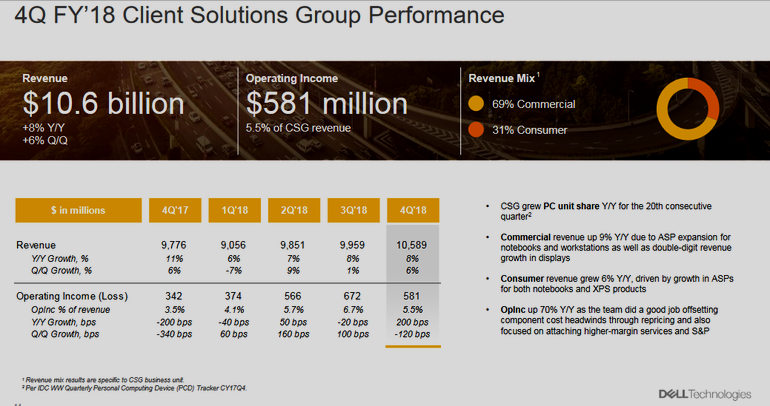
Dell-Dell's Q4 posts revenue gains as PCs, servers, networking show strength

The company, which is pondering ways to go public, said its focus in 2019 is to grow faster than the market, focus on storage and client revenue, pay down debt, and bolster profits in the infrastructure group.


Dell Technologies logged fourth-quarter revenue growth across its various units led by its client solutions group and commercial PCs with infrastructure getting a boost from servers and networking sales.

The company reported a fourth-quarter operating loss of $321 million on revenue of $21.9 billion, up 9 percent from a year ago. Non-GAAP operating income was $2.1 billion.

Dell Technologies is currently pondering strategic options including going public or merging with VMware, a unit that represents the company growth and cash engine.

For fiscal 2018, Dell reported an operating loss of $3.3 billion on revenue of $78.7 billion. Non-GAAP operating income was $6.9 billion.

The company said it has paid down $10 billion of debt since acquiring EMC. Dell ended the quarter with $52.7 billion in total debt including subsidiaries.

Jeff Clarke, vice chairman of products and operations at Dell, said the company saw strength in commercial PCs, servers, and networking. All-flash storage and hyperconverged systems also fared well. Storage revenue in the fourth quarter was down 11 percent.


Dell's client solutions group had revenue of $10.6 billion, up 8 percent. Infrastructure solutions had revenue of $8.8 billion, up 5 percent.

For the year ahead, Dell said it plans to grow faster than the market and focus on storage and client revenue, pay down debt, bolster profits in the infrastructure group, and help customers navigate digital transformation.

Friday, March 2, 2018

3/02/2018 01:36:00 AM

HPE's half and half IT approach pays profits in Q1: Will development proceed?

Hewlett Packard Enterprise conveyed a solid first quarter and sees strong IT spending ahead, however, the correlations and capacity to pass on expanding memory costs are challenges.


Hewlett Packard enterprises wagered on crossbreed IT and move far from item servers gives off an impression of being paid off, however, there is a touch of questions about the income development bends ahead. 

The organization detailed first-quarter income of 89 pennies an offer on the income of $7.7 billion, up 11 percent from a year prior. Non-GAAP income of 34 pennies an offer avoided tax reductions. 

HPE's outcomes topped appraisals and the organization increased its standpoint as well. In any case, the huge news was that HPE conveyed strong income development. Actually, HPE's income development was the best in late memory notwithstanding changing for cash where deals would have been up 9 percent from a year back. 


Unmistakably, HPE's first profit phone call with Antonio Neri was a win. Nonetheless, there are some key things. Among the moving parts: 

The organization fared well with pitching servers to corporate clients who are getting tied up with HPE's half and half IT vision with keen edge figuring. 

In any case, quite a bit of HPE's business picks up were because of cost increments as it went through higher item costs. Prominently memory costs. 

In October, HPE laid out projections for level income development to up 1 percent for the year. 

So what's it going to be HPE? Twofold digit development or the place that is known for level income. Neri supported the phone call: 

We clearly are focused on the money related design we laid out in October at the Security Analyst meeting. Once more, how about we backpedal to the Q1 development, again a great deal of that was clearly the expands we see. We found in the market in light of the fact that the costs expanding. Yet in addition solid execution. I think when I consider the Q1 comes about is a proof purpose of we have the correct methodology and core interest. I think we need to perceive what the estimating condition will do, however, by and large, I think our concentration is true to be the portfolio from the volume side of the house to the esteem set of the house, which clearly, the development rates are altogether different. 

As it were, HPE's valuing force may not last. HPE's Neri likewise noticed that the organization will have harder correlations in the second half. All things considered, HPE's hyperconverged framework, way to deal with crossbreed IT, stockpiling (Nimble and 3Par) and smart edge (Aruba) organizations are faring great. 


For example, HPE's stockpiling income was up 24 percent in the primary quarter contrasted with a year prior. Systems administration was up 27 percent from a year prior. SEE: What is distributed computing? All that you have to think about the cloud, clarified | Top cloud suppliers 2018: How AWS, Microsoft, Google Cloud Platform, IBM Cloud, Oracle, Alibaba stack up 

Oppenheimer investigator Ittai Kidron said in an exploration note: 

While HPE profited from the lower US charge rate and an FX tailwind, the outcomes were strong notwithstanding changing for these, approving our view that HPE's fundamental business patterns are superior to anything financial specialists accept. 

In the meantime, HPE CFO Timothy Stonesifer said IT spending is strong. 

From a full-scale point of view, we keep on seeing an extensively enhancing IT spend condition from the enhanced client request. 

Neri likewise said that it is concentrating its endeavors on elite registering and hyperconverged frameworks. "We are absolutely deemphasizing the emphasis on what we call the redid, commoditized, process stages," he said. 

HPE's solid quarter gives off an impression of being an awesome begin to financial 2018. At last, it'll require a couple of additions to change over skeptics.


Tuesday, February 13, 2018

2/13/2018 01:10:00 AM

Ampere, led by band of former Intel execs, aims to push ARM into data center

Ampere, led by former Intel president Renee James, is betting the time is right to scale ARM-based silicon in hyper-scale cloud data centers.


A new 64-bit ARM server processor company launched Monday and it's led by the former president of Intel.

Renee James is now CEO of Ampere, which aims to target hyper-scale cloud applications and data centers.

Of course, the big question is whether the timing is right for ARM-based processors to take their spot in the data center. ARM servers have been in development for years with multiple vendors -- Hewlett Packard Enterprise, Qualcomm, Cavium and others -- taking a shot at the market.

The rationale is sound: ARM can provide better power savings and lower total cost of ownership. What the ARM-server ecosystem has been lacking has been the applications, but that's changing.

Ampere is betting that the timing is right. Ampere's first processor has been sampled. the processor is a custom core ARM v8 64-bit operating at up to 3.3 GHz, 1TB of memory, and a power envelope of 125 watts. Ampere is fabless and expects production in the second half.


Kumar Sankaran, the vice president of software and platform engineering at Ampere, said the timing is better for ARM processors in the data center. "Historically, it has taken 8 to 10 years for a new architecture to work in the data center," explained Sankaran. "You need the software ecosystem that follows the hardware."

He added that ARM in the data center today is similar to where x86 was years ago.

In a statement, James noted that Ampere is targeting workloads such as artificial intelligence, big data, and next-gen data centers. The management team at Ampere is stocked with former Intel and AMD executives, including:

Chief Architect: Atiq Bajwa, 30-year Intel veteran and head of all X86 architecture (all products)

Sr. Fellow: Greg Favor former AMD fellow on K6/7 team and AMCC Arm lead architect

EVP of hardware engineering: Rohit Vidwans -- 26 years Intel veteran, head of all platform engineering

CFO/COO: Chi Miller, former Intel, and Apple executive

Ampere is funded by the Carlyle Group.


Monday, January 22, 2018

1/22/2018 11:07:00 PM

Cloud computing: AWS bumps up its data center capacity, again


Amazon Web Services (AWS) has extended its cloud computing infrastructure again, adding more capacity to its London region.

Amazon's cloud computing resources are hosted in multiple locations worldwide: each AWS region is a separate geographic area, which Amazon then subdivides into what AWS calls availability zones (AZs).

Each AZ is made up of one or more cloud computing data centers that are far enough apart that one single event won't take both offline, but close enough together for business continuity applications that require rapid failover. Each AZ has multiple internet connections and power connections to multiple grids. AWS said it now had 50 AZs after adding a third zone to its EU (London) region.

The company said this would give customers more flexibility to architect fault-tolerant applications that run across multiple AZs in the UK. The AWS Europe (London) Region was made up of two AZs when it launched in December 2016.

Customers for the London AWS region include the BBC, BT, Deloitte, and Travis Perkins, which AWS said has implemented the biggest systems and business change in its history, including an all-in migration of its data centers to AWS. The Met Office is using AWS to support its Met Office Weather App and the Driver and Vehicle Licensing Agency is using the EU (London) Region for services such as the Strategic Card Payments platform.

The AWS cloud is now made up of 50 AZs across 18 geographic regions. AWS has already announced plans for 12 more AZs and four more regions -- in Bahrain, Hong Kong SAR, Sweden, and a second AWS GovCloud Region in the US. In Europe there are three AZs in Frankfurt, three in Ireland, three in London, and three in Paris.


Friday, December 29, 2017

12/29/2017 03:05:00 AM

NextDC offered APDC datacentres it possesses for 'nonsensical' AU$300 million


The spat amongst NextDC and Asia Pacific Data Center Group (APDC) has proceeded through the Christmas break, with APDC offering the offer the datacentres exclusively possessed by NextDC back to it for AU$300 million. 

APDC was initially made as a land speculation assume that was in charge of the structures and land whereupon NextDC works its business, and under the terms of the leases, NextDC has first right of refusal on any offer of the datacentres. 

The responsibility for changed in November following an offering war amongst NextDC and 360 Capital, which saw the last develop triumphant with 67 percent proprietorship, and in this manner introduce its favored board individuals. 

A week ago, APDC named specialists to advertise the offer of the datacentres, and said on Thursday it had gotten "more than 50 qualified enquiries and solicitations for classification assentions". 

In light of the current offer of Metronode to Equinix for AU$1 billion, APDC trusts its advantages are worth around AU$300 million. 

As indicated by APDC, NextDC has 20 days to acknowledge its offer, and if not taken up, it will have the capacity to offer its datacentres to others for AU$300 at least million. 

Be that as it may, NextDC struck out at such valuations last Thursday, expressing that Metronode was a datacentre administrator and not a land trust. 

"APDC's reference to Metronode's accepted 4.73 percent securing yield is much the same as one proposing that a property landowner should exchange on a similar capitalisation rate or different as its inhabitant be they BHP or Google," NextDC CEO Craig Scroggie said at the time. 

"This has no rationale and is just erroneous". 

NextDC said APDC resources were as of late valuated "just a couple of months prior" at AU$213 million. 

Prior in December, NextDC reported its expectation to twist up the trust supporting APDC, expressing that it is miserable with the course that 360 Capital is taking the organization under its steerage. 

A gathering has been set for January 31, 2018 to permit put stock in individuals to vote on the breeze up proposition. 

APDC said a week ago that as the choice to embrace a capital redistribution, which sits at the core of NextDC's grievances, had not been made, the breeze up proposition was "untimely and not well established". 

The sole inhabitant of APDC's datacentre offices in Sydney (S1), Melbourne (M1), and Perth (P1) remains NextDC, while APDC said it has submitted non-restricting offers to secure AU$150 million worth of datacentre advantages for develop its portfolio. 

"APDC has additionally gone into preparatory exchanges with outsiders, including a worldwide server farm proprietor/administrator in regards to the possibility to fundamentally extend APDC in Australasia," the organization said a week ago. "APDC has the chance to end up noticeably a noteworthy server farm proprietor all through the Asia Pacific locale in accordance with its system."


Tuesday, November 21, 2017

11/21/2017 07:09:00 PM

Marvell purchases Cavium for $6B as semiconductor players plan to merge

Marvell said the buy of Cavium will enhance income and reinforce its capacity to address the server farm and cloud markets.


Marvell said it will obtain Cavium in an arrangement worth $6 billion as the semiconductor business keeps on merging. 

For Marvell, the Cavium buy will give the organization more income broadening and scale to rival equals that are building up. Intel is the greatest player, yet Broadcom, which simply shut the buy of Broadcom, is making a spontaneous offer for Qualcomm, which is endeavoring to close a procurement of NXP. Qualcomm has rejected the Broadcom suggestion. 

Marvell said it will pay $40 an offer in real money for Cavium and 2.1757 in Marvell shares for each Cavium share. 

In an introduction, Marvell and Cavium presented the defense that it will be more prepared to pitch to cloud suppliers and undertakings running their own particular server farms. 


The consolidated organization will have $3.4 billion in yearly income. Marvell said the arrangement its to join its stockpiling controllers, systems administration and remote availability items and protected innovation with Cavium's multi-center preparing, systems administration, and capacity devices. The objective for Marvell is to offer clients a more extensive item menu. 

Marvell CEO Matt Murphy and Cavium CEO Syed Ali said the consolidated organization will have end-to-finished results, scale and more innovative work haul. The exchange is required to item $150 million to $175 million in yearly reserve funds inside year and a half and lift income and income development. 


As per the organizations, Murphy will be CEO of the organization and Ali will stay as a vital consultant and board part. Jean Hu, Marvell CFO, will proceed in his part and Cavium's Raghib Hussain will work boss. Cavium's Anil Jain will be VP of IC building. 

Marvell additionally said its second from last quarter income will be between $610 million to $620 million with non-GAAP profit of 32 pennies an offer to 34 pennies an offer. 


Saturday, November 18, 2017

11/18/2017 02:28:00 AM

HPE dispatches overhauled elite frameworks for AI applications

The organization needs to make superior registering and AI more available to littler organizations.


Hewlett Packard Enterprise (HPE) has reported the dispatch of redesigned high-thickness process and capacity frameworks to support the appropriation of elite registering (HPC) and computerized reasoning (AI) among ventures. 

The HPE Apollo 2000 Gen10 is a multi-server stage for ventures hoping to help HPC and profound learning applications yet have constrained datacentre space. The stage underpins Nvidia Tesla V100 GPU quickening agents to empower profound getting the hang of preparing and surmising for utilizing cases, for example, ongoing video examination for open security. 

Ventures sending the HPE Apollo 2000 Gen10 framework can begin little with a solitary 2U shared the foundation and scale-out up to 80 HPE ProLiant Gen10 servers in a 42U rack. 

"HPC and AI assume an inexorably critical part in the advanced change, empowering associations to use displaying, reenactment, and profound figuring out how to drive business development in ranges like monetary exchanging, PC supported outline and building, video reconnaissance, and content examination," HPE said in a declaration. 

"These territories require the parallel preparing of substantial, unstructured data sets that exclusive outrageous process arrangements can convey. What's more, the developing volume, speed, an assortment of information build the significance of proficiently putting away the information and diminishing application idleness for parallel preparing applications." 

The HPE Apollo 4510 Gen10 framework is intended for endeavors with information concentrated workloads that are utilizing object stockpiling as a dynamic document. The framework, which has 16 percent a greater number of centers than the past age, offers stockpiling limit of up to 600TB of every a 4U shape factor with standard server profundity. It additionally bolsters NVMe cards. 

The HPE Apollo 70, set to end up plainly accessible in 2018, is the organization's initially ARM-based HPC framework utilizing Cavium's 64-bit ARMv8-A ThunderX2 server processor. It is intended for memory-serious HPC workloads and is good with HPC segments from HPE's biological system accomplices including Red Hat Enterprise Linux, SUSE Linux Enterprise Server for ARM, and Mellanox InfiniBand and Ethernet texture arrangements. 

Additionally reported on Tuesday is HPE LTO-8 Tape, slated for general accessibility in December, which enables ventures to offload essential stockpiling to tape, with a capacity limit of 30 terabytes for every tape cartridge - twofold that of the past LTO-7 age. 

The HPE T950 tape library now saves to 300 petabytes of information, while the HPE TFinity ExaScale tape library gives stockpiling ability to up to 1.6 exabytes of information. 

Furthermore, LTO-8 full tallness drives present to 360MB/s exchange rate speeds, which is a 20 percent execution increment from the LTO-7 age. 

In July, HPE propelled new HPC frameworks went for research and national security associations that need to crunch monstrous measures of information, which incorporated the HPE Apollo 6000 Gen10 and HPE SGI 8600 frameworks. 

HPE additionally as of late declared joining forces with Rackspace to apply the compensation as-you-go model of the general population cloud to a solitary inhabitant private cloud condition. 

The compensation as-you-go OpenStack private cloud conveyed as an oversaw benefit, will be for the most part accessible on or off-premises on November 28. 

Two or three months back, HPE uncovered it was collaborating with NASA to dispatch a supercomputer into space utilizing SpaceX CRS-12 rocket, with a definitive point of building registering assets that could serve on board a mission to Mars. 

The objective of the joint test is to have the supercomputer, called the Spaceborne Computer, work easily in space for one year, which is generally to what extent it would take to go to Mars.