Breaking

Showing posts with label Salesforce. Show all posts

Wednesday, November 26, 2025

11/26/2025 03:32:00 PM

Salesforce CEO Says Gemini 3 Is a Game Changer, Ditches ChatGPT for Good

Salesforce CEO Says Gemini 3 Is a Game Changer, Ditches ChatGPT for Goo


salesforce-ceo-says-gemini-3-is-game-changer-ditches-chatGPT-for-good

While you buy through hyperlinks on our website, we may additionally earn an affiliate fee. Here’s the way it works.

  • Salesforce CEO Marc Benioff has ditched ChatGPT for Google Gemini three
  • He made the transfer after attempting Gemini three for simply hours
  • Benioff praised Gemini 3’s pace, reasoning, and multimodal capabilities as a major step forward

Salesforce CEO Marc Benioff has fallen head over heels for Gemini three and has publicly dumped ChatGPT in the process. His statement left a whole lot of the AI global reeling. After just hours of playing with Gemini three, a top enterprise software program chief disavowed the maximum famous AI chatbot in favor of its rapidly ascending rival.

Holy shit. I’ve used ChatGPT each day for three years. Simply spent 2 hours on Gemini three. I’m no longer going lower back. The bounce is insane — reasoning, speed, photos, video… the whole lot is sharper and quicker. It feels like the international simply changed, again. 

The post wasn’t subtle. It wasn’t hedged with well-mannered comparisons or impartial optimism. no longer the most effective has one of the maximum visible enterprise figures in Silicon Valley crossed from OpenAI to Google, but he's additionally made a factor of telling the world.

Gemini 3 has attracted plenty of different accolades for its mixing of Google DeepMind’s modern-day advances right into a unmarried unified architecture. Gemini three helps text, images, code, audio, and video in a single interface. Gemini 3 is properly positioned to take ChatGPT's crown for cross-to AI chatbot in many ways.

Though ChatGPT's ubiquity made it sense inevitable, Benioff’s post indicates that inevitability has an expiration date. In a depend of hours, one of its maximum prominent evangelists defected. that announces more about the tempo of AI evolution than any leaderboard or benchmark can.

AI rivalry heating up

Benioff isn’t only a few casual early adopters. Salesforce has deeply incorporated AI into its merchandise and enterprise strategy. It turned into among the first company giants to companion with OpenAI for productivity tools embedded in consumer courting software. When Benioff makes a non-public bounce like this, it carries the load of corporate alignment. And if Gemini 3 is now the version he's defaulting to, the software stacks around him can also follow suit.

Gemini 3’s strengths seem to match what high-frequency customers like Benioff search for in terms of speed, reasoning, and flexibility. Google has been clear that Gemini three was constructed to feature as a flexible engine for both purchasers and builders, able to energy the entirety from helpdesk bots to video editing suggestions. That breadth may be what tipped the scales for Benioff, whose day possibly includes toggling between datasets, dashboards, and vision decks at Silicon Valley warp speed.

It's a terrific reminder that the AI panorama is getting more aggressive. There’s a growing refrain of contenders scrambling to make your AI assistant. For folks who casually take a look at it with ChatGPT once in a while, nothing has to change in a single day. However, Benioff’s public conversion gives a peek into how quickly even entrenched possibilities can pave the way to the promise of sharper gear.


Saturday, October 6, 2018

10/06/2018 04:28:00 PM

Microsoft and Salesforce race to offer a single view of customers' data

Microsoft, Adobe and SAP aren't yet revealing technical details of the Open Data Initiative they announced this week. But Azure Data Lake and the Microsoft CDM seem to figure prominently.


With Microsoft's Ignite and Salesforce's Dreamforce conferences happening the same week, it's not too surprising the two were gunning to unveil the biggest and best partnership line-ups. Microsoft called on Adobe and SAP, and Salesforce on Apple and SAP during their respective keynote kickoffs.

Microsoft took the wraps off something called the "Open Data Initiative" (ODI), which it founded with Adobe and SAP, on Sept. 24. The high-level mission of the ODI is to "reimagine customer experience management" (aka CRM) by being able to integrate CRM, ERP, commerce, sales, product usage and other data into a single data view that works across devices.

I've spent the last few days trying to glean any kind of technical details about the planned deliverables, to no avail. (It looks like some analysts did get NDA briefings about what ODI actually is, but it seems Microsoft isn't willing to talk about this yet.)

Microsoft did provide the high-level architectural diagram describing ODI, which I've embedded above. The platforms which the original founders of ODI are looking to integrate are the Adobe Customer Experience Platform, the Microsoft Dynamics 365 CRM/ERP platforms and SAP C/4HANA CRM and SAP S/4HANA database. The goal of integrating these, as well as other CRM, ERP and database platforms is to create a single view of customer data, but one which customers -- not the vendors -- will control.

What's not labeled in the diagram, but which I've heard from a few different sources, is the low-level Azure data layer is a reference to Azure Data Lake storage. And the "one data model" in the diagram is Microsoft's Common Data Model (CDM).

The race to single view of the customer: Salesforce launches Customer 360, aims to integrate all your data, applications | SAP unveils C/4HANA, aims to revamp CRM, leverage its ERP base | SAP pivots as the customer turns 2018

Azure Data Lake is Microsoft's repository for big-data analytic workloads in the cloud. Azure Data Lake Storage Gen2 unifies the core capabilities of the first-generation Azure Data Lake with a Hadoop-compatible file system endpoint that has been directly integrated into Azure Blob Storage.

The Microsoft Common Data Model, which Redmond has used extensively in its own Dynamics offerings, is an open-source definition of standard entities that represent commonly used concepts and activities across a variety of business and application domains. In the October 2018 update to Dynamics 365, the Microsoft Data Integration platform will be updated with more connectors and gateways "that make it possible to bring any external data into the Common Data Service and store the data in Common Data Model (CDM) form."

Because both Adobe and SAP previously committed to making their software/services available on Azure, it's not surprising that Microsoft's cloud is the common thread in this partnership. All three of these vendors already committed to running their CRM, ERP and database products on Azure. From there, I'd imagine it's not a huge step for them all to commit to using Azure Data Lake and CDM.

The part of the diagram I'm most curious about is the common AI piece of the base layer. Adobe is going its own way with AI, as is an SAP, as is Microsoft. On the ERP/CRM front, Microsoft recently announced it will be rolling out more new AI-infused Dynamics apps (for Sales, Customer Service, and Insights). Maybe Microsoft will offer up some lower-level pieces of its Azure AI infrastructure, such as its Machine Learning and Cognitive Services to be incorporated as part of the ODI specs, moving forward. Or perhaps Microsoft's "Power platform," which centers around Power BI business-intelligence/analytics, will become a key component of ODI.

There's another potentially interesting piece of the ODI which no one discussed publicly at Ignite this week. If you look at the URL of the ODI -- https://www.microsoft.com/en-us/quantum/open-data-initiative -- it's somehow related to Microsoft's quantum-computing efforts, apparently. Quantum originally was supposed to be a big topic at Ignite, but barely got a mention. Data-intensive problems are ideally suited to quantum processing so the connection between the two may not be tenuous.


SOURCE:

Saturday, September 29, 2018

9/29/2018 04:16:00 PM

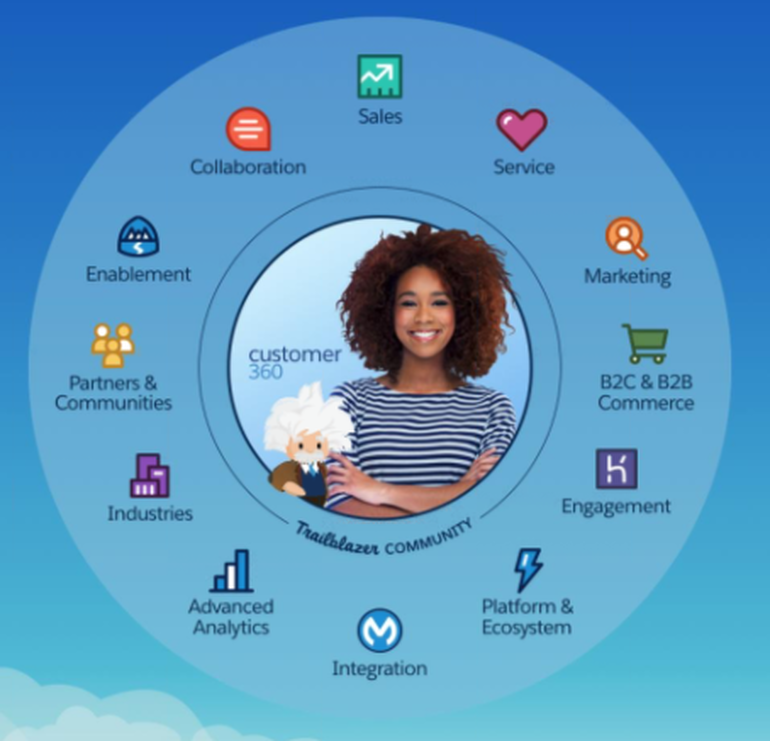
Salesforce Launches Customer 360, aims to Integrate all Your Data, Applications

Salesforce's idea to provide a 360-degree view of the customer isn't exactly new, but the company maintains its execution will be different. Here's the master plan.


Salesforce's big idea is one that you've heard of before from other enterprise software vendors--a 360-degree view of the customer--with a different lens. The big question will come down to executing Salesforce's effort, dubbed Customer 360.

At Dreamforce, Salesforce's developer and customer powwow, the company will outline Customer 360, which includes the following:


  • An admin interface that connects and manages customer data across Salesforce apps.
  • Customer 360 ID, which gives customers one ID that will have up-to-date contextually relevant profiles across apps and experiences.
  • Packages for Customer 360 focused on service, marketing, and commerce to scale up cross-channel customer experiences.


Co-CEO Marc Benioff and CTO Parker Harris in their Dreamforce keynote outlined Customer 360. Benioff reiterated his customer-first mantra and talked about how companies have to be about their values. In a talk where you half expected Benioff to announce he was running for public office, he said:

For each company, we have to listen. We're watching for companies not listening. For them we watch the executives walk out, the employees walk out and the customers walk out.
Parker Harris, CTO of Salesforce, put some more technology meat on the Customer 360 platform. In a demo, Harris showed how data is connected via Customer 360 in multiple systems.


The problem Salesforce is hoping to solve is a big one even if it's not terribly original. Customers are typically in experience silos and data from various parts of a company may not be shared. These disjointed customer experiences have plagued interactions for years.

However, there are other players that have hopped on this one-view of the customer bandwagon. SAP CEO Bill McDermott outlined how his company was going to take on Salesforce in CRM with the one unified customer experience takes. SAP's argument is that the customer experience starts with its ERP and HANA analytics platform and then expands to CRM. "We have moved from a 360-degree view of sales automation where some companies focus to a 360-degree view of the actual customer," said McDermott.

Microsoft, which is touting its Dynamics ERP and CRM platform at its Ignite conference, has talked about a 360-degree view of the customer before. Using ActiveDirectory and its hook into Azure, Microsoft already has a customer ID system. Microsoft starts with Office and Dynamics and now extends its reach with artificial intelligence and connections on LinkedIn.

Oracle has also talked the 360-degree view of the customer with the talking points picking up in 2015. In 2013, Oracle Siebel CRM was talking 360-degree views of the customer and being customer-centric.

Simply put, there's a lot of marketing speak invested in this 360-degree view of the customer thing.

HOW SALESFORCE PLANS TO BE DIFFERENT

Patrick Stokes, SVP Integration Cloud, said that the issue is that previous effort to provide a 360-degree view of the customer have been made on the assumption that a company can control the journey a customer would take.

"Our point of view is simple. What we need is a single identifier. Not a single version of the truth, but a unified ID that can connect systems," said Stokes.

Salesforce's biggest argument is that traditional master data management tools--the technology that keeps customer records updated and current between apps-- require a lot of IT work and lack real-time updating.

Customer 360 is designed to sit in the middle of all of Salesforce's ecosystem.


Via it Mulesoft acquisition, Salesforce is planning to integrate this customer data, leave the information in place and keep it integrated for personalized experiences whether in the cloud or on-premises. Salesforce tipped its plans when it announced updates to its Financial Services Cloud. This slide, which highlights, the moving parts in a customer, system and data bowl of spaghetti is designed for banks and insurers but represents most enterprises.


Salesforce does intend to integrate various applications in an enterprise, but much of Customer 360 revolves around connecting Salesforce apps and data.

Customer 360 will include a click-based user experience so admins can manage apps and data. The idea is that admins will make connections between apps. This dashboard would be one place to view customer data, applications, and various connections.

The 360 ID is Salesforce's way of giving one identifier for every customer that would include name, email, phone number as well as the social handle. Salesforce's tools would match, reconcile and update customer data across clouds. Salesforce noted that 360 ID leaves data in place and the system where it originated. Salesforce would retrieve data only when needed and refrain from a data lake and data warehouse architecture. The concept rhymes more with Pure Storage's Data Hub concept as an architecture.

Pre-built packages for service, marketing, and commerce. Experiences for customers would be tailored on use cases on Service Cloud, Commerce Cloud, and Marketing Cloud. The packages are designed to deliver connected experiences and be attached to Customer 360.

Perhaps the most notable idea Salesforce has is that Customer 360 isn't replicating data, but pulling it from where it resides. The general idea is that Customer 360 would enable a company to know when a shopping cart was abandoned in Commerce Cloud and then activate a campaign in Marketing Cloud for discounts.

These connections between Salesforce clouds are called Commerce Journeys and Service for Commerce. The packages are designed to provide immediate returns on moving to one customer ID.

According to Stokes, these integrated packages would put experiences and engagement first.

Stokes acknowledged that Salesforce isn't the center of the universe. However, it is worth noting that the company does house much of an enterprise's customer data. To connect various systems, MuleSoft will use APIs to connect applications across a company.

MuleSoft Anypoint is designed to connect Salesforce Customer 360 with other applications. These connections are designed to create what the company says a "truly complete customer view."

THE DETAILS

Customer 360 will be built into the platform and Stokes noted that the intention is to include much of the functionality under existing licenses.

Salesforce doesn't have all the details on pricing as Customer 360 is slated for general availability in the second half of 2019. There will be net new services with Customer 360 and they may revolve around prepackaged journeys as well as MuleSoft connections via APIs. The integration space is one of Salesforce's big growth areas.

In the end, the Customer 360 effort provides a stronger layer integration between Salesforce clouds. But Salesforce won't represent most of your systems. As a result, Salesforce's up sell may revolve around MuleSoft.

Here are some screens of what Customer 360 will look like.


WHAT'S MULESOFT'S ROLE?

If Customer 360 is the secret sauce to integrate all of the data on Salesforce's clouds, MuleSoft is the integration layer to connect the rest of the information silos in an enterprise.

Mark Dao, chief product officer at MuleSoft, said the unit's Anypoint platform will be the "data platform for external systems" and connect to Customer 360. Dao said MuleSoft aims to provide an "application network" that can integrate various systems. For instance, MuleSoft will demo how Salesforce Commerce Cloud can integrate with Oracle's NetSuite and use machine learning to recommend data mapping choices.

At Dreamforce, MuleSoft will outline updates to the Anypoint platform that will add up to "an application network graph" so services across a company can be integrated via the cloud on on-premises.

MuleSoft's October 2018 release of the Anypoint Platform includes:


  • Machine earning for data mapping and a flow designer that creates an application network graph.
  • A visualization engine that provides a view of a company's APIs and integration points. Monitoring via Anypoint also troubleshoots issues.
  • An expanded API management toolset. These additional controls apply security at the API level and add tokens to data at rest and in transit.
  • Add it up and MuleSoft is the hub of Salesforce's integration efforts but is designed to ride shotgun with Customer 360.


Friday, September 28, 2018

9/28/2018 07:39:00 PM

Salesforce, Apple forge iOS Mobile App Development Partnership

Salesforce's mobile app for CRM will be revamped with native features for Apple's iOS platform.


Salesforce and Apple have formed a partnership that will bring exclusive features from CRM apps to iOS devices.

Under the partnership, Salesforce said it will redesign its app to run native on Apple's iOS and add exclusive features. Salesforce will also launch a Salesforce Mobile SDK for iOS and optimized for Apple's Swift as well as developer courses on Trailhead.

The Salesforce Mobile SDK for iOS will be available by the end of 2018 with the rebuilt Salesforce Mobile App available in early 2019. A Trailhead Mobile App will launch later in 2019.

Apple under CEO Tim Cook has formed a bevy of partnerships with enterprise technology players including Cisco, Accenture, SAP and IBM. These partnerships revolve around bringing enterprise apps native features to iOS, which is the dominant mobile platform in the enterprise.

According to Cook and Marc Benioff, co-CEO of Salesforce the new features on iOS and more native tools for Salesforce CRM will bolster customer experiences.

The companies said the initial focus of the partnership will revolve around Salesforce iOS apps that will offer Siri Shortcuts, Face ID integration and Business Chat. Salesforce's Lightning Platform will also be integrated with the Salesforce Mobile SDK.


SOURCE ZDNet:

Friday, September 21, 2018

9/21/2018 07:42:00 PM

Salesforce outlines Financial Services Cloud roadmap, single view of customer test bed

Salesforce's Financial Services Cloud aims to bridge various integration points and technology and business silos to give customers a unified experience.


Salesforce unveiled updates to its Financial Services Cloud that aims to unify the various silos within financial services companies and provide one holistic view of the customer.

Rohit Mahna, senior vice president, and general manager of Salesforce's financial services unit, billed a series of updates as unified financial services. "We've heard from day one that the industry is going from selling to products to relationships to a holistic view of the customer," he said. "It's a journey."

Salesforce in 2016 rolled out its Financial Services Cloud as a way to tap into the financial services and tech market. Like healthcare, Salesforce is targeting specific verticals. So far, Salesforce's Financial Services Cloud has more than 400 customers.

The strategy with the Financial Services Cloud is to bring industry-specific updates as well as innovation from Salesforce's platform to banks, insurers, fintech companies and the like. Like most mature industries, financial services firms grew by acquisition and mergers, have legacy systems, back-office operations, retail and commercial units and a complex web of integration points.

Mahna calls it "industry spaghetti." The end result is a fragmented customer experience due to multiple silos, systems, and functions. Using Salesforce's Integration Cloud, via the MuleSoft acquisition, the company plans to knit together various systems into one comprehensive view of a customer.

Now Salesforce isn't going to wave a magic wand to cure technological debt but aims to be an enabling technology as financial services firms work to simplify. Salesforce's Financial Services cloud can bring some of the experiences from newfangled services such as Volt Bank and Stripe while connecting professional and personal accounts at traditional firms.

Starting with the Winter 2019 update, Financial Services Cloud will get a commercial banking app, action plans, surveys and Einstein bot integration along with a recommendation for next best actions. In the Spring 2019 update, Financial Services will get more Einstein Analytics services.

Ultimately, a relationship manager at a financial services firm will get a dashboard that shows referrers, the customer's various accounts and roles (commercial, personal and professional). Mahna's demo featured a woman who ran a household, was a C-level executive and needed a commercial loan to expand. With one view, a bank could know this one person could leverage multiple client services.


In addition, Salesforce is building out its partner base for Financial Service Cloud with integrations with the likes of Guidewire, Roostify, eMoney, Jemstep and a bevy of other firms touching on everything from mortgages to insurance to loans.


Thursday, September 6, 2018

9/06/2018 09:38:00 PM

Salesforce beats Q2 expectations, Q3 guidance light

The CRM giant delivered non-GAAP earnings of 71 cents per share on revenue of $3.28 billion, up 27 percent year over year.


Salesforce reported strong second quarter financial results on Wednesday that topped estimates. The CRM giant delivered non-GAAP earnings of 71 cents per share on revenue of $3.28 billion, up 27 percent year over year.

Wall Street was looking for earnings of 47 cents per share with revenue of $3.23 billion. Salesforce stock was down roughly one percent in late trading.

"Salesforce revenue grew 27 percent to almost $3.3 billion in the second quarter, with excellent performance across our clouds, industry segments and geographies," said the company's recently minted co-CEO, Keith Block. "With this strong quarter, we're well on our way to our next milestone of $23 billion in revenue in FY22."

The company's Q2 net income was $299 million, or 39 cents per share. Subscription and support revenues increased 28 percent annually to $3.06 billion. Professional services and other revenues totaled $221 million, up 28 percent year over year.

Breaking subscription revenues down by segment, Sales Cloud revenue was $1 billion, Service Cloud revenue was $900 million, Marketing and Commerce Cloud revenue was $500 million, and Salesforce platform and other revenue was $700 million.

As for the outlook, analysts are looking for earnings of 54 cents a share on revenue of $3.35 billion for the current quarter. Salesforce responded short of expectations, with a revenue range of $3.35 billion to $3.36 billion and earnings between 49 and 50 cents per share.

For the full-year, Salesforce expects earnings between $2.50 and $2.52 per share on revenue between $13.12 billion and $13.17 billion.


Monday, July 16, 2018

7/16/2018 07:10:00 PM

Salesforce makes Einstein Bots for Service Cloud generally available

With Einstein Bots, the aim is to help companies automate routine customer service requests and improve customer experiences.


Salesforce is bringing its Einstein Bots to market as part of the next generation of Service Cloud, along with a bevy of other new features.

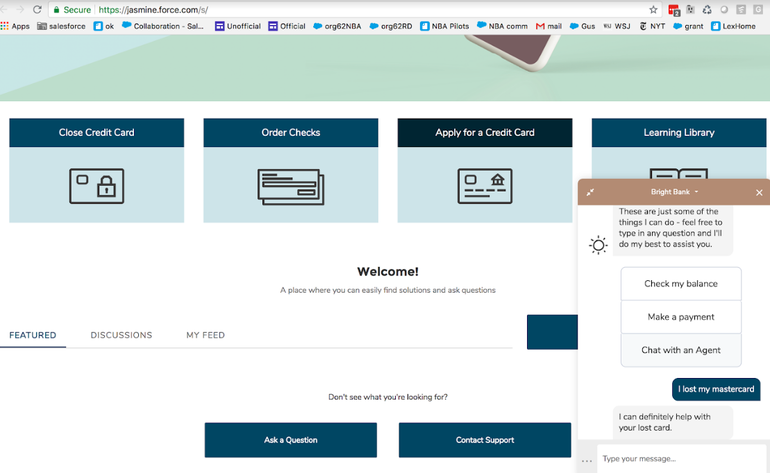
With Einstein Bots, the aim is to help companies automate routine customer service requests and improve customer experiences regardless of whether customers are interacting with a bot, an agent, or a combination of the two. The bots use historical service data and CRM data to form their answers, but they can also hand the conversation off to a human employee if needed.

Meanwhile, developers and admins can use the same point-and-click interface to build custom chatbots. Examples of Einstein Bots would be a chatbot that helps track a customer's order or one that can reset passwords.

Salesforce originally introduced the Bots pilot at Dreamforce last year and has since iterated on the concept with more intricate features. Instead of just automating queries, the bots were made to connect to customer data and process woven throughout. That's where Salesforce's other new product, Einstein Next Best Action, comes into play.

Einstein Next Best Action guides agents and customers by surfacing recommended answers and offers and uses AI to analyze the conversation in real time. The system pulls from both Salesforce and non-Salesforce data to provide recommendations. The main idea is to help with problem resolution and highlight upsell opportunities.

Salesforce's process automation tool Lightning Flow is also being made generally available today.

"Artificial intelligence alone will not drive your business forward -- AI must be connected to CRM data and guided processes so companies can create seamless experiences that put customers at the center," said Bill Patterson, SVP, and GM of Salesforce Service Cloud, in a press release. "Today is a big step forward in empowering our customers with an easy way to provide guided, intelligent service at scale."


Tuesday, June 26, 2018

6/26/2018 07:09:00 PM

Salesforce Research creates Swiss Army Knife for natural language processing

Salesforce has created a multi-task model for natural language processing that takes an architecture approach.


Salesforce Research has created a natural language processing architecture that can handle multiple models and tasks. Typically, natural language processing (NLP) has a model for each function such as translation, sentiment analysis and question and answer.

The research, led by Salesforce Chief Scientist Richard Socher, revolves around a challenge dubbed Natural Language Decathlon (decaNLP). The challenge spans 10 tasks--question answering, machine translation, summarization, natural language inference, sentiment analysis, semantic role labeling, relation extraction, goal-oriented dialogue, database query generation, and pronoun resolution--and feeds into a system that jointly learns.

Think of decaNLP as a Swiss Army Knife for natural language processing. If NLP is customized repeatedly it won't scale. Salesforce was looking for a general purpose NLP approach where every task is transformed into a question answering format and trained jointly.

Socher said the approach melds deep learning and NLP and moves the discussion to one that revolves around a meta-architecture. He added that an architecture approach can also be used to prevent model sprawl as NLP functions are layered together.

"This is a project that can have immediate useful applications because it's a model that is a single deploy and easier to maintain," said Socher. "We're bringing a bunch of tools together."

Salesforce is likely to use the decaNLP approach in its product roadmap for Einstein and its various clouds.

The decaNLP is combined with a multitask question answering network that jointly learns all tasks without any specific model. The network also allows for adaptation by completing new tasks through related descriptions.

Here's a diagram of the multitask question answering network.


And finally, Salesforce Research came up with code for processing data sets, training and evaluating models and ultimately coming up with a score called the decay score.

NLP trained on the decaNLP system will, in theory, be better equipped to provide a framework for chatbots as well as any information in a customer service exchange.


Saturday, June 23, 2018

6/23/2018 04:30:00 AM

Salesforce expands integrations between its clouds, Google Analytics 360

The overall aim for Salesforce is to create custom customer experiences between its various clouds and functions.


Salesforce has integrated its Marketing Cloud with Google Analytics 360 to use campaign data for tailored audiences and analysis outside of the search giant's tools.

The integration, now generally available, is part of a partnership outlined last year between Salesforce and Google Cloud.

Bobby Jania, vice president of product marketing for Salesforce, said the integration allows customers to create an audience in Google Analytics 360 and pass the IDs to Marketing Cloud to engage over various channels in a way that is compliant with GDPR. "We're looking to create personalized journeys," said Jania.

experience-insights.png
At Salesforce's Connections conference in Chicago, the company outlined the following:

  1. B2B Commerce in Commerce Cloud. Built on Salesforce's platform, B2B Commerce aims to provide consumer-like e-commerce for business buyers. The B2B effort combined with its consumer e-commerce allows customers to offer a coherent experience across units and channels.
  2. LiveMessage expanded SMS support. LiveMessage, part of Service Cloud, will add 21 additional countries with SMS support.
  3. Marketing Cloud Interaction Studio goes generally available. The studio enables experiences and coordination for promotions, discounts and offers across a brand's channels.
  4. Marketing Cloud gets Einstein audience segmentations via its data management platform as well as Einstein Splits, which create AI-driven paths for each customer.
  5. Integrations between Commerce, Marketing and Service Clouds. For instance, Service Cloud and Commerce Cloud integrations will allow service reps to see order history and use customer service interactions for cross-selling. Commerce Journeys combines Marketing Cloud and Commerce cloud so companies can tailor shopping experiences.


Wednesday, May 16, 2018

5/16/2018 01:03:00 AM

Rimini Street to offer Salesforce third party support in SaaS expansion

And the real shocker--at least based on Rimini Street's history battling Oracle--is that the support provider and Salesforce are partners in the effort.


Rimini Street will branch out into offering third-party support for Salesforce in a move that takes the company into software as a service.

And in an interesting twist, Salesforce and Rimini are partners with complementary services. Rimini historically has offered third-party support for Oracle and SAP applications and undercut lucrative maintenance revenue streams from those two software giants. Oracle and Rimini Street have been battling in courts for years.

"This is a big potential change in our relationship with vendors," said Rimini Street CEO Seth Ravin. "Rimini Street is 13 years old and we were in a truly tough neighborhood. The SaaS world is different in that maintenance is included in licenses and mostly bare bones."

SaaS, PaaS, and IaaS: Understand the differences | What is cloud computing? Everything you need to know about the cloud explained

In other words, Rimini Street and Salesforce are more like business partners looking to expand their respective ecosystems. Dan Smoot, executive vice president of global partner sales at Salesforce, said Rimini Street has been a long-term customer.

Given that Oracle and SAP are often coupled with Salesforce in the enterprise, Rimini Street has a fertile market as it moves to support as-a-service software. Salesforce customers that also use Rimini Street for Oracle and SAP can now bridge cloud and licensed applications and log multiple issues at once. About 40 percent of Rimini Street's customer base runs Salesforce along with SAP or Oracle applications.

Here's what Rimini Supports today:


Specifically, Rimini Street will offer support services for Salesforce Sales Cloud and Service Cloud. Rimini Street's support services will complement what is offered by Salesforce. Rimini Street will also handle configurations for Salesforce that can be as complex as the customization it sees with Oracle and SAP on-premises applications.

Rimini Street's support of Salesforce includes 24x7x365 staffing and a 15 minute guaranteed response for urgent items as well as managed system administrations, customization and integration. Rimini Street also provides a primary support engineer.

Think of Rimini Street's Salesforce coverage like you would Medicare Gap insurance. "We are coming in to cover the gaps in basic and premium maintenance," said Ravin.

More: Rimini Street to offer database, security services | Rimini Street merges with an investment firm, will be publicly traded | Rimini Street's latest gambit: Even faster SLAs

The Salesforce support effort was years in the making and Ravin mentioned SaaS as a market in an interview with ZDNet years ago. Rimini Street also mentioned SaaS as a growth area in its regulatory filings.

Ravin said the SaaS market will have a few nuances that on-premises support lacks. "This will be about reducing risk and optimization across spending, resources and time," said Ravin. "We're not saying we're cutting 50 percent of what you're paying now. An enterprise may have an architect, consultant and support team. We need to do the upfront work to find out where the holes are and then create a plan to streamline it."

Separately, Rimini Street announced first-quarter results. The company reported first-quarter earnings of $3.5 million, or 5 cents a share, on revenue of $59.8 million, up 22 percent from a year ago.

During the first quarter, Rimini Street received a litigation refund of $21.5 million from Oracle. A U.S. Court of Appeals ruling reversed and vacated awards to Oracle and told the software giant to refund $50 million. Rimini Street said it used the refund to pay down a credit facility.

The company ended the quarter with 1,581 active clients. As for the outlook, Rimini projected second-quarter revenue between $60 million and $61 million and 2018 sales of $250 million to $270 million.


Saturday, March 24, 2018

3/24/2018 02:59:00 AM

We Found 22 Cloud Services your Business Definitely Needs To Try

When it comes to cloud services and software-as-a-service (SaaS), we're all familiar with the usual players. But there's a huge world of opportunity and available resources beyond Google, Dropbox, Salesforce, Amazon, and Microsoft.


When it comes to cloud services and software-as-a-service (SaaS), we're all familiar with the usual cloud providers. But for small businesses and larger enterprises, there's a huge world of opportunity and available resources beyond those best-known cloud storage services and cloud computing services: Google, Dropbox, Salesforce, Amazon, and Microsoft.

In this guide to services for business, we're looking at 22 incredibly valuable services that solve real-world business problems. A few you may have heard about before. Many may be new to you. All are capable of providing nearly instant benefit -- without you having to make any infrastructure investment whatsoever.

With that, let's get started with our first cloud-based service...

1) APPROVAL DONKEY

Cloud-based approval workflows

Free version: Up to three workflows
Plus program: $13 per month

How many times has a project come to a screaming halt, simply because the next approval in the chain never happened?

Often, these bottlenecks aren't because a higher-up didn't actually want the project to go through, but simply never got around to signing off. The approval email might have gotten lost or, if you're still on paper approvals, buried in a huge inbox mound.

Approval Donkey (which has our nomination for best cloud-based service name ever) automates this process. It can integrate with hundreds of other applications using Zapier (see below) and provides a centralized interface. You can set up certain approval workflow patterns, which move the approval along a pre-defined chain. You can also track the status of any approval and see if there are any bottlenecks.

If you're dealing with accounting and finance approval flows, stakeholder approval flows, or operations and administration approval flows, give Approval Donkey a try. There's a free version that allows for up to three workflows, and a Plus program at $13 a month.

2) ASANA

Work manager application

Free version: Up to 15 members, limited features
Paid version: $9.99 per month

Imagine if your favorite to-do manager and Slack got together and had kids. That's Asana. Asana is a project management app that organizes projects across teams. It manages sets of tasks across people and groups and allows for connected conversations, reporting, and tracking.

What makes Asana stand out is that all of the project-related work is transparent to the team members, visible, and easily accessible. If you've been managing projects through a pile of spreadsheets or emailing attachments to everyone, Asana will be like a breath of fresh air. All your project's documents can also be embedded with the project, for everyone to work on and collaborate together.

Asana has a free version for up to 15 members, but it has limited features. If you want to expand beyond 15 people to large teams, SSO, custom fields, specialty dashboards, and the rest of the project management kitchen sink, Asana runs $9.99 a month. There's also an enterprise version if you need to go really big.

3) AIRTABLE

Mix of cloud-based spreadsheet and database

Free version: Manage up to 1,200 elements, limited features
Paid version: $10 per month

Airtable is an interesting product. It's billed as part spreadsheet and part database, but it's really a flexible information manager that can look a bit like Trello, a bit like Google Docs, and a bit like a structured Evernote.

Airtable allows you to store information, structure it, share it among collaborators, and work on it in a variety of forms. The key is that Airtable comes with a wide range of templates, so you can structure your data to look like an inventory, a Kanban chart, a calendar, a catalog, or whatever fits your project.

If Asana helps you manage the stages of your project and the inter-team communication, Airtable helps you manage the stuff that your project is made up of. There's a free version that lets you manage up to 1,200 elements and store up to 2GB of data, along with two weeks of revision tracking. Move up to $10 per month and you get more data, more items, and six months of revision tracking, along with support.

4) BACKBLAZE

Easy and less expensive cloud storage

Free version: N/A
Paid version: $5 per machine every month

Backblaze is trying to straddle two aspects of the cloud storage market: End-user backups and object-based cloud storage.

In the end-user backup market, they're competing with the likes of Carbonite and CrashPlan by providing a very simple-to-setup backup mechanism for end-user machines. Let's be clear: This isn't cloud sync like Dropbox, Google Drive, or OneDrive. You're not mirroring portions of your cloud storage on your local machine. Instead, Backblaze offers a set-it-and-forget-it backup system that keeps copies of your local data (including some system files) in the cloud.

For end-users, BackBlaze is $5 per machine every month. You can backup any drive inside the machine, as well as any drive connected via a USB connection. This won't back up your personal NAS boxes, but it's still pretty generous.

Backblaze also competes against object-based cloud storage like that offered by Amazon S3 and Azure. Backblaze's service is called B2. Like other object-based cloud storage providers, you're going to pay both a monthly cloud storage fee, plus a download fee for any data you want back. Backblaze's differentiation is that it's generally less expensive than the big guys, yet still offers a rich API and some nice integrations, including into the Synology NAS boxes we reviewed previously.

There's one other thing to like about Backblaze: Its data center approach. It regularly reports on hard drive reliability and even the challenges of running a data center. In a world where most cloud storage providers are opaque, Backblaze's transparency is a breath of fresh air.

5) CLOUDPHONE

Virtual PBX

Free version: N/A
Paid version: Starts at $12 per month for one local number

When my first small business started to grow into offices, we needed a phone system. This was back in the days when landlines were common. We needed a way for calls to come into a central location and for them to be routed to individual extensions.

I wound up paying way more than I wanted for an AT&T Spirit system, which was the smallest PBX-like system I could find that could handle enough employees. It required wiring, physical phones, a central box, and so much more. It was a hassle.

Today, of course, we have the cloud. We don't need physical boxes or phones. We don't even need landlines. But we still need to be able to route calls, have automated attendant services, business voice mail, conference calling, and business phone numbers (because no one wants to give out a personal number to every customer).

Enter Cloud Phone. It's like having a fully-functional corporate PBX without all the hassle. It turns individual smartphones into business phones, allowing your employees to work anywhere and still be on the corporate phone system.

There's no free plan, but the company has a 30-day money back guarantee. The base plan starts at $12 per month for one local number and three extension and up to $49 per month for five local numbers and unlimited extensions.

6) DIGITAL OCEAN

Alternative to AWS

Free version: N/A
Paid version: Starts at $5 per month

Digital Ocean provides IaaS (infrastructure as a service) services. You can create virtual machines in the cloud, load them up with resources, and operate them as if they were physical servers. In addition to cloud-based virtual machines, Digital Ocean recently added cloud-based object storage.

What I like about Digital Ocean over Amazon's AWS is the simplicity. You create droplets (Digital Ocean's term for virtual machines), provision them with RAM and processing power, decide what region you want them to run it, and you're up. You can preload the VMs with a relatively wide range of configurations, from WordPress to Ubuntu, a pre-built LAMP (Linux/Apache/MySQL/PHP) stack, an e-commerce stack, and more.

Don't get me wrong. You still need some solid geek skills. Once you start configuring your own virtual Linux environment, you're on your own for the Linux part of the project. But setting up the actual virtual machine droplets and performing IaaS administration is a breeze.

Increasing RAM footprint is pretty much a button-press away. You can easily scale up and down RAM, but once you increase your virtual disk storage, you can't go back without migrating your configuration to another droplet.

Standard droplets and spaces start at $5 per month. Depending on what kind of resource load you need, that can go up (and up). Digital Ocean is pretty scalable. I wouldn't want to run Netflix or Hulu on it, but for most good-sized projects, Digital Ocean is definitely a good IaaS solution.

7) DRIP

Marketing automation

Free version: For less than 100 subscribers
Paid version: Starts at $43 per month for up to 2,500 subscribers

Drip bills itself as "the CRM Salesforce didn't build," but that's both confusing and misleading. Drip isn't a Salesforce-style CRM at all. Instead, it's a marketing automation tool that automates customer interactions, mostly via email. Think of it as a list manager on steroids.

Drip takes its name from the practice of drip marketing. The idea of this is that a pre-written set of messages are sent out to customers or prospects over a period of time. One message might welcome a prospect to a mailing list. Another might introduce one or two products. Another might provide an "exclusive discount," and so on.

The Drip service integrates with many different shopping carts and lead capture tools. Once a customer's contact is brought into Drip, it can be subject to any number of campaigns, which are drip mailings sent out over time. This is a very powerful way to maintain customer engagement and to do so without direct labor on the part of individual sales folks or marketers.

If you have less than 100 subscribers, Drip is free. It's $43 per month for up to 2,500 subscribers. Drip's prices go up as you add subscribers. For that rate, you can have an unlimited number of "sends," or the messages you send out.

8) HELP SCOUT

Help desk software

Free version: N/A
Paid version: Base $10-a-month program per support provide, requires at least three provider licenses

Help Scout helps your small business manage support interactions with customers. While the core of Help Scout is a shared email support environment, Help Scout has integrations that allow it to manage incoming voice calls, voice mail, and more.

Each customer interaction gets a ticket. Help Scout can route customer requests to individual agents, as well as prevent collisions (when more than one agent tries to manage a ticket). The product has a support chat component as well as a centralized knowledge base, pre-canned replies, customer satisfaction ratings, and automated workflows.

We like Help Scout a lot because it's easy to set up, but it can be extended in so many ways, whether that's integrating into Salesforce, your e-commerce system, or just your website.

There's a base $10-a-month program per support provider, but you need to purchase at least three provider licenses. Sadly, individual developers managing their own support need not apply. If you have a greater number of support providers, there are more advanced programs that add workflow, add providers, and add inboxes. The company does offer a free 15-day trial.

9) HOOTSUITE

Social media management

Free version: Up to three social profiles
Paid version: Starts at $29 per month for 10 profiles

Despite (or, perhaps, because of) its odd mix of what-I-ate-for-breakfast reports, random news, Presidential tweets, and cat pictures, social media has become an incredibly powerful force for corporate communications.

The problem for marketing managers is that the signal-to-noise ratio favors the noise. Without help, it's almost impossible to sift through all the chaos across services ranging from Twitter to Facebook to YouTube to Instagram (and others) to pick out what's important to your company.

That's where Hootsuite comes in. Hootsuite allows you to schedule and prepare corporate messaging across many popular social networks, listen for requests from consumers and prospects, watch for key trends, and keep up with the constant flow. We particularly like the browser extension that allows you to immediately grab the article you're currently reading and share it to your audience or queue it for later transmission.

There's a free plan for monitoring up to three social profiles. The price then goes up, starting at $29 per month for 10 profiles and one user all the way up to enterprise levels, where an entire marketing team can manage tons of social profiles across different departments or groups.

Let's be clear about one thing: If you're not doing social listening, you're putting your company at risk. You need a social media management tool like Hootsuite (or one of its competitors, like Buffer), because that's where your customers are at all times.

10) HUBSPOT

Inbound marketing

Free version: Base plan
Paid version: Goes up as you add services

Most of us are familiar with the concept of outbound marketing. That's the practice of sending mailings, making phone calls, and otherwise putting ourselves in front of customers. It's what you'd consider traditional marcom.

Inbound marketing is a buzzword for what is, essentially, the opposite. It's creating an environment where you attract interactions to you. Inbound marketing can be used to drive all the content creation, social media, SEO optimization, mail list subscription campaigns, and other activities where customers self-select their interest in your products.

HubSpot manages this process. It does a bunch of the things other services in this directory perform (like social media monitoring, mail list management, landing pages, SEO), but it integrates it all together into one platform. Rather than logging into a bunch of different services that probably won't share data, you can consolidate it all in HubSpot.

HubSpot isn't for everyone. Pricing is free for a base plan, but it quickly goes up as you add services. But if you're running a marketing-oriented company and you want a single, central solution to manage most of the process, HubSpot may be ideal for you.

11) JIRA

Beyond bug and issue tracking

Free version: N/A
Paid version: Starts at $10 per month for up to 10 users

Jira is a tool for software development teams. That doesn't mean you need to be running a software company to benefit from Jira. Any organization that has software projects -- whether for internal use or for market -- can benefit from the tools Jira provides.

Jira is known for being a bug and issue tracker. It allows you to create a database of bugs and development issues, track how they're being handled, and follow-up on fixes and solutions.

But Jira adds a number of agile team coordination tools, including scrum and kanban boards. While the boards look similar, Jira's implementation of scrum focuses on schedules and sprints, while its kanban implementation focuses on ongoing improvement. The Jira scrum boards also provide for management and roles.

If you're thinking Jira's scrum and kanban boards look a lot like Trello, you'd be right. Jira is owned by Atlassian, which bought Trello last year for $425 million. That's a heck of a lot of money for a virtual post-it note board, but once you start looking at agile development, the synergies become obvious.

Beyond organizing agile development, Jira also provides for a wide range of powerful reporting oriented at the agile development process. This allows teams of developers to work together while also managing workflow, production velocity, and quality.

Jira offers a free seven-day trial, and then it's $10 per month for up to 10 users. If you have more than 10 users, the price is $7 per month for every user. There's also an enterprise solution, so if your small team grows big, Jira can grow with you.

12) MAILCHIMP

Mailing list management

Free version: Up to 2,000 subscribers and a 12,000 emails

Paid version: Pricing goes up, depending on the number of subscribers and services used

If you can have an approval donkey, you might as well have a mail chimpanzee. MailChimp is a mailing list management service that, like Drip and HubSpot, does basic marketing automation via email.

What we like about MailChimp is that its very careful about list management, has a great management dashboard, and excellent integrations with tools like shopping carts and blogging systems. The company also provides sign-up templates and other tools that allow you to easily integrate mailing list capture into your website.

Recently, MailChimp added display ad retargeting to its offerings. This allows you to display ads in Google's advertising network automatically. The idea is that if someone visits your site, they may get distracted. But as they surf other sites, they'll see Google ads for your products and services. By doing this automatically as part of MailChimp's automation process, you don't need to schedule or run ads. Just pay Google for the clicks as they come in.

MailChimp provides a free plan for up to 2,000 subscribers and a generous 12,000 emails a month. After that, pricing goes up, depending on the number of subscribers you maintain and the services you use.

13) SHOPIFY

Turn-key ecommerce

Free version: N/A
Paid version: Starts at $9 per month for lite version

There are a ton of ecommerce and web hosting cloud providers, but we chose to spotlight Shopify because it's about as complete an ecommerce experience as you're likely to find.

Not only will Shopify set up an online store for you, the company offers mobile apps and two variations of "chip and swipe" readers for use in physical point-of-sale retail environments. The company has a full cash register option as well. Add in integrations with Pinterest, Facebook selling, and Amazon, and you have an end-to-end selling system that gives you a lot of choice in setting up both (or either) your online store or physical selling environment.

We like how Shopify comes with a bunch of nice templates, and for those of you running online shops, there are tight shipping integrations with DHL, UPS, and the USPS.

Shopify offers a 14-day free trial, a $9 per month lite version, and then it starts at $29 per month for a basic plan that provides a whole host of services. There are transaction fees for credit card processing, but they're in line with most other services.

14) SURVEYMONKEY

Survey building and tracking

Free version: Unlimited surveys with up to 10 questions and a hundred responses

Paid version: Services start at $34 per month and go up depending on how many respondents and how many team members
Earlier, we showed you MailChimp. Now, we're looking at SurveyMonkey. For the record, chimps are not monkeys. Chimpanzees are actually members of the great ape family, have longer life spans, and are greater tool users. That said, SurveyMonkey is a great tool for researching opinions and determining sentiment.

As you might have guessed, SurveyMonkey lets you design and field surveys online. Surveys can be simple, or have multiple stages based on the information you're trying to gather. What we particularly like about SurveyMonkey is the many different types of questions and formats you can include in your survey. You can even turn a survey into a quiz.

Additionally, SurveyMonkey supports robust report and analysis tools, allowing you to explore the data you've gathered in a variety of ways -- including real-time results.

Of particular note is an add-on service offered by SurveyMoney, where it'll find folks to fill out your surveys. So, if you need to gather data and you don't have an available audience, SurveyMonkey can help you get one. That, alone, can be a huge boon for certain projects.

The company offers a generous free version that allows unlimited surveys with up to 10 questions and a hundred responses. Beyond that, services start at $34 per month and go up depending on how many respondents and how many team members you have. The company also offers enterprise services, particularly for measuring customer satisfaction.

15) TEACHABLE

Cloud-based learning management system

Free version: N/A
Paid version: Starts at $39 per month for a basic plan

Online learning is a fast-growing field. Not only have traditional universities embraced online learning as a way to extend their reach, many companies and trainers have found they can reach a wider audience and bring their knowledge to more people.

The appeal is strong to learners as well. Folks are busy and need to fit in their learning process around work and life responsibilities. Online learning allows students to learn where and when they want, at whatever pace works for them.

Teachable helps create online courses. It combines the necessary learning management features of course preparation, grading, and reporting with the business necessities of a great landing page and payment processing. In addition, Teachable allows you to create quizzes and group class discussions. It also provides integrations with conferencing and video collaboration software.

Teachable starts at $39 per month for a basic plan. Unfortunately, the company does keep a full 5 percent of fees paid. If you want to avoid these transaction fees, you'll need to upgrade to the $99 per month professional plan, which also adds additional services and priority support.

16) TWILIO

Add voice services and SMS messages to cloud apps

Free version: N/A
Paid version: Pricing is pay as you go

Twilio is another service aimed mostly at software developers. Twilio provides a series of communications APIs (applications programming interfaces) that developers can use in their applications. These include inbound and outbound SMS messaging, voice, and chat.

What makes Twilio particularly interesting is that the company provides all the communications infrastructure to back-end the communications services. This means that if you want to add SMS messaging into your app, all you need to do is add the code. There's no need to negotiate with carriers, build out infrastructure, or anything else. Just code and go. The same applies for voice services, chat, video conferencing, screen sharing, and more.

Pricing is pay as you go, which means you can pay a pre-determined fee based on the number of messages, number of calls, etc. There is a free layer for basic coding, but the company watermarks the interactions. That allows you to get a feel for how the code will work without paying, but you'll definitely need to upgrade to a paying account before customers encounter your apps.

17) UNBOUNCE

Drag and drop landing pages

Free version: N/A
Paid version: Entry-level program is $79 per month, pricing goes up for more features and landing pages

In the world of web analytics, the bounce rate is a measure of how many visitors do a quick hit and split on a webpage. This happens often as a result of a search. A user finds a result in a search that seems interesting and clicks into the site -- only to find that the destination site doesn't have what he or she was hoping to find. That user then leaves, bouncing on out.

Unbounce is a service that helps you build landing pages that... wait for it... bounce less. Hence the name Unbounce. The service has a webpage builder with a large array of very highly customizable templates. You can drag and drop elements to create the destination page that best meets your needs.

Unbounce also allows you to A/B test your pages, so you can experiment with different approaches and see which format works better. You can also use tools for lead capture, capture on scroll, and more. You can test and customize your pages, so they work well on mobile devices as well as computer screens.

Unbounce offers a 30-day free trial. After that, the entry-level program is $79 per month, which gets you 75 published landing pages. Prices go up, but so do the features and number of landing pages. The company also offers an agency program, so if you build pages for your clients, you'll have special tools to help you manage those projects.

18) WUFOO

Online form generator and database

Free version: Up to five forms and 100 form entries
Paid version: Base price of $19 per month, pricing goes up with more forms and features

If there is any category of SaaS service that has an almost unending number of similar service providers, its online forms. You can even build very powerful forms right in Google's apps. That said, we chose to spotlight forms-builder WuFoo pretty much (OK, mostly) because of its name. It's whimsical, and who doesn't need a bit of whimsy these days?

Actually, we really like that WuFoo goes beyond traditional form-filling by allowing you to design forms that upload files. That way, you can build out a form that captures more than just text. You can build a form that captures images, PDFs, or other files as well.

Another feature we like is that WuFoo integrates with many other web services, ranging from CRMs to project management services. This allows you to extend your existing applications with custom forms and have the mash-up work well together. WuFoo forms can also be integrated with payment processing services, so you can create forms that result in transactions.

WuFoo is free for up to five forms and 100 form entries. If you want the file upload feature or other integrations, you'll need to pay the base price of $19 per month. Pricing goes up as you add more forms and more features. You can start accepting payments with their $39 per month plan. WuFoo is owned by SurveyMonkey, the survey service we spotlighted earlier in this guide.

19) XERO

Accounting alternative to QuickBooks

Free version: N/A
Paid version: Starts at $9 per month

If there's one thing you never want to see in your banking software, it's a zero (or negative) balance. On the other hand, if you're looking for accounting software, you might want to consider Xero. It's pronounced the same, but has an X.

Xero is often viewed head-to-head against QuickBooks Online. In reviews, both are considered very strong competitors. QuickBooks tends to have slightly better integrations and features for the US domestic market, while Xero is particularly strong in the UK, New Zealand, and Australia.

The differences between these products is subtle. If you're building a larger business, you may find yourself drawn to the wide range of features and automation capabilities of Xero. If you want a more straightforward entry-level tool, you might prefer QuickBooks.

Xero isn't the only competitor to QuickBooks. There's also FreshBooks and ZohoBooks, along with a range of free accounting services like Wave and ZipBooks, which make their money off your transactions and add-on services.

Xero has a 30-day free trial. The company's starter plan is $9 per month for just a few invoices, transactions, and bills. In practice, you're probably not going to be able to get much value out of the service until you start using their $30 per month plan. There are also premium plans available, which allow for multiple currencies and teams of users.

20) ZAPIER

Inter-application automation system for cloud apps

Free version: Simple two-step Zaps
Paid version: $20 per month

If you've ever tried to automate smart home devices like light bulbs, you may be familiar with a service called IFTTT, which stands for IF This Then That. IFTTT connects web applications. So, if Weather Underground indicates rain, then set the living room Hue lights to blue. If the weather is going to be sunny, then set them to yellow.

The idea is the output of one web application triggers the behavior of another. Zapier takes that to a whole new level, allowing you to link more than just one input and one output, but entire sequences of behaviors across many different sites. These sequences are called Zaps.

You can, for example, create a Zap that monitors Twitter, and based on certain phrases, triggers a new help log in Help Scout while also posting a note on Slack. Or, you could create a Zap that watches Shopify, and when a new sale occurs, records the customer information in MailChimp and sends a text via Twilio.

Zapier is incredibly powerful. While it involves creating workflows, real programming skill isn't required. As such, line-of-business managers can use Zapier to create mashups quickly. While IT can certainly get involved, you're looking at mashup apps that take minutes or hours to create, not weeks or months.

Think of Zapier as the connective glue that ties together almost all the other web services highlighted in this guide. If you want to make some simple two-step Zaps, that's free. There is a 14-day trial for Zaps with more steps. After that, it's $20 per month. There's also a team-based service that allows for many users and unified billing. That's priced higher.

21) ZOHO ONE

Almost everything (and more) that G Suite does, without the Google

Free version: N/A

Paid version: $30 per month for every user annually or $35 per month for every user if you pay month-by-month

At its core, Zoho One has a web office offering, comparable with G Suite or Office Online. But there's more. Zoho One is actually 40 different web apps, along with companion mobile apps.

There's a full-featured CRM application, a help desk application, a complete accounting application, a survey system, a conferencing and chat system, an e-commerce system, an HR management system, and on and on and on.

What's more impressive is that these aren't little mini-apps. Each application is a fully-powered solution, the sort of thing a web startup would create and would be its entire business. Zoho has more than 40 of these -- and they're all very good and very complete.

There's a 30-day free trial. After that, all the apps, together in a bundle, are $30 per month for every user if you pay annually, and $35 per month for every user if you pay month-by-month.

22) ZOOM

Video conferencing alternative to Skype, GoToMeeting, and Hangouts

Free version: Free for up to 100 participants
Paid version: Basic program is $14.99 per month or $149 for a year

Zoom is a video conferencing and webinar alternative to Skype, GoToMeeting, and Hangouts. While it offers many of the same features as the market leaders, in my experience, Zoom has been a more solid application than Skype, less expensive than GoToMeeting, and has better in-the-video-conference management tools than Hangouts.

It's also easier for participants to join meetings. Unlike either Skype or Hangouts, your participants don't need to register and create an account. All they need to do is have the web URL provided for the meeting. Click it, install a little helper app, and go.

That means you're no longer stuck just before a meeting explaining to the one manager without a Gmail account how to set up a full account, just to be able to join a meeting.

Zoom is free for up to 100 participants -- as long as your meeting is less than 40 minutes. If you want your meetings to run longer and want to add cloud-based recording, scheduling, and some administration features, the basic program is $14.99 per month or $149 for a year. There's a slightly more expensive program that allows you to use your own branding (rather than that of Zoom).

Zoom also offers a webinar management system that handles registrations and promotions to create virtual, live events. That starts at $54 per month and scales to enterprise level, depending on your needs.

BUILD YOUR OWN CLOUD SERVICE WITH INMOTION HOSTING

In this guide, we've spotlighted 22 cloud-based services that can take your business to the next level. But what if you want to create your own cloud-based service? Then you need a hosting provider that can scale with you.

InMotion is the top-rated, 5-out-of-5 hosting provider in our Best Web Hosting Providers for 2018 directory. They impressed us with its wide range of services, hands-on site migration assistance, and all-SSD infrastructure.

The company also offers managed hosting (where it does a lot of the work for you), virtual private servers, and dedicated server hosting. If you want to build a web application that requires its own data center, but you don't want to build (or pay for) the data center, then InMotion is a great option.

Let's be clear, though: You don't have to start big. InMotion's basic plan starts at $3.49 per month. It also offers 24/7 support, so you can start small and just grow and grow and grow, without having to find another hosting or infrastructure solution.

WRAPPING IT ALL UP

In this guide, I've shown you 22 lesser-known web services that can take your business to new heights instantly. This goes to the core of the cloud.

When I started my first online company, it took months of infrastructure development. We had to run lines, order gear, build servers, install everything, and provision everything. It was expensive, because we had to buy enough to accommodate what we thought would be our peak demand.

If you couldn't build the infrastructure and get the dedicated internet cables run to your building, you just couldn't be in business.

Today, all it takes for your small business is a credit card number. No matter what sort of solution you want, just go to the service provider's web site, create an account, fill out a few forms, and you can be up and running. All the heavy lifting (sometimes quite literally) is done for you.

With the services we've spotlighted here, you can focus on your business operations and let each of these companies do what they do best: Provide top-notch web applications that help you find, win, and keep customers.