Breaking

Showing posts with label 5G Mobiles. Show all posts

Wednesday, November 27, 2019

11/27/2019 04:44:00 PM

Mobile Phone: 2020 can see 5G smartphone sales explosion

The market can finally come back to growth as 5G excitement builds


The worldwide smartphone market can finally come back to growth in 2020, buoyed by the launches of 5G networks around the world – particularly China.

Analysts at IDC believe shipments can increase by one.5 percent to one.4 billion this year, with 5G smartphones totaling a hundred ninety million. this is able to represent fourteen percent of all shipments, considerably quite the one.3 percent share recorded for the primary year of 4G shipments in 2010.

After many years of large growth throughout the first a part of the last decade, sales have slowed in recent years because of a variety of things. Market saturation, higher costs, and a perceived lack of innovation have junction rectifier to shoppers holding onto their handsets for extended.


  • UK 5G speeds slower than the remainder of the world
  • 5G within the UK: everything you wish to grasp
  • Operators reach £1bn shared rural network deal


5G smartphone sales

IDC’s figures show that there has been currently growth for the past 3 years.

Manufacturers have looked to rectify true with new kind factors, as well as foldables, and 5G devices. A 5G version of the Samsung Galaxy Note ten is out there within the United Kingdom of Great Britain and Northern Ireland as an example.

 the value of 5G devices is predicted to return down next year, whereas Apple is ready to launch the primary 5G iPhone at some purpose in 2020.

Meanwhile, operators round the world are launching and increasing 5G networks, driving demand for compatible devices. China, the world’s largest mobile market, has simply switched on 5G sooner than expected, increasing optimism inside the trade.

“Recent developments within the China market at the side of anticipation of aggressive activity from [phone makers] have caused U.S.A. to lift our short 5G forecast,“ aforesaid Ryan Reith, Associate in Nursing analyst with IDC.

“There is small doubt that China can quickly become the lead market in terms of 5G volume, however alternative vital markets just like the U.S., Korea, UK, and North American nation square measure all expected to assist drive 2020 volume. the $64000 story here is around rating, which has each hardware and repair. we tend to square measure terribly assured that 5G smartphone costs can come back down quickly so as for this market phase to grow.”

5G can facilitate mechanical man increase its market share from eighty-five .1 percent in 2018 to eighty six.6 percent in 2020 but Apple can struggle because of market conditions and since it won’t have a 5G device till the latter a part of the year. One issue which will be in Apple’s favor is that it'll have had an extended time to achieve a far better understanding of the 5G market in terms of applications, options and promoting.


source:

Monday, February 25, 2019

2/25/2019 07:27:00 PM

What we've learned about the OnePlus 7 from the OnePlus 5G prototype

A bigger, higher resolution display?


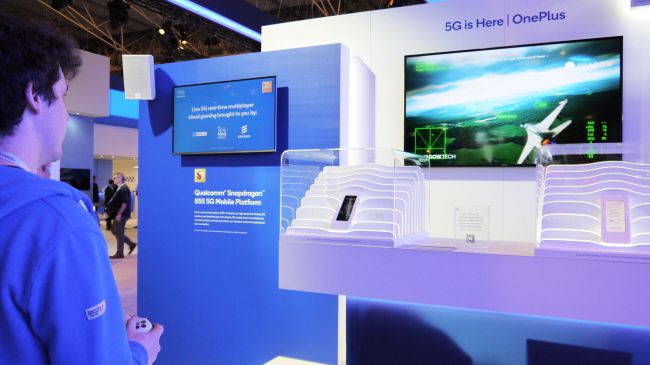
Smartphone manufacturer OnePlus isn't making any announcements at MWC 2019 in Barcelona, Spain, but it did have a presence in the form of a 5G prototype handset.

In a recent interview with USA Today, OnePlus CEO Pete Lau revealed some details about the firm's first 5G phone – which could be called the OnePlus 7 – including the fact it'll run a Snapdragon 855 chipset and X50 modem – the latter of which is key to providing 5G connectivity.

Lau also confirmed that OnePlus would be making a 4G LTE variant of the same device (mainly for the US market), with minimal differences between the two.

We went to check out the prototype 5G device, housed in a sizable case to protect its identity, to see what it could tell us about the OnePlus 7.


We grabbed some footage of the prototype device in action, check it out below:

Big screen and no notch?

While the case the OnePlus 5G phone is it doesn't show any of the handset's body, one thing is clear: the screen here is tall.

It looks to be a 21:9 aspect ratio display, which we've just seen on the new Sony Xperia 1, which makes it a great display for movie watching.

We wanted to make sure though, so we've measured the display and can confirm the screen we saw is indeed 21:9, as you can see in the image below.

There also doesn't appear to be a notch, which means we could get an uninterrupted view, although we were unable to tell if the device will have bezels above and below the display.

The OnePlus 6 and 6T have reduced bezel size with just a slender chin below the display, and we hope OnePlus can continue this design with the OnePlus 7.

However, if it does continue with a no-notch and slender bezel approach it raises the question as to where the front-facing camera will be housed.

Perhaps it may have a mechanically raising snapper like the Find X from sister company Oppo, or perhaps the screen will slide down to reveal a camera, similar to the Xiaomi Mi Mix 3. Or maybe it'll come up with a whole new way to solve the problem. We'll have to wait and see.

Time to move on from Full HD


Every OnePlus handset to date has featured a Full HD resolution, and while this has been good enough for a number of years there's increasing demand for higher resolution displays on our phones.

However, there could be some good news for OnePlus fans. We played Ace Combat 7 on the prototype device (using a wireless Xbox controller, and we weren't allowed to take the phone out from behind the glass) and on closer inspection of the display the quality looked impressive.

We held up our Galaxy S10 Plus alongside (with QHD+ resolution enabled) and there wasn't a noticeable difference in quality between the two – although we weren't able to do a full side-by-side comparison.

Another highlight for us was the smoothness of the gameplay, as we flew through the air, firing missiles at targets. There's a chance OnePlus may have upped the refresh rate of the screen here as well.

It's also worth noting that the game only had 20MB of data installed on the handset, with the rest of the content streamed over 5G, with no lag or latency issues experienced during our time with it.

All of this, of course, could well change before we see the launch of the OnePlus 7, but considering the lengths the firm has gone to in protecting the design of the device, it suggests it's a near-final build.


READ MORE:

Tuesday, February 19, 2019

2/19/2019 09:26:00 PM

You may want to hold off buying a 5G phone until 2020

This second generation 5G modem will make a difference


We know that 5G will officially launch in 2019, but the first 5G phones to hit the market this year could be quickly outshone by 5G devices launched towards the end of 2019 and into 2020.

Smartphone chipset maker Qualcomm has announced its second generation 5G modem, the Snapdragon X55, which it claims is the world's first capable of 7Gbps.

What does that mean for you? Even faster internet speeds, allowing you to download movies, apps, TV shows, games and music in seconds, although you're unlikely to see that top-end 7Gbps speed instantly as networks continue to develop their 5G experience.


  • These are the 5G phones we're expecting this year
  • There could be a 5G Samsung Galaxy S10
  • We'll see 5G phones launch at MWC 2019


However, the more exciting feature of the X55 is its flexibility. Whereas Qualcomm's first 5G modem (the Snapdragon X50) was developed with smartphones in mind, the Snapdragon X55 is designed to work in pretty much any application.

That means we could see the second generation 5G modem make its way into a host of phones, Wi-Fi hotspots, laptops, tablets, autos, IoT devices and more - helping the premise of 5G being something that can connect far more items than just phones and tablets.

Super support

The Snapdragon X55 is also the first modem to support standalone 5G networks, allowing your phone to carry out all its tasks over the speedy connection.

Most 5G phones which arrive in 2019 and use the X50 or rival modems will be non-standalone, where they connect to both the 5G and 4G connections, with the former used for data and the latter for the phone's main connection to the network.

The X55 also supports virtually any band in any region around the world, which means manufacturers shouldn't have to produce different variants for different regions to cope with specific network demands.

Qualcomm expects the first Snapdragon X55 devices to hit the market before the end of the year - so we could see it feature in handsets such as the Samsung Galaxy Note 10 or Google Pixel 4, but the X55 will likely really take hold in 2020's flagship devices.


Thursday, December 20, 2018

12/20/2018 09:26:00 PM

The new big: Lenovo unveils a phone with Snapdragon 855, 12GB RAM and 512GB storage

But it won’t support 5G


Lenovo is more known for its mid-range phones, like the Lenovo Z5 that came out last June or, through its sub-brand Motorola, the Moto Z3. But today the company unveiled what may be the most powerful Android phone on the market: the Lenovo Z5 Pro GT, which might be the first phone to pack a Snapdragon 855 when it’s released in China on January 24.

It’s unclear when or even if it will come to the rest of the world, which is a shame. This is clearly a souped-up device to cater to users eager for top-tier performance, and it will reportedly cost the equivalent of $640.

For that upper mid-range price, the Z5 Pro GT far outstrips the specs on the Lenovo Z5 Pro, which was released in November.

The Z5 Pro GT comes with an industry-topping 12GB of RAM, 512GB of storage and a 6.39-inch (2,340 x 1,080) OLED display. It packs a 3,350mAh battery, a pair of rear cameras (16MP & 24MP) and two front-facing cameras (16MP & an infrared 8MP).

Lenovo opted to hide the twin front-facing cameras behind a sliding front screen – a design option we’ve seen most recently in the Xiaomi Mi Mix 3 – which gives the notchless Z5 Pro GT an astonishing 95% screen-to-body ratio. Unfortunately, the earpiece is nestled between the cameras, meaning you'll have to slide down the screen to take calls, according to Engadget.

The future, but not 5G


Crucially, however, it won’t support 5G. If Lenovo ends up being the first to launch a 5G-compatible smartphone, as it boasted last year, it won’t be with this special-edition phone.

Still, the Lenovo Z5 Pro GT will manage a smartphone first with its 12GB of RAM. We've seen these kinds of outlandish specs before, but mostly from special limited-run versions of existing phones like the Porsche Design Huawei Mate 20 RS and OnePlus 6T McLaren Edition.

If you're still interested in this powerful phone, Chinese buyers can preorder it starting on January 13.


SOURCE:

Monday, December 10, 2018

12/10/2018 11:14:00 PM

5G is just the beginning for the future of smartphones

The future of mobile looks promising


Smartphones have become so important nowadays that we can safely say that they are almost a part of us. Given the fact that the entire mobile industry is evolving at an incredibly fast pace, it's important to analyze what is the current state of smartphones (both from a hardware point of view and from a software one) in order to better understand what will happen in the next couple of years.

The development side

When it comes to architectural development, the mobile industry is incredibly hard to predict: if we take Apple into consideration, we can safely say that their development plans have been quite static, while its Chinese competitors (Huawei especially) have been pushing new technologies, embracing a more "desktop" approach in terms of both technologies and materials.

With this in mind, we can still trace a general prediction line in terms of hardware development, especially given the fact that (as pointed out by many industry analysts) Virtual Reality and Machine Learning seem to be the biggest development trends that every major player wants to embrace in his future plans.

What's so big about virtual reality?

We've seen a small introduction to VR applied to mobile with Apple's Animoji, which are indeed a simplified version of SLAM (Simultaneous Localization And Mapping) applied to an internal mobile environment. Many mobile app development companies have stated the fact that Virtual Reality could be implemented in many technical, educational and entertainment-related apps.

Although the main problem is related to the fact that, in order to properly experience VR, the currently available peripherals are pretty bulky and expensive, we can easily say that there are indeed several signals of startups within the mobile development industry moving towards this matter.

The market value and the future of this industry

When it comes to industry insights, there are several aspects that should be considered, ranging from prices for tools, materials and everything in between. With this in mind, the mobile industry, of course, relies on the fact that there are several limitations due to the current state of processors, RAM and such.

Today, the market value, within the mobile sector, is pretty much based on the fact that there are several startups who are covering just the software development side of the mobile industry. With all that being said, we can easily say that the future of mobile will pretty much be a startup matter.


SOURCE TechRadar:

Thursday, December 6, 2018

12/06/2018 04:47:00 PM

Smartphone innovation to ramp in 2019 thanks to foldable screens, in-screen fingerprint, 5G

5G isn't the only reason that the smartphone industry is getting interesting: Foldable phones, in-screen fingerprint scanners and AI will drive innovation.


If 2018 was the year of peak iPhone demand for Apple, stale designs and more of the same, 2019 promises a wave of innovation that may reset the pecking order among tech giants.

While Qualcomm is hosting its technology summit in Maui, the stars are aligning for what may be a smartphone renaissance. Yes, we've documented peak smartphone, more of the same and a software-centric and services approach that minimizes hardware but I'm becoming oddly optimistic about the sector.

First, let's get the obvious hype out of the way. 5G will usher in new devices, more speed and a lot more use cases. But 5G will also have a bigger business impact due to edge computing, Internet of things and intelligent networks. On the consumer front, 5G in 2019 will be more about early adopters. Simply put, 5G is merely about 15 percent why I'm more optimistic about the smartphone food chain.

Here are the other reasons why I'm suddenly optimistic-ish (the -ish is there because I'm a cynical person by nature and frankly the best you'll get out of me):

Samsung's foldable phone. Samsung will hit the market with a foldable device and other Android vendors are likely to follow. How these devices sell -- and are priced -- remains to be seen, but the Android ecosystem is aligned behind 5G and the form factor and there will be interesting use cases. See:

Components of the smartphone will become more innovative. CNET outlined how Corning's Gorilla Glass is approaching the foldable market. These innovations mean that something more than the camera improvements may drive sales.

Qualcomm's fingerprint behind the screen trick. CNET outlined how fingerprint scanning will come back to the front of the device via Qualcomm's platform. The move is notable since let's get real:


  • The move to facial recognition has been a bit annoying.
  • Biometrics has put fingerprint readers in awkward behind-the-device places.
  • Most of us miss the fingerprint scanner on the front.


Artificial intelligence is everywhere. The software embedded in phones will be vastly improved by machine learning and artificial intelligence. Google will lead this charge and its Pixel 3 and the ability to take pictures at night without flash highlight the possibilities.

Add it up and there's clearly enough to spur a new era for smartphone devices and set us up for 2020.

Tuesday, December 4, 2018

12/04/2018 09:42:00 PM

Samsung plans to be early with 5G support: Will it matter if Apple hangs back?

Verizon and Samsung will show off a proof of concept 5G device and eye an early 2019 launch. AT&T will also offer an early 2019 5G device. Is there an opportunity for Samsung to leapfrog Apple?


Samsung and Verizon are planning to launch one of the first commercial 5G smartphones in the first half of 2019 as Apple will reportedly hang back until 2020. AT&T will also launch a 5G device with Samsung.

The big question is whether the 5G upgrade will matter in the smartphone market.

In a statement, Verizon and Samsung outlined their 5G plans and said they will unveil a proof of concept device powered by Qualcomm's 5G components. This proof of concept device will be shown at the Qualcomm Snapdragon Technology Summit in Maui. Good gig if you can get it.

AT&T followed up with a similar announcement. AT&T is also focusing its 5G efforts on business customers as well as consumers. AT&T has installed 5G infrastructure in 12 markets so far.

For Verizon and AT&T, being early with a 5G device is critical as is its early 2019 launch of services. 5G networks will be faster than 4G and be easier to manage for wireless carriers. Less latency and more speed offer a lot of options for new services, edge computing and the Internet of things deployments. Simply put, it helps to have a flagship partner to highlight how 5G will boost the wireless experience.

What is 5G? Everything you need to know about the new wireless revolution | Wiring for wireless: 5G and the tower in your backyard | Palo Alto Networks to launch next-gen firewall for 5G networks | On a roof, inside London's 5G mobile trial

As Samsung makes it clear it's going 5G early, Apple will reportedly take a different approach, according to a Bloomberg report. Historically, Apple has waited for standards, networks and efficiency gains to be ironed out. Apple's iPhone lagged in 3G and 4G services relative to the Android crowd. The delay didn't matter then, and it's unclear whether it matters now. CNET noted that details on 5G devices have been vague at best.

The 5G push for 2019 will be led by Android devices makers. Huawei, Samsung, and others are going to push 5G. Here's a look at the moving 5G parts and factors to consider when pondering the Samsung vs. Apple race.


  • Samsung has an opportunity for a leapfrog. Keep in mind that Samsung is also making 5G equipment and has the opportunity to be a network player. It only makes sense to get ahead of 5G with an endpoint device that is premium and can serve as a showpiece. And in the premium market, Samsung can drive profit margins. Perhaps Samsung can even steal some share from the iPhone ecosystem. Samsung still wants to be the first to launch the foldable phone, says mobile boss
  • Apple is right to hold back. Yes, 5G service will be available in 2019, but it's unclear what the hit will be to wallets, battery life and overall experience. Standards are still being worked out and 2019 will set a lot of groundwork.
  • There are Android people and there are iOS people. With the Android community racing to 5G, it's likely that the key players will just beat each other up instead of Apple. It's unlikely that 5G is going to entice Apple folks to switch to Android.
  • The smartphone upgrade cycle is long and getting longer. There's a reason Apple will stop reporting unit figures for its devices: We're at peak iPhone. However, peak iPhone isn't necessarily bad. As long as consumers stick with iOS then Apple can market services and collect recurring revenue.
  • 5G adoption may be impacted by costs. The devil in the 5G push by Verizon, AT&T, and T-Mobile will be in the details. While 5G devices sound great, how customers are charged for these speedier services remains to be seen. Is that extra speed worth $20 a month more? The other wrinkle will be the cost for 5G devices overall. Samsung and Apple are already pushing the smartphone cost curve out. It's unclear how much more a tech buyer will be willing to spend on a device--even a 5G one.


Monday, November 5, 2018

11/05/2018 10:36:00 PM

Apple tipped to launch a 5G iPhone in 2020

Super-fast speeds on the way


Infrastructure for next-generation 5G phone networks is only in the very early stages of being established, but that isn't going to stop phone makers building 5G capabilities into their handsets (and making a lot of noise about it) as soon as they possibly can. According to a new report, Apple is going to join the party in 2020.

Insider sources speaking to Fast Company say the Intel 8161 5G modem chip will be the one to supply this 5G connectivity, though apparently, Intel is battling with heat issues as it looks to get the chip prototyped and developed for commercial use.

It would appear Apple is ready to let other companies get to market first with their 5G phones before following up with its own implementation the year after next. The likes of Oppo, LG, Samsung, Huawei, Lenovo, and Sony have all confirmed or at least intimated that 5G handsets are on the slate for some point during 2019.

The need for speed

Depending on where in the world you live, you might only have just got used to seeing the 4G or LTE symbol on your phone on a regular basis. The roll out of 5G in terms of actual networks is likely to lag behind the arrival of 5G-capable phones – as with 4G, it'll first appear in pockets, likely in major cities, before extending everywhere else.

And the improvements aren't just in raw speed, they're in bandwidth too. That means more devices getting connected (think self-driving cars) and better reception when you're in a crowded area (like watching a game at your local sports stadium).

Download speeds have the potential to be up to a thousand times faster than 4G – 10Gbps rather than 100Mbps – though that's a theoretical maximum (so the reality will be somewhat different). By the time Apple's rumored 5G iPhone arrives in 2020, you might even be able to latch on to a 5G network somewhere close to where you live.

Tuesday, October 30, 2018

10/30/2018 10:40:00 PM

Oppo Wants to Release the First 5G Smartphone

Oppo wants to beat LG to the punch after successful 5G tests.


Oppo is aiming to be the first smartphone manufacturer to launch a commercial 5G handset after achieving a significant milestone in its lab tests of next-generation mobile networks.

The Chinese phone maker was able to connect one of its devices to a 5G network for the first time, overcoming one of the final hurdles in development and paving the way for a release in 2019.

“Oppo made the connection successfully between an R15 smartphone terminal and the 5G network, in [its] 5G communication protocol laboratory environment,” the company said in a statement.


Oppo 5G smartphone

“The connection was carried out on a pre-commercially available 5G smartphone developed on the basis of Oppo [Release-15]. It was customized with fully integrated 5G components including System board, RF, RFFE, and antenna. The "5G" logo also appeared in the top right corner of the screen.”

It is keen to stress its contributions to the 5G standard and its R&D efforts, with its Oppo Research Institute exploring 5G applications in the fields of 3D vision, Virtual Reality (VR) and Augmented (AR) reality. It believes these three technologies will combine to create a ‘Ubiquitous Reality’ that will be used for 3D video calls and online gaming among other use cases.

On top of this, the firm is working with chipmaker Qualcomm on a ‘5G Pilot’ programme to jointly investigate 5G innovations.

Oppo will have stiff competition to be first to market from LG, which has previously stated it plans to launch a compatible device with US operator Sprint. Oppo is one of the world’s leading device manufacturers, but its success has so far been limited to its homeland and emerging markets like India.

The first 5G network has already gone live in the US, offering Fixed Wireless Access (FWA) broadband in major cities, with others set to come online in 2019.


SOURCE: