Breaking

Showing posts with label Q1. Show all posts

Friday, November 30, 2018

11/30/2018 07:33:00 PM

Nutanix Q1 tops estimates on strong subscription revenue growth

Nutanix said subscription revenue was up 104 percent year-over-year to $127 million.


Software defined data center player Nutanix delivered strong first quarter results, with revenue on the up amid the company's shift towards a subscription business model.

The company reported a first quarter non-GAAP net loss of 13 cents a share on revenue of $313.3 million. Wall Street was expecting a net loss of 27 cents a share on revenue of $305.26 million.

For the second quarter, Nutanix projected a non-GAAP net loss of 25 cents a share with revenue between $325 million to $335 million. Wall Street was expecting a loss of 26 cents a share on revenue of $2326 million. Shares of Nutanix were up nearly 10 percent after hours.

Nutanix said subscription revenue was up 104 percent year-over-year to $127 million. The company's chief executive Dheeraj Pandey said the results "prove that our core business continues to grow strongly and put us on a solid path to meet our goal of at least $3 billion in software and support billings by 2021."

Elsewhere on the balance sheet, Nutanix's software and support revenue came to $280.7 million, up 44 percent year-over-year. Billings for the quarter totaled $383.6 million, up from $315.3 million the year prior. Nutanix said it ended Q1 with 11,490 end-customers.


SOURCE:

Wednesday, June 27, 2018

6/27/2018 09:11:00 PM

Red Hat Q1 solid, but currency dings outlook

Red Hat's first quarter was swell, but the company cut its second quarter and fiscal year outlook due to currency fluctuations.


Red Hat delivered another strong quarter as its OpenShift portfolio drove subscriptions and services revenue, but its outlook for the second quarter was light.

The company reported first-quarter earnings of $113 million, or 59 cents a share, on revenue of $814 million, up 20 percent from a year ago. Non-GAAP earnings for the first quarter checked in at 72 cents a share.

Wall Street was looking for non-GAAP first-quarter earnings of 69 cents a share on revenue of $807.5 million.

CEO Jim Whitehurst said Red Hat saw strong growth in OpenShift as more companies "modernize their applications in Linux containers for their hybrid cloud and digital transformation initiatives."

Red Hat's only business plan is to keep changing plans | Lucky 13? Red Hat releases Red Hat OpenStack Platform 13

The number of deals worth more than $1 million grew 48 percent in the quarter. Subscription revenue from infrastructure products was $522 million, up 14 percent from a year ago. Application development and other subscriptions were $189 million, up 37 percent from a year ago.

Red Hat ended the quarter with $2.5 billion in total cash, cash equivalents, and investments.

As for the outlook, Red Hat said second-quarter revenue will be between $822 million to $830 million with non-GAAP earnings of about 81 cents a share. Wall Street was looking for revenue of $854.9 million with non-GAAP earnings of 89 cents a share.

The company said currency exchange rates were the primary reason for the outlook.

Red Hat projected fiscal 2019 revenue between $3.37 billion to $3.41 billion with non-GAAP earnings between $3.44 a share to $3.48 a share.


Tuesday, June 12, 2018

6/12/2018 07:41:00 PM

Worldwide server business ramps up in Q1 2018

Enterprise and SMBs that are replacing servers and investing in infrastructure are prompting the gradual growth of the industry.


Worldwide server revenue continues to grow with an increase of 33.4 percent in Q1 2018.

According to Gartner, the server market is being driven by renewed interest in the hyperscale, data centers, and investment by everyone from enterprise players to SMBs seeking to update their infrastructure, abandon legacy systems and sign up to new technological solutions.

On Monday, the research firm said that server revenue grew by 33.4 percent worldwide in the first quarter. Shipments grew by 17.3 percent year-over-year.

"Enterprises and midsize businesses are in the process of investing in their on-premises and colocation infrastructure to support server replacements and growth requirements even as they continue to invest in public cloud solutions," said Jeffrey Hewitt, research vice president at Gartner. "Additionally, when it came to server average selling prices (ASP) increases for the quarter, one driver was the fact that DRAM prices increased due to constrained supplies."

The demand for DRAM has outstripped supply for over a year. The increasing demand for data storage has been prompted by the booming smartphone and tablet industry, the Internet of Things (IoT), and research projects ranging from artificial intelligence (AI) to autonomous driving.

The global chip industry has pushed up prices for DRAM across the board as a result. According to market research firm DRAMeXchange, global DRAM bit supply will grow by 19.6 percent over the course of 2018, while demand is forecast to surge by 22 percent.

North America and the Asia Pacific region enjoyed the most growth in the server industry, with estimates reaching 34 percent and 47.8 percent. When it comes to shipments, the regions grew by 24.3 percent and 21.9 percent, respectively.

The EMEA region posted server revenue growth of 32.1 percent, while shipments increased at a lower rate of 2.7 percent.

Dell EMC's shareholders are likely to be happy with a 51.4 percent growth rate in the worldwide server market in Q1 2018 and an estimated market share of 21.5 percent -- a 2.5 percent increase year-on-year.

In comparison, HPE has lost market share over the first quarter this year. The company's growth in the server market has been pegged at 10.4 percent, with overall market share now 19.9 percent, a decline from 24.1 percent in Q1 2017.


When it comes to shipments, Dell maintained the top spot with market share of 18.2 percent, and despite a decline of 8.5 percent in server shipments, HPE has held onto second place. Inspur Electronics is not as well-known as Dell EMC or HPE, but the firm's growth and increase in market share is of note.


The x86 server market increased in revenue by 35.7 percent and shipments went up by an estimated 17.5 percent in Q1 2018.

However, shipment rates and revenue in the RISC/Itanium UNIX plummeted by 52.8 percent and 46.7 percent, respectively.


Ongoing issues with memory shortages and vendors forced to maintain a balance between pleasing shareholders through their profit margins and catering to the needs of customers may still cause industry growth problems throughout 2018.

However, the interest of businesses in server adoption has created a far stronger start to the year than we experienced back in 2017.


Friday, April 27, 2018

4/27/2018 09:19:00 PM

Intel reports strong Q1, accelerates growth in data center business

CEO Brian Krzanich noted that Intel's data-centric businesses accounted for almost half of Q1 revenue.


Intel delivered strong first quarter financial results Thursday led by growth in its data center Internet of things businesses.

The tech giant reported a net income of $4.5 billion, or 93 cents per share.

Non-GAAP earnings were 87 cents per share on revenue of $16.1 billion, up 13 percent from the year prior.

Wall Street was looking for earnings of 72 cents per share with $15.1 billion in revenue.

In prepared remarks, CEO Brian Krzanich noted that Intel's data-centric businesses accounted for almost half of Q1 revenue.

On a conference call with analysts, Krzanich said:

What we're seeing is an unrelenting demand for computing performance driven by the continuing growth of data and the need to process, analyze, store and share that data. That dynamic benefit our traditional CPU business and it reinforces the big bets we've made in memory, modem, FPGAs and autonomous vehicles. We're competing to win in our largest collection of the addressable market ever.
Looking closer at the numbers, Intel's data center unit rang up $5.2 billion in revenue during the quarter, up 24 percent year over year. The Internet of things business grew at a rate of 17 percent year-over-year to deliver $840 million in revenue.

Meanwhile, Intel's client computing group posted revenue of $8.2 billion, up three percent from the previous year.

"Compared to the first-quarter expectations we set in January, revenue was higher, operating margins were stronger and EPS was better," said Intel CFO Bob Swan. "Our data-centric strategy is accelerating Intel's transformation."


Swan said Intel is raising its full-year revenue outlook based on the strong quarter. The company now expects revenue of $65 billion and earnings of $3.55 per share.

For the current quarter, Wall Street is looking for non-GAAP earnings of 81 cents per share with $15.55 billion in revenue. Intel responded well above target with second-quarter EPS of 85 cents and revenue guidance of $16.3 billion.

Robert Swan, CFO of Intel, was upbeat following the outlook. He said:

We believe 2018 will be another record year for Intel. We've met and exceeded our financial commitments, and we feel great about where we are relative to our 3-year plan. Our PC-centric team keeps winning in a challenging market, and our data-centric businesses are growing fast, fueling Intel's transformation to a company that powers the cloud in smart connected devices.

SOURCE BY

Thursday, April 19, 2018

4/19/2018 07:37:00 PM

IBM Q1 solid, IBM Z boosts hardware, as-a-service run rate at $10.7 billion

IBM got some help by currency fluctuations, but strategic imperatives revenue delivered growth.


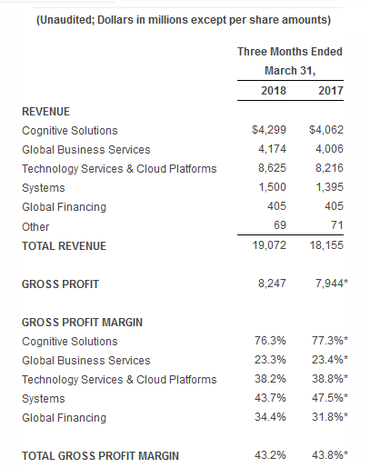
Aided in part by currency rates, IBM reported a better-than-expected first quarter where "strategic imperatives" delivered double-digit revenue growth over the last 12 months and as-a-service sales hit an annual run rate of $10.7 billion.


IBM reported non-GAAP first-quarter earnings of $2.45 a share on revenue of $19.1 billion, up 5 percent from a year ago. Adjusting for currency revenue was flat.

Wall Street was looking for first-quarter adjusted earnings of $2.42 a share on revenue of $18.82 billion.


On a net basis, IBM reported earnings of $1.81 a share, or $2.3 billion.

Read also: Enterprises learning to love cloud lock-in too: Is it different this time? | IBM says breached records dropped by nearly 25 percent to 2.9 billion last year | IBM Think 2018 postmortem: Making incumbent enterprises great again

Big Blue also maintained its outlook for 2018 and said it would deliver non-GAAP earnings of at least $13.80 a share. IBM also said it would deliver free cash flow of about $12 billion for 2018.

IBM's new businesses -- also known as strategic imperatives -- had revenue of $37.7 billion, up 12 percent over the last 12 months. In the first quarter, analytics revenue was up 9 percent with mobile up 19 percent. Security revenue in the first quarter was up 65 percent in the first quarter.

James Kavanaugh, CFO of IBM, said the following on a conference call with analysts.

Our first quarter results reflect much of the work we've done to reposition our portfolio and our skills to address the secular trends in the market, led by the phenomenon of data. We've been building new platforms and solutions while modernizing existing ones, embedding cloud and AI into more of what we offer. And so IBM is now a cognitive solution and cloud platform company focused on the high-value areas of IT.

By unit, IBM's cognitive solutions division had revenue of $4.3 billion, up 6 percent. Business services had revenue of $4.2 billion, up 4 percent, with technology services and cloud platforms delivering sales of $8.6 billion, up 5 percent. Systems revenue got a boost from IBM Z mainframe sales in the first quarter with revenue of $1.5 billion, up 8 percent.

Read also: IBM's cloud strategy revolves around multi-cloud support, grabbing new workloads | IBM launches Cloud Private for Data; elite data science consulting team | IBM launches 'skinny' Z mainframe designed for 19-inch standard data center rack

Here's a look at IBM's quarterly growth by product line.


A few notable items:

  1. Digital offerings are driving consulting growth and there were "modest" improvements in revenue in the first quarter relative to the fourth quarter.
  2. IBM Z sales were driven by the z14 and new workloads. IBM Z sales were up 54 percent from a year ago.
  3. Storage revenue declined after four straight quarters of growth.
  4. First quarter revenue in the Americas was flat with EMEA up 1 percent and the Asia Pacific flat. Americas revenue saw growth in Canada and Latin America and a decline in the US.


Friday, March 2, 2018

3/02/2018 01:36:00 AM

HPE's half and half IT approach pays profits in Q1: Will development proceed?

Hewlett Packard Enterprise conveyed a solid first quarter and sees strong IT spending ahead, however, the correlations and capacity to pass on expanding memory costs are challenges.


Hewlett Packard enterprises wagered on crossbreed IT and move far from item servers gives off an impression of being paid off, however, there is a touch of questions about the income development bends ahead. 

The organization detailed first-quarter income of 89 pennies an offer on the income of $7.7 billion, up 11 percent from a year prior. Non-GAAP income of 34 pennies an offer avoided tax reductions. 

HPE's outcomes topped appraisals and the organization increased its standpoint as well. In any case, the huge news was that HPE conveyed strong income development. Actually, HPE's income development was the best in late memory notwithstanding changing for cash where deals would have been up 9 percent from a year back. 


Unmistakably, HPE's first profit phone call with Antonio Neri was a win. Nonetheless, there are some key things. Among the moving parts: 

The organization fared well with pitching servers to corporate clients who are getting tied up with HPE's half and half IT vision with keen edge figuring. 

In any case, quite a bit of HPE's business picks up were because of cost increments as it went through higher item costs. Prominently memory costs. 

In October, HPE laid out projections for level income development to up 1 percent for the year. 

So what's it going to be HPE? Twofold digit development or the place that is known for level income. Neri supported the phone call: 

We clearly are focused on the money related design we laid out in October at the Security Analyst meeting. Once more, how about we backpedal to the Q1 development, again a great deal of that was clearly the expands we see. We found in the market in light of the fact that the costs expanding. Yet in addition solid execution. I think when I consider the Q1 comes about is a proof purpose of we have the correct methodology and core interest. I think we need to perceive what the estimating condition will do, however, by and large, I think our concentration is true to be the portfolio from the volume side of the house to the esteem set of the house, which clearly, the development rates are altogether different. 

As it were, HPE's valuing force may not last. HPE's Neri likewise noticed that the organization will have harder correlations in the second half. All things considered, HPE's hyperconverged framework, way to deal with crossbreed IT, stockpiling (Nimble and 3Par) and smart edge (Aruba) organizations are faring great. 


For example, HPE's stockpiling income was up 24 percent in the primary quarter contrasted with a year prior. Systems administration was up 27 percent from a year prior. SEE: What is distributed computing? All that you have to think about the cloud, clarified | Top cloud suppliers 2018: How AWS, Microsoft, Google Cloud Platform, IBM Cloud, Oracle, Alibaba stack up 

Oppenheimer investigator Ittai Kidron said in an exploration note: 

While HPE profited from the lower US charge rate and an FX tailwind, the outcomes were strong notwithstanding changing for these, approving our view that HPE's fundamental business patterns are superior to anything financial specialists accept. 

In the meantime, HPE CFO Timothy Stonesifer said IT spending is strong. 

From a full-scale point of view, we keep on seeing an extensively enhancing IT spend condition from the enhanced client request. 

Neri likewise said that it is concentrating its endeavors on elite registering and hyperconverged frameworks. "We are absolutely deemphasizing the emphasis on what we call the redid, commoditized, process stages," he said. 

HPE's solid quarter gives off an impression of being an awesome begin to financial 2018. At last, it'll require a couple of additions to change over skeptics.


Wednesday, February 7, 2018

2/07/2018 11:03:00 PM

Juniper Networks cuts Q1 standpoint as substantial cloud clients hit stop

Juniper Networks cuts Q1 standpoint as substantial cloud clients hit stop 

Juniper is experiencing serious difficulties emerging and developing as systems administration mammoths pitch cloud merchants on new models. 


Juniper Networks said that organization delays among huge cloud clients will hurt its first-quarter comes about. 

The systems administration organization, which announced final quarter income and deals that were superior to anything gauges, cut its first-quarter viewpoint. 

In an announcement, Juniper said that its first-quarter will endure a shot because of "continuous arrangement delays" among expansive cloud clients. Juniper included that its substantial cloud clients are experiencing an engineering change. Some Juniper clients are progressing to the organization's cutting-edge stage. 

Juniper said that it anticipates that gross edges will be experiencing strain in light of its item blend and lower volume. Juniper said its income for the principal quarter will be about $1.05 billion, plus or minus $30 million. Non-GAAP first quarter profit around 25 pennies an offer in the principal quarter, plus or minus 3 pennies an offer. 

Money Street was expecting a first-quarter non-GAAP profit of 42 pennies an offer on the income of $1.15 billion. 

The viewpoint affirmed fears about Juniper's quarters ahead. Cowen expert Paul Silverstein said in front of the profit report: 

We see what we accept to be an undeniably difficult focused scene in specialist co-op directing as well as huge difficulties to Juniper's picking up and maintaining share in the cloud advertising. 

For the final quarter, Juniper detailed a net loss of $148.1 million, or 40 pennies an offer, because of expense charges. Non-GAAP income for the final quarter were 53 pennies an offer on the income of $1.24 billion. 

Money Street was anticipating that Juniper should report final quarter non-GAAP income of 52 pennies an offer on the income of $1.23 billion. 

For 2017, Juniper announced net salary of $306.2 million, or 80 pennies an offer, on the income of $5.03 billion. 


Wednesday, August 2, 2017

8/02/2017 10:55:00 PM

Sony posts 181 percent benefit surge for Q1 2017

The Japanese hardware producer's benefits have recouped on account of development in offers of semiconductors, budgetary administrations, and picture sensors.


Sony Corporation has posted an 180.5 percent year-on-year surge in working benefit for the principal quarter of 2017, credited fundamentally to expanding offers of semiconductors and Imaging Products and Solutions (IP&S). 

Working salary for the quarter finished June 30, 2017, came to 157.6 billion yen, up 180.5 percent from 56.2 billion yen in Q1 2016; while income for the quarter achieved 1.9 trillion yen, a 15.2 percent expansion from the 1.6 trillion yen announced for the past comparing time frame. 

While deals for Sony's Mobile division dropped 2.5 percent to 181.2 billion yen, working pay rose 771.3 percent to 3.6 billion, for the most part, because of diminishments in working expenses and R&D costs, the organization said. The outcomes check a steady recuperation for the division, which the combination beforehand considered leaving because of substantial rivalry and a decrease in a piece of the overall industry. 

Semiconductor deals rose 41.4 percent year on year to 204.3 billion yen for the quarter, which was somewhat because of an expansion in unit offers of picture sensors for portable items. Subsequently, working salary for the division rose to 55.4 billion yen from the 43.5 billion yen announced for a similar quarter in the earlier year. 

Budgetary Services income rose to 303.2 billion yen, in spite of the fact that the division saw a drop in working income of 4.8 percent to 46.2 billion yen. 

IP&S income expanded from 122.2 billion yen to 155.6 billion yen, while working salary for the division rose 209.1 percent to 23.2 billion. 

Music wage expanded 57.6 percent year over year to 25 billion yen; while Home Entertainment and Sound salary rose 11.6 percent to 22.6 billion yen. 

Recreations and Network Services salary, then again, declined 59.7 percent year over year, for the most part because of the nonattendance of first-party programming title. 

Sony took 27.5 billion yen in working income amid the quarter from the offer of assembling auxiliary Sony Electronics Huanan. Protection because of the Kumamoto tremors additionally contributed 6.7 billion yen and 2.6 billion yen for the semiconductor and IP&S portions individually. 

Results for the quarter stamp a change from this time a year ago, when Sony detailed a 42 percent year-on-year drop in working income, credited to the "weakening of working outcomes" in the semiconductors portion. 

Q1 2016 income was down 10.8 percent year-on-year, which Sony faulted for seismic tremors, remote trade rates, and the break in disaster protection buying. 

As a major aspect of rebuilding endeavors, Sony stopped cell phone generation in Brazil in June because of an absence of "monetary motivations". 

In 2015, the organization additionally reported the cutting of 2,100 occupations internationally from its battling versatile interchanges portion by March 2016. 

Some portion of rebuilding endeavors lately incorporate the improvement of new wearable gadgets, putting resources into Internet of Things chip innovation, and in addition acquisitions in chips and amusement. 

For the monetary year finishing March 31, 2018, Sony is expecting 8.3 trillion yen in deals and working income and 500 billion yen in working wage.