Breaking

Showing posts with label IBM. Show all posts

Wednesday, February 22, 2023

2/22/2023 01:06:00 PM

Cloud Update: In its cloud, IBM has created a machine with affordable AI.

Cloud Update: In its cloud, IBM has created a machine with affordable AI.

cloud-update-in-its-cloud-ibm-has-created-a-machine-with-affordable-AI


Furthermore, it is built for AI tasks.

Although IBM's response to the affordable supercomputer has been operational for some time, it has only lately made any concrete disclosures about its so-called Vela project.

Looking to its blog(opens in new tab) for more information, IBM disclosed that the study, which was written by five company employees, addresses issues with earlier supercomputers and their unpreparedness for AI tasks.


The business clarifies the choices it made regarding the use of low-cost but powerful hardware in order to adapt the supercomputer model for this future type of workload.

We need your assistance to create a better website for our users. By responding to our poll and sharing your thoughts and ideas about the tech sector in 2023, you can contribute. Your responses will all be kept private and secret, and it won't take long. Once more, thank you for your assistance in improving TechRadar Pro.

Although it's obvious that these supercomputers can handle demanding AI workloads, including the one built for OpenAI, the company behind the well-known ChatGPT live chat software, a lack of optimization has left traditional supercomputers at risk of lacking valuable power and having an excess in other areas, which results in an unnecessary expenditure.

Although it is well known that bare metal nodes are the best for AI, IBM wished to investigate making these available inside of a virtual machine (VM). Big Blue claims that the outcome is significant efficiency improvements.

We developed a method to expose all of the node's capabilities (GPUs, CPUs, networking, and storage) into the VM so that the virtualization overhead is less than 5%, which is the lowest overhead in the industry that we are aware of, after conducting a substantial amount of research and discovery.

Vela has four 3.2TB NVMe storage drives, 1.5TB of DRAM, and 80GB of GPU memory in terms of node architecture.


According to The Next Platform's estimation, if IBM wished to include its supercomputer in the Top 500 rankings, it would produce approximately 27.9 petaflops of performance, putting it in 15th place as of November 2022.

Although existing supercomputers are capable of handling workloads related to artificial intelligence, the rapid advancements in this field and the pressing need for cost-effectiveness highlight the need for such a machine.


Wednesday, March 6, 2019

3/06/2019 07:42:00 PM

IBM hits quantum computing milestone, may see 'Quantum Advantage' in 2020s

IBM said its latest Q System One has double the Quantum Volume of its predecessor. If Quantum Volume doubles annually for nearly a decade quantum computing will become way more practical.


Foldable phones: Why they won't change the shape of the smartphone industry
IBM is outlining another milestone in quantum computing -- its highest Quantum Volume to date -- and projects that practical uses or so-called Quantum Advantage may be a decade away.

Big Blue, which will outline the scientific milestone at the American Physical Society March Meeting, made a bit of a splash at CES 2019 with a display of its Q System quantum computer and has been steadily showing progress on quantum computing.

In other words, that quantum computing buying guide for technology executives may take a while. Quantum Volume is a performance metric that indicates progress in the pursuit of Quantum Advantage. Quantum Advantage refers to the point where quantum applications deliver significant advantages to classical computers.

Quantum Volume is determined by the number of qubits, connectivity, and coherence time, plus accounting for gate and measurement errors, device cross talk, and circuit software compiler efficiency.

IBM said its Q System One, which has a 20-qubit processor, produced a Quantum Volume of 16, double the current IBM Q, which has a Quantum Volume of 8. IBM also said the Q System One has some of the lowest error rates IBM has measured.

That progress is notable, but practical broad use cases are still years away. IBM said Quantum Volume would need to double every year to reach Quantum Advantage within the next decade. Faster progress on Quantum Advantage would speed up that timeline. IBM has doubled the power of its quantum computers annually since 2017.

Once Quantum Advantage is hit, there would be new applications, more of an ecosystem and real business use cases. Consumption of quantum computing would still likely be delivered via cloud computing since the technology has some unique characteristics that make a traditional data center look easy. IBM made it's quantum computing technology available in 2016 via a cloud service and is working with partners to find business and science use cases. 

Here's how quantum computing and classic computing differs via our recent primer on the subject.

Every classical electronic computer exploits the natural behavior of electrons to produce results in accordance with Boolean logic (for any two specific input states, one certain output state). Here, the basic unit of transaction is the binary digit ("bit"), whose state is either 0 or 1. In a conventional semiconductor, these two states are represented by low and high voltage levels within transistors.

In a quantum computer, the structure is radically different. Its basic unit of registering state is the qubit, which at one level also stores a 0 or 1 state (actually 0 and/or 1). Instead of transistors, a quantum computing obtains its qubits by bombarding atoms with electrical fields at perpendicular angles to one another, the result is to line up the ions but also keep them conveniently and equivalently separated. When these ions are separated by just enough space, their orbiting electrons become the home addresses, if you will, for qubits.


READ MORE:

Thursday, February 14, 2019

2/14/2019 04:33:00 PM

IBM frees Watson AI to work on any cloud

Watson Anywhere plan looks to free up AI platform across multiple clouds


IBM has announced it is liberating its Watson AI services to work across any cloud platform.

The news was announced at the opening of IBM's Think event in San Francisco and could mean a major expansion to the possibilities of what Watson can do, and where it can be deployed.

Going forward, IBM Watson services will be integrated with IBM Cloud Private for Data, meaning they can be run on any environment, whether that be on-premise or in the field, or across any private, public or hybrid-multi-cloud - meaning companies can now take Watson to their data.

The launch will include services such as the Watson Assistant, which offers the chance to build AI conversational interfaces into apps and devices, and Watson OpenScale, which can deploy large-scale rollouts of AI across multiple devices.


  • What is AI? Everything you need to know
  • 5 unusual things you can do with IBM's Watson
  • How IBM Watson will improve your morning commute


Watson breaks free

IBM says that the move will also allow Watson customers to do more with the platform, as until now, the platform has been limited to IBM's own cloud, meaning many users have had to store and manage data across multiple siloes and with different suppliers.

"Businesses have largely been limited to experimenting with AI in siloes due to the limitations caused by cloud provider lock-in of their data," said Rob Thomas, General Manager, IBM Data and AI.

"With most large organizations storing data across hybrid cloud environments, they need the freedom and choice to apply AI to their data wherever it is stored. By breaking open that siloed infrastructure we can help businesses accelerate their transformation through AI."

The news also comes as IBM looks to finalize the $34bn acquisition of open-source software firm Red Hat, suggesting that Watson could be about to become even more accessible for developers around the world.

The services will be linked to rival, non-IBM clouds using Kubernetes, again potentially opening up more opportunities for open-source developers.


READ MORE:

Friday, January 18, 2019

1/18/2019 11:15:00 PM

IBM’s quantum announcement is a big step in a 1,000-mile journey

Does IBM’s announcement of its new quantum computing system mean that quantum computing must be on your technology roadmap?


IBM unveiled a complete "quantum computing system," IBM Q System One, last week. What's more, it chose to do it at CES in Las Vegas. Should you take IBM's claim of a "commercial" quantum computing system to mean that it is time to put quantum on your tech road map? The short answer is "no" -- but, as always, there are exceptions. Since there is a lot of confusion on quantum computers (QC), we think the market needs help to stay grounded in reality.

Here is my take on the announcement: It is a big step forward, but QCs are taking baby steps and the journey is a thousand miles long. To understand this, you need to let go of a bunch of assumptions. After that, you need to appreciate why IBM's announcement is significant without losing sight of the long road ahead of us. Let me break these down for you briefly.

START BY LETTING GO OF YOUR (DIGITAL) ASSUMPTIONS

As I've been diving deeper into quantum computing, I've discovered that I have been making a lot of assumptions because the things that work for classical computing turn out to be different for QCs. Let me help you avoid the same mistakes.


  • Universal QCs don't have RAM or CPU clocks. Digital computing power is measured by how many 1s and 0s you can process and how quickly bitsets are processed in and out of CPUs using RAM as a storage buffer. QCs work with states between 1 and 0; however, there is no way to write these rich, complex intermediate quantum states to "quantum RAM." Thus, you can't think of QCs as working the same way that digital computers do because QCs cannot do sequential processing.
  • Universal QCs today are batch problem solvers, not general-purpose programmable systems. We naturally assume that a universal QC is programmable and can do many different things using instructions, loops, or object calls. In fact, QCs require a completely different approach to programming logic. Without RAM, QCs are more like batch problem solvers. Digital data goes in, quantum magic happens, and digital data comes out that represents a probable answer to the input problem. This is good for computationally intensive tasks in optimizations, materials, and chemistry, some machine-learning tasks, engineering, etc. It's not good for software as we typically understand it.


WHY Q SYSTEM ONE IS A BIG DEAL (AND WHY IT'S NOT)

With this information as background, you can start to see why IBM's announcement is significant and why it's not the bombshell that some media outlets imply. First, because it's a completely new computing paradigm, it's best to think of our current state as somewhere between Turing's WWII machine and the first mainframe. There is a lot of system and software engineering foundation that needs to be developed and given time to mature.

Here is what I think is significant about IBM's announcement and what is perhaps a bit of hype:


  • Significant: It's a system. This is the most important thing about IBM's announcement. Up until now, quantum computing systems have been stitched together the same way we built computers in our garages back in the 1980s. IBM is claiming that it now has a fully integrated computing system. This is very important because instead of optimizing components, IBM can how to start to optimize the system as a whole. Until we can start engineering integrated quantum computing systems, we really can't drive consistent increases in power.
  • Significant: It's modular. Not only is it a system, IBM claims that it's modular. That means components can be upgraded separately, which is big because it starts to make the quantum system commercially viable. If you wanted a more powerful version, you don't have to buy a whole new multimillion-dollar box. Given the exponential effects that could dramatically increase quantum computing's power over the next few years, being able to swap out for new components to increase performance is a good thing.
  • Hype: It's the "first commercial QC." This is where I urge caution. IBM likes to tout being the first at things. And many times, it is -- but its claims also rev up the market, sometimes too far in advance. I can see the sense in IBM's claim because (A) you can buy it if you have deep pockets and (B) its systematic approach and modular design make it more commercially viable. However, IBM's claims can be interpreted as "ready for primetime"problem-solving. That's far from true, as I cover next.


HOW FAR WE HAVE TO GO

We have a long way to go before quantum computers can solve real problems that businesses have. No QC today (universal or annealing) can do anything better than a digital computer simulating a quantum computer. That is very, very important.

No quantum computer today can do anything better than a digital computer simulating a quantum computer.

What's more

Researchers don't know when QCs will be commercially useful. The technical term is "achieving quantum value." This means that on a cost-for-performance basis, QCs can solve a problem more economically than a classical computer. All the work being done today is searching for quantum algorithms that might someday (hopefully sooner rather than later) be commercially viable. In our report, "A First Look At Quantum Computing," we estimate that it will be three to five years before we see mainstream applications exploiting QCs to solve a few select business problems.

It's likely to take 10 to 20 years before QCs can break PKI encryption. The holy grail of quantum computing is something called error-corrected universal quantum computers. Today, universal QC qubits only stay stable for a short time. Due to the reasons mentioned above, you must solve your problem in that time or go back and start over. If vendors can design sufficient redundancy, they can theoretically create a stable, logical, error-corrected qubit. For reasons, I lay out in my report, "Quantum Is Not An Immediate Security Threat," this is likely to take 10 years. Until then, we won't have QCs that can factorize sufficiently large numbers to threaten PKI encryption.

Quantum machine learning is still largely theory. One of the most exciting use cases for QC is its application to improve machine learning. However, machine learning today involves a lot of optimization and vector math operations that QCs, because of their limitations, don't do very well. Experts are searching for quantum machine-learning algorithms that replace or supplement traditional iterative approaches, but this work is a very early stage. My point is: Researchers don't know exactly how transformational QC will be with AI. On the other hand, Google's quantum moonshot is called the Google Quantum AI Lab, so we know what the tech giant thinks.

What should the smart CIO do? First, read our previous research to get your team smarter, then give us a call to help you identify opportunities to investigate further.


SOURCE:

Friday, November 23, 2018

11/23/2018 07:26:00 PM

IBM: Chip making is hitting its limits, but our techniques could solve that

IBM makes progress on-chip fabrication without using lithography.


IBM has devised materials and processes that could help improve the efficiency of chip production at the 7nm node and beyond.

The company's researchers are working on challenges in the emerging field of 'area-selective deposition', a technology that could help overcome limitations on lithographic techniques to create patterns on silicon in 7nm processes.

Semi Engineering has a neat account of lithographic patterning and why at 7nm there's growing interest in an area-selective deposition.

Techniques such as 'multiple patterning' helped ensure integrated circuits kept scaling, but as chips have shrunk from 28nm to 7nm processes, chipmakers have needed to process more layers with ever-smaller features that need more precise placement on patterns.

Those features need to align between layers. When they don't, it leads to 'edge placement error' (EPE), a challenge that Intel lithography expert Yan Borodovsky believed lithography couldn't solve and which would ultimately impede Moore's Law.

In 2015 he encouraged the industry to investigate area-selective deposition, the area that IBM's researchers are exploring, which may one day be a successor to EUV lithography, the technique Samsung is now preparing for the fab after decades in the lab.

Fabs already use some forms of selective deposition to deposit materials on metal surfaces in devices. Area-selective deposition requires a tool that can deposit different combinations of material sets -- metals on metals and dielectrics on dielectrics -- on a device.

Rudy J Wojtecki, a researcher at IBM's Almaden Research Center, explains IBM's effort to improve the technology:

"With traditional methods of fabrication, this would require coating a substrate with resist, patterning the resist through an exposure step, developing the image, depositing an inorganic film and then stripping the resist to give you a patterned inorganic material.

"We found a way of depositing this inorganic film much more simply, using a self-aligned process, where we immerse a pre-patterned substrate in a solution containing a special material and then add that coated substrate it to a deposition chamber and you're done. We are literally able to grow a component of a device in a controllable manner at the nanoscale."

The group is using one of three main methods for area-selective deposition called 'atomic layer deposition' with a focus on using 'self-assembled monolayers' (SAMs).

It may help pave the way for hardware that better supports AI applications, such as three-dimensional structures.

"Once we develop methods of scaling this process, we can begin to integrate it as we build next-generation hardware, whether it is for new AI hardware or making devices at the 7nm technology node or beyond," Wojtecki said.

IBM isn't alone in developing techniques for area-selective atomic layer deposition, but Wojtecki argues his ability to tailor a chemical structure for demanding applications has enabled the development of "new polymerizations, materials and characterization methods" that may one day become scalable.


IBM says it's found a way of depositing inorganic film much more simply, using a self-aligned process.

Thursday, October 18, 2018

10/18/2018 09:33:00 PM

IBM launches IBM AI OpenScale to combat AI sprawl as part of a broad open strategy

IBM AI OpenScale, Multi-cloud Manager and IBM Security Connect equate to a strategic push by Big Blue to be the agnostic integrator and platform provider for key enterprise technologies.


IBM launched IBM AI OpenScale, a platform designed to help enterprises build, run, manage and operate artificial intelligence applications.

The launch of AI OpenScale is part of IBM's ongoing effort to become a management plane for AI and add transparency to so-called black box approaches. If AI sprawl isn't here today it soon will be and enterprises are likely to have a management headache ahead. IBM has been pushing for more AI transparency and tools that allow data scientists, as well as business executives, find flaws in models.

For IBM, AI OpenScale is one front of a multi-pronged strategy to position its wares as being more open and serve as an integrator for data, multiple clouds, and security analysis. IBM's big message: Serving as an agnostic technology provider can better help enterprises.

Beth Smith, general manager of Watson Data and AI at IBM, said AI today is a mesh of tools, models, and frameworks. "People use a variety of tools. Some are rolling your own," said Smith, who added that IBM AI OpenScale is an interoperable system that can support AI implementations.

IBM's AI OpenScale platform, which will be available later this year on IBM Cloud and IBM Cloud Private, will operate AI applications and debug them for things like bias wherever they were built or currently run. The platform will support frameworks such as Watson, Tensorflow, Keras, SparkML, AWS SageMaker, Azure ML and others.

Part of the AI OpenScale launch includes NeuNetS, which is a system that can automate and build AI. Smith noted that NeuNetS can save data scientists time and can narrow an enterprise skills gap.

IBM AI OpenScale is designed to explain how AI applications reach decisions, provide an audit trail and ensure AI models are fair at runtime.

Here are some points and examples of how AI OpenScale would work in practice:


  • AI OpenScale manages and optimizes AI applications, but data scientists would build models in the framework of their choice.
  • However, IBM AI OpenScale would automate many items in the AI development process. For instance, de-biasing would be automated. "AI OpenScale would bring fairness to an attribute in a model and does it in a way that doesn't alter the base model," said Smith.
  • AI OpenScale would leave the original model alone but de-bias it with a new auto-generated model.
  • NeuNetS would be used to fine tune AI and models and could speed up development time by months. NeuNetS has been in use at IBM for "several months," said Smith, who said the service would start out as a beta within the platform.


For IBM AI OpenScale to work within an enterprise the client would have to be able to point Big Blue to a direct endpoint where the AI black box resides. IBM wouldn't be able to manage embedded AI in another application. For instance, Salesforce's Einstein couldn't be accessed from AI OpenScale, but the CRM giant could use IBM's platform to manage its models that it embeds into applications.

Separately, IBM launched Multi-cloud Manager, an operations platform based on Kubernetes containers to manage public and hybrid cloud deployments.

The console from IBM is optimized on IBM Cloud but can integrate and manage workloads on clouds from the likes of Amazon Web Services, Red Hat and Microsoft. The Multi-cloud Manager runs on IBM Cloud Private.

According to Big Blue, the differentiator for its cloud management console is that it's based on open standards to manage data and apps across clouds.

Multi-cloud Manager, available this month, includes:


  • The ability to interconnect different clouds, unify systems and automate operations.
  • A dashboard to manage thousands of Kubernetes applications and data where its located.
  • An integrated compliance and rules engine for enterprise policies and security standards.
  • Automation to define how, where and when Kubernetes applications are deployed and how they are backed up.
  • In addition, IBM outlined IBM Security Connect, an open platform that aims to aggregate and analyze federated security data across multiple systems and environments.

  • IBM Security Connect is based on machine learning and AI.


According to IBM, Security Connect will open its framework, micro-services, software developer kits and application programming interfaces for integration and development. IBM Security Connect will house the company's current Security App Exchange and all of its security applications.

The company also committed to using existing open security and protocol standards. IBM Security Connect will be available in the first quarter of 2019.


SOURCE:

Thursday, August 2, 2018

8/02/2018 09:26:00 PM

IBM, Google, Red Hat pushes Istio to 1.0 release

Managing microservices is a critical issue since enterprises are increasingly built on them.

DevOps

Istio, an effort to manage micro-services across various systems in the cloud, has reached its 1.0 release courtesy of IBM, Google Cloud, Red Hat and others.

IBM launched Istio along with Google Cloud and Lyft a little more than a year ago. The goal of Istio is to give developers a vendor-neutral way to connect, secure and manage networks of various microservices.

Managing microservices is a critical issue since enterprises are increasingly built on them. By breaking services and applications into smaller parts developers can be agiler. The issue is that managing various microservices requires a good bit of choreography.

What Kubernetes really is, and how orchestration redefines the data center | What is DevOps? An executive guide to the agile development and IT operations

Istio has been expanding its ability to scale the volume of the microservices it can manage along with orchestration tools.

IBM, Google, and Red Hat are also working to run Istio on their Kubernetes services. In 2018, Istio has focused on monitoring and access policies, routing APIs, traffic mirroring and connecting to external web services.

Istio 1.0 will be the most stable release so far and include intelligent routing and load balancing, telemetry tools and fleet-wide policy enforcement.


Tuesday, July 31, 2018

7/31/2018 09:18:00 PM

IBM banks on strong history for success with AU$ 1b government contract

Big Blue's VP and CTO of cloud told ZDNet that Australia is punching above its weight in technological adoption after the federal government announced handing it AU$1 billion to do just that.


The federal government last month announced it had signed a AU$ 1 billion contract with IBM to provide hardware, software, and cloud-based solutions across all of its departments and agencies.

The five-year, whole-of-government contract, which also includes standing up joint innovation programs in quantum computing, cybersecurity, and research, was touted by Canberra as furthering its digital transformation agenda.

Speaking with ZDNet, global VP and CTO of IBM's Cloud Platform Jason McGee said the new contract is an opportunity to take past learnings and put them into practice in the future.

"IBM has been a partner with the Australian government and many customers because we have a long history together. Because we learn from projects that we do together, we are able to take those experiences and take our technologies and move forward with clients," he said.

"I think we will just focus on what we're trying to accomplish next and we have a long history of being a trustworthy partner and really bringing technologies to help them serve the customer."

The contract was awarded by the Digital Transformation Agency (DTA) despite it being in the middle of a project to spread the AU$6.5 billion spent annually on IT by the Australian government across the smaller players in the space.

While the new billion-dollar arrangement is in contrary to that body of work, it also follows a handful of IT-related bungles that have occurred at the hands of Big Blue in Australia.

According to newly minted local MD David La Rose, the agreement is a "very tangible demonstration" of IBM's partnership with the Australian government and its agencies, has been the vendor of choice for many Commonwealth entities for 40-plus years.

One contract IBM held in the past was the delivery of the 2016 Census.

On August 9, 2016, the Australian Bureau of Statistics (ABS) experienced a series of denial-of-service (DDoS) attacks, suffered a hardware router failure, and balked at a false positive report of data being exfiltrated, which resulted in the Census website being shut down and citizens unable to complete their online submissions.

The ABS called out IBM for failing to adequately address the risk posed to the Census systems it was under contract to provide, and that IBM should have been able to handle the DDoS attack.

In April 2016, the Queensland government was ordered by the Supreme Court of Brisbane to pay IBM Australia's legal fees stemming from the legal proceedings over the state's troubled health payroll system, which cost taxpayers an estimated AU$1.2 billion.

It was said at the time that the cost of the case was potentially as high as AU$3 million.

The state government originally settled with IBM in early 2011 over the debacle, in exchange for IBM fixing the system; however, former premier Campbell Newman announced in December 2014 that the state was taking legal action against the tech giant instead.

IBM also has contracts with a handful of the country's large banks, with Westpac last month announcing it had implemented a new offsite hybrid cloud, built and operated by IBM.

Praising Westpac for its innovation in moving banking workloads to the cloud, McGee said customers in Australia are certainly keeping pace with their global peers, and in a number of cases are actually leading when it comes to cloud adoption.

"Bendigo and Adelaide Bank -- they've been really innovative in adopting some of these newer technologies like containers as a way to drive innovation within their organization," McGee explained.

"While Australia may be small in the grand scheme of things, it kind of punches above its weight in its adoption of these technologies and leverage them as a way to change their businesses."

It is expected all government agencies will have access to the tech under the billion-dollar agreement; however for the agencies that already have extensive money invested with IBM -- the Department of Human Services, the Australian Taxation Office, the Department of Home Affairs, and the Department of Defence -- IBM said the agreement "improves the current arrangements and gives them the autonomy and flexibility to change the profile of their technology over the next five years".


Saturday, July 28, 2018

7/28/2018 07:31:00 PM

Microsoft is now bigger than IBM has ever been - but Google's growth is astonishing

Microsoft's latest financial results show that it is now bigger than IBM has ever been -- but Google got there first.


Microsoft reached another two milestones when it unveiled its annual financial results last week. First, as ZDNet noted, its annual revenues passed $100bn for the first time. Second, its $110.4bn turnover was not only bigger than IBM's, it was bigger than IBM's has ever been.

But I'm sure the Softies are not going to get complacent about that: Microsoft will also know that it has already been overtaken by a much younger firm: Google. (Technically, the company is now called Alphabet.) Worse, Google is still growing faster than Microsoft, though the success of Microsoft's Azure cloud may yet keep it in the hunt.

Graph of annual revenues for IBM, Microsoft and Google

Microsoft's annual revenues of $110.4bn took it past 'peak IBM', but Google did it even faster. (IBM and Google have different financial years so have yet to announce equivalent results.)

IT professionals know that Microsoft and IBM have been closely linked. IBM put Microsoft on the road to riches by using Microsoft Basic and MS-DOS in its industry-defining personal computer, the IBM PC, in 1981.

IBM also tried to kill Microsoft after the two companies fell out over OS/2, the operating system they developed to replace MS-DOS. It was the start of a bitter war that continued until IBM brought in an outsider who quickly realized that OS/2 had lost.

But even incoming CEO Lou Gerstner would not have imagined that Microsoft's annual revenues would overtake IBM's. That happened at the start of 2015 when I noted here that once-tiny Microsoft has overtaken the mighty IBM.

In that blog post, I contrasted the state of the two companies when the DOS deal was done:

At the time, Microsoft had annual revenues of $7.5 million (not billion) and a staff of 40 that included a new hire from Procter & Gamble by the name of Steve Ballmer. By contrast, IBM had a turnover of $26.2 billion and a staff of 341,279 - it was about the same size as General Electric and Gulf Oil, but made more profits than both of them put together.

Fast forward from 1980 to 2000, when Microsoft was losing an antitrust lawsuit and Ballmer was about to take over as CEO. In the aftermath, Microsoft did pretty well, growing annual revenues from $25.30bn in 2001 to $86.83bn in 2014, albeit it was heading for a fall. (In September 2013, Microsoft bought Nokia's smartphone business for $7.2bn. In 2015, new CEO Satya Nadella had to write off $7.6bn and restructure the company.)

As my graph shows, IBM's repeated failures were worse than Ballmer's big mistake. IBM's revenues fell from $87.4bn in 2001 to $79.1bn in 2017, after peaking at $106.9bn in 2011. This is the number Microsoft has just surpassed.

IBM has spent two decades promoting itself as the leader in new fields such as artificial intelligence, and scored a couple of PR successes. First, in 1997, its Deep Blue computer beat world chess champion Garry Kasparov in a six-game match. Second, in 2011, IBM's Watson computer beat human contestants at Jeopardy!, an American game show. Neither victory appears to have had any visible impact on IBM's revenues.

Of course, Microsoft is not the only company to start small and overtake the former Masters of the Computer Universe. Google did it even faster.

Google only got going in 1998, and the following year, co-founders Larry Page and Sergey Brin tried to sell it to Excite for only $1m. However, in 2000, Google started selling keyword-based advertising, and it did well enough to go public in 2004.

After that, Google's annual revenues blew through $50bn in 2015 and hit $110.9bn last year. In historical terms, its growth has been astonishing. In the current context of Amazon, Apple, Facebook, and Google, growing at an astonishing rate is the new normal.

IBM's revenues boomed when it converted enterprises to mainframe-based computing, Microsoft's boomed when the world adopted personal computers running Windows, Apple's when it reinvented and redefined the mobile phone industry, and Facebook's when it did the same for social networking.

Google, Amazon's AWS, and Microsoft are booming now because of the once-in-a-lifetime move to cloud computing. IBM could be -- perhaps should be -- booming as well. The next three years will tell.


Thursday, July 19, 2018

7/19/2018 04:48:00 PM

IBM delivers Q2 revenue growth, IBM Z leads hardware gains

Big Blue's as-a-service revenue hit an annual run rate topping $11 billion, but the big growth was put up by the hardware unit.

IBM delivers Q2 revenue growth IBM Z leads

IBM delivered second-quarter revenue growth of 4 percent from a year ago in a sign that the company may be turning the corner.

Big Blue reported non-GAAP second-quarter earnings of $3.08 a share on revenue of $20 billion. Wall Street was expecting IBM to deliver non-GAAP second-quarter earnings of $3.04 a share on revenue of $19.85 billion. IBM delivered its second consecutive quarter of revenue growth following a solid first quarter.

The company said its cloud as-a-service revenue was at an annual run rate of $11.1 billion. IBM also showed revenue growth of 15 percent for its "strategic imperatives" revenue, which includes analytics, security, cloud, and Watson.

Business analytics: The essentials of data-driven decision-making | Executive's guide to implementing blockchain technology | What is cloud computing? Everything you need to know about the cloud explained

Hardware, led by IBM Z systems, delivered the strongest revenue growth in the quarter.

CEO Ginny Rometty said IBM is making progress in "high-value segments of the IT industry."

Strategic Imperatives Revenue

IBM also noted that it was performing well in hybrid cloud efforts as well as analytics, which saw revenue up 7 percent.

By unit, IBM's cognitive solutions division had revenue of $4.6 billion, flat compared to a year ago.

  • Global business services revenue was $4.2 billion, up 2 percent from a year ago.

  • Technology services and cloud platforms had second-quarter sales of $8.6 billion, up 2 percent from a year ago.

  • Systems revenue was $2.2 billion, up 25 percent due to growth in IBM Z mainframes. IBM launches 'skinny' Z mainframe designed for 19-inch standard data center rack

  • For the year, IBM said it expects non-GAAP earnings of at least $13.80 a share with free cash flow of about $12 billion.

IBM delivers Q2 revenue growth


Tuesday, June 26, 2018

6/26/2018 09:12:00 PM

Box, IBM intro new services for building Box Skills with Watson

Box Skills provide a framework for applying machine learning to the Box cloud content management platform.


Box and IBM are rolling out two new services for building custom Box Skills with Watson smarts.

First announced in October, Box Skills provide a framework for applying machine learning to the Box cloud content management platform. The aim is to use AI to help customers extract insights and additional value out of their Box content.

IBM signed up as a Box Skills partner at launch and is now introducing new services that leverage Watson Visual Recognition and Watson Natural Language Understanding. The image insights skill analyzes image data, marks it with classifiers and trains custom visual models to pull insights.

The document insights skill, based on natural language understanding, will automatically tag documents stored in Box with relevant concepts and keywords to make the content more searchable.

In addition to applying Watson technologies to Box Skills, IBM says it's also building services that apply Watson AI to Box via the Box Platform APIs for other use cases. For instance, IBM says it has built a service that processes documents uploaded to Box to so they're easier to translate into other languages.

Back in October, Box previewed an audio intelligence skill using technology from IBM Watson, a video intelligence skill powered by Microsoft Cognitive Services, and an image intelligence skill using Google Cloud Platform. Box also offers a Skills Kit that lets companies build their own custom skills.


Friday, June 15, 2018

6/15/2018 04:12:00 AM

IBM's cloud surge: Can 18 new availability zones close gap on AWS, Microsoft?

IBM has announced new cloud availability zones to boost its capacity in several key regions around the world.


IBM has created 18 new availability zones in North America, Europe, and the Asia Pacific to bolster its IBM Cloud business.

The availability zones are spread across six IBM Cloud regions, including Dallas and Washington DC in the US, Germany and the UK in Europe, and Tokyo and Sydney in Asia Pacific.

IBM defines an availability zone as a logically and physically isolated location in a cloud region with independent power, cooling and network infrastructure.

Each region is a geographically and physically separate group of one or more availability zones with their own electrical and network infrastructure that's isolated from other regions.

The new zones are intended to expand IBM's cloud footprint but also boost capacity, availability, redundancy, and fault tolerance. The new regions add to 60 locations IBM Cloud previously operated out of.

The new zones are also aimed to cater to businesses responding to the EU's new General Data Protection Regulation (GDPR).

In March IBM CEO Ginni Rometty outlined a range of new 'multi-cloud' services and technologies aimed at enterprise customers with mixed IT environments, including on-premise equipment, and private and public cloud deployments.

And to one-up the managed Kubernetes container services offered by AWS, Microsoft Azure, and Google, IBM announced it was the first cloud provider to let developers run managed Kubernetes containers directly on bare metal with direct access to GPUs to improve the performance of machine-learning applications.

IBM customers will also be able to deploy multi-zone Kubernetes clusters across the availability zones using the IBM Cloud Kubernetes Service, the company said.

To support the announcement, IBM revealed that ExxonMobil, Bausch and Lomb, and Westpac are migrating core workloads to the IBM cloud.

"The world's biggest companies work with IBM to migrate them to the cloud because we know their technology and unique business needs as they bridge their past with the future," David Kenny, senior vice president or IBM Watson & Cloud Platform, said in a statement.

"Our continued cloud investment and growing client roster reflect that companies are increasingly seeking hybrid cloud environments that offer cutting-edge tools including AI, analytics, IoT, and blockchain to maximize their benefits."

If the new availability zones can improve customer uptake of IBM Cloud services, it may help the company accelerate increasingly important cloud revenues, which haven't kept pace with those of AWS and Microsoft.

At its Q1 earnings IBM reported cloud revenue of $17.7bn over the past year, which was up 22 percent on the previous year.

However, as Jack Schofield pointed out, part of that figure includes mainframe sales, which had two bumper quarters that aren't likely to be repeated.

AWS meanwhile grew its quarterly revenues by 49 percent to $5.4 billion, while Microsoft recently reported 93 percent growth for Azure revenues.


Thursday, June 7, 2018

6/07/2018 04:29:00 PM

CA Technologies, IBM forge mainframe DevOps, cloud pact

IBM and CA Technologies are combining hardware and software forces to bring more applications and cloud connections to the mainframe.


CA Technologies and IBM have forged a partnership designed to make the mainframe more amenable to cloud workloads and DevOps approaches.

According to the companies, the partnership will combine IBM's mainframes with CA tools to develop applications, optimize performance and co-mingle workloads in the cloud.

The companies will jointly develop and sell services for IBM's Cloud Managed Services on z Systems, or zCloud. Mainframes are used for transaction-heavy workloads and IBM has been working to bridge the systems with hybrid architectures.

CA's partnership with IBM includes:

  1. CA Brightside, a new mainframe management suite, will be available on zCloud so developers can create applications for the mainframe using existing tools.
  2. CA Service Virtualization to test and modify applications. The tools make it easier for companies to develop and test mainframe applications in the cloud.
  3. CA Mainframe Operational Intelligence for performance management and monitoring.
  4. CA Data Content Discovery to find and protect data for compliance purposes.
  5. CA Mainframe Resource Intelligence, which offers a SaaS-based way to automate management and optimize performance.


The software for IBM's mainframe systems is available in North America with global rollouts throughout the year.


Friday, May 11, 2018

5/11/2018 09:32:00 PM

IBM, Red Hat couple containers for hybrid cloud deployments

Under the partnership, IBM will extend its IBM Cloud Private and IBM Cloud Private for Data and middleware to Red Hat's OpenShift Container Platform and Certified Containers.


IBM and Red Hat said they will expand a partnership to better combine containers and hybrid cloud platforms.

Under the partnership, IBM will extend its IBM Cloud Private and IBM Cloud Private for Data and middleware to Red Hat's OpenShift Container Platform and Certified Containers.

Joint customers will more easily couple IBM and Red Hat wares in hybrid cloud deployments. IBM has retooled its architecture and moved its entire software portfolio to container technologies.

The companies said:

  • IBM Cloud Private can deploy containers across Red Hat.
  • Developers will be able to use IBM's cloud services for AI, the blockchain, and the Internet of things.
  • IBM and Red Hat will serve as an integrated hybrid cloud platform.
  • IBM also said that IBM PowerAI, the company's deep learning toolkit, will also be available on Red Hat's operating system.
  • Red Hat and IBM are two of the larger open source software players, and their partnership dates back to 1999. In 2002, IBM and Red Hat outlined an enterprise Linux partnership, and the two companies have been advancing hybrid cloud development.


Here's an overview of IBM, Red Hat, and open source milestones:

1998 - signed an agreement to work together
1999 - PR announcing the agreement
2000 - IBM announces e-business solution bundles
2001 - IBM donates Eclipse and other IP to open source
2002 - IBM and Red Hat agreed to deliver Enterprise Linux solutions
2005 - IBM and Red Hat agreed to accelerate Linux adoption in emerging countries -
2005 - IBM and Red Hat announce Common Criteria certification for intelligence communities and commercial
2007 - IBM and Red Hat announce Linux on the Mainframe program
2011 - Open Virtualization Alliance formed around KVM
2012 - IBM and Red Hat announce KVM security certification
2013 - IBM and Red Hat announce expanded support for Linux on Power
2014 - IBM and Red Hat deliver Open Virtualization to IBM Power
2016 - IBM and Red Hat announce collaboration for Next-Generation Cloud Platforms
2017 - IBM and Red Hat collaborate to accelerate Hybrid Cloud


Thursday, April 19, 2018

4/19/2018 07:37:00 PM

IBM Q1 solid, IBM Z boosts hardware, as-a-service run rate at $10.7 billion

IBM got some help by currency fluctuations, but strategic imperatives revenue delivered growth.


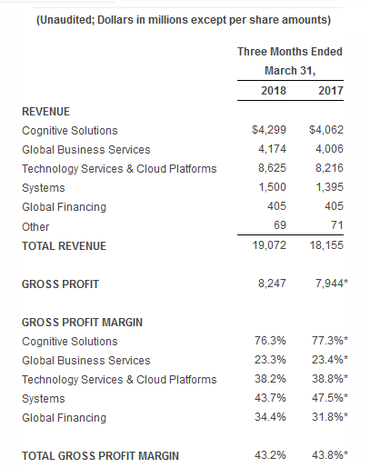
Aided in part by currency rates, IBM reported a better-than-expected first quarter where "strategic imperatives" delivered double-digit revenue growth over the last 12 months and as-a-service sales hit an annual run rate of $10.7 billion.


IBM reported non-GAAP first-quarter earnings of $2.45 a share on revenue of $19.1 billion, up 5 percent from a year ago. Adjusting for currency revenue was flat.

Wall Street was looking for first-quarter adjusted earnings of $2.42 a share on revenue of $18.82 billion.


On a net basis, IBM reported earnings of $1.81 a share, or $2.3 billion.

Read also: Enterprises learning to love cloud lock-in too: Is it different this time? | IBM says breached records dropped by nearly 25 percent to 2.9 billion last year | IBM Think 2018 postmortem: Making incumbent enterprises great again

Big Blue also maintained its outlook for 2018 and said it would deliver non-GAAP earnings of at least $13.80 a share. IBM also said it would deliver free cash flow of about $12 billion for 2018.

IBM's new businesses -- also known as strategic imperatives -- had revenue of $37.7 billion, up 12 percent over the last 12 months. In the first quarter, analytics revenue was up 9 percent with mobile up 19 percent. Security revenue in the first quarter was up 65 percent in the first quarter.

James Kavanaugh, CFO of IBM, said the following on a conference call with analysts.

Our first quarter results reflect much of the work we've done to reposition our portfolio and our skills to address the secular trends in the market, led by the phenomenon of data. We've been building new platforms and solutions while modernizing existing ones, embedding cloud and AI into more of what we offer. And so IBM is now a cognitive solution and cloud platform company focused on the high-value areas of IT.

By unit, IBM's cognitive solutions division had revenue of $4.3 billion, up 6 percent. Business services had revenue of $4.2 billion, up 4 percent, with technology services and cloud platforms delivering sales of $8.6 billion, up 5 percent. Systems revenue got a boost from IBM Z mainframe sales in the first quarter with revenue of $1.5 billion, up 8 percent.

Read also: IBM's cloud strategy revolves around multi-cloud support, grabbing new workloads | IBM launches Cloud Private for Data; elite data science consulting team | IBM launches 'skinny' Z mainframe designed for 19-inch standard data center rack

Here's a look at IBM's quarterly growth by product line.


A few notable items:

  1. Digital offerings are driving consulting growth and there were "modest" improvements in revenue in the first quarter relative to the fourth quarter.
  2. IBM Z sales were driven by the z14 and new workloads. IBM Z sales were up 54 percent from a year ago.
  3. Storage revenue declined after four straight quarters of growth.
  4. First quarter revenue in the Americas was flat with EMEA up 1 percent and the Asia Pacific flat. Americas revenue saw growth in Canada and Latin America and a decline in the US.


Wednesday, April 11, 2018

4/11/2018 02:30:00 AM

IBM launches 'skinny' Z mainframe designed for 19-inch standard data center rack

IBM is hellbent on bringing the power and unique characteristics to a private or public cloud data center near you.


IBM is rolling out a "skinny" mainframe that has a 19-inch industry standard, single frame design and be easier to integrate into cloud data centers.

The game plan for IBM is to make the skinny mainframe, which is built on the z14 technology, easier to place in public and private cloud data centers. IBM's traditional mainframe is in a 24-inch architecture.

These skinny mainframes include the IBM z14 Model ZR1 and IBM LinuxONE Rockhopper II.

Mike Desens, vice president of offering management for IBM Z systems, said he "always thought our mainframe was svelte anyway," but acknowledged that the 19-inch footprint means air flow, storage and a mainframe can be integrated into a standard rack. "It gives our customers more flexibility with what they are used to doing," explained Desens. "The 19-inch footprint provides all classical strengths of mainframes in a standard data center."

IBM Z, Big Blue's latest mainframe, has landed some sales as enterprises are looking for more transaction throughput and security. IBM Z and IBM Cloud Hyper Protect are a tandem designed to encrypt data on the mainframe level.

IBM launches IBM Z, a revamped mainframe with pervasive data encryption | New IBM big iron for Linux

To roll out the new mainframes, IBM said it used design thinking to work with more than 80 clients including managed service providers, online banks and insurance firms.

IBM said it will deploy the new mainframe systems in its own public cloud data centers.

These skinny mainframes include the technologies in the Z14, which launched in July, in a smaller footprint:

The ability to process more than 850 million fully encrypted transactions a day on a single system with the z14 ZR1.

No requirements for special space, cooling or energy and pervasive encryption and secure service container for data serving.

10 percent more capacity than the predecessor z13s and twice the memory with the z14 ZR1 at 8TB.

19-inch standard form factor, 50 percent more capacity and 2x more memory with the Rockhopper II.

Docker certified infrastructure for Docker EE with integrated management and scale tested up to 330,000 Docker containers.


Wednesday, March 21, 2018

3/21/2018 03:30:00 PM

World's smallest computer: IBM's fraud-fighter is so tiny it's almost invisible

IBM has big ambitions for its barely visible computer, including helping combat fraud with blockchain tech.


Two of the world's smallest computers are the raised cubes in the top-left corner.

IBM has unveiled a computer so small it can slip through a salt shaker and could help prevent the $600bn a year trade in counterfeit drugs, gadgets, and cash.

The company announced the new microcomputer on Monday at its Think conference and predicts it will play a key role in a blockchain network designed to monitor fraud in global supply chains.

The microscopic computer is one square millimeter in size and will act as a so-called 'crypto-anchor' in anti-fraud systems.

IBM says the devices cost just 10 cents to manufacture and contain "several hundred thousand transistors, storage, power, and communications capabilities all packed into a footprint about the size of a grain of salt".

IBM hasn't revealed specifications for the computer yet, but a spokesperson told ZDNet that each of the devices is as powerful as an x86 chip from the 1990s.

IBM researchers at the Thomas J Watson Research Center in Yorktown Heights, NY, will detail the computers in a forthcoming paper. In the meantime, IBM has offered a rough outline of the computer's schematics.

The photo below shows 64 motherboards. Two of the world's smallest computers are the raised cubes in the top-left corner, which are mounted on the motherboard beneath.

IBM reckons the dramatic fall in cost and size of the computers will make it possible to integrate them into products to ensure goods are authentic as they move through the supply chain and on to consumers.

The tiny solar-powered computers IBM designed would be embedded in products and rely on LED lights to communicate with a network. Businesses could ensure and prove the authenticity of each product or component with one of IBM's computers in it.

The first of these tiny computers could be available for customers within 18 months, according to IBM, which sees them playing a role in food safety, pharmaceuticals, manufacturing, genetically modified goods, expensive wines, and in the luxury goods market.

It builds on its existing crypto-anchor systems based on an optical structure that can be placed on product labels and used as digital fingerprints.