Breaking

Showing posts with label Operating systems. Show all posts

Wednesday, November 27, 2019

11/27/2019 05:12:00 PM

Microsoft is working on the dual-screen future of Windows 10, with the 20H2 replace about to enter the testing

As Windows 10 20H1 is very shut to being finalized now


Microsoft has pushed out a new preview of Windows 10 20H1, the next incoming replace for the OS due perhaps quite early in 2020, asserting that it’s almost completed now – and that as a result, checking out is about to start on the following replace which will logically be referred to as Windows 10 20H2 (and is internally codenamed ‘Manganese’).

Windows 10 preview build 19033 (20H1) has been launched to testers in each the quick and sluggish rings, with only some minor fixes being carried out for the reason that the previous build, due to the fact as noted, this model is almost finished now.

Microsoft gave a current Windows 10 update to the wrong users
Windows 10X leak shows it’s not simply for dual-screen devices
These are the best Windows 10 laptops out there

In fact, as Microsoft observes, it has removed the build watermark (which indicates a preview take a look at build) which is usually in the bottom right-hand nook of the desktop, however the enterprise provides in daring type: “This doesn’t imply we’re done…”

However, we are very certainly almost done, and Microsoft additionally announced: “We are searching to commence releasing new builds from our improvement branch. This capacity we will be releasing builds to Insiders in the Fast ring from the RS_PRERELEASE improvement department again rather of the VB_RELEASE branch.”

As mentioned, this is the subsequent big 20H2 replace which have to be imminently on hand for testers in the quick ring, and this is the upgrade which is to be tailor-made for dual-screen units like Microsoft’s very own Surface Neo (hardware jogging Windows 10X, a new spin on the OS designed for such two-screens-are-better-than-one portables).

Bugs aplenty

Naturally, the very first versions of a new update are possibly to comprise extra bugs and be much less stable, so Microsoft warns that you need to take a look at your Windows Insider Settings and change your self into the slow ring if you favor continuing to be on 20H1.

Fast ring testers will soon get switched over to take a look at the new improve (presumably 20H2, as noted).

Interestingly, Microsoft has named the 20H1 update model 2004, when it would generally be 2003 (for example this year’s spring replace was model 1903, accompanied via 1909). This is to keep away from any viable confusion with Windows Server 2003, apparently.

Last-minute worm fixes applied in this new 20H1 preview construct ordinarily involve options for crashing issues, consisting of one where the Start menu would crash on launch if a Windows replace was once wanting a restart.

As the 20H1 update is about to be finalized, there’s an opportunity it ought to be launched until now than regular when the new 12 months rolls into the city – possibly even as early as January or February, as a substitute than ready until spring as typically happens. That said, nothing is positive in phrases of Microsoft’s meant launch time table for next year, and the firm might also just maintain onto the update even if it’s ready. 

Monday, July 8, 2019

7/08/2019 08:08:00 PM

Debian 10 ‘Buster’ is out with lots of tweaks and better security

Plus a host of updated packages…


Debian 10 has been released, with the latest incarnation of the Linux distro being codenamed ‘Buster’ and bringing a number of improvements, not to mention a host of updated packages.

The developers note that Buster took just over two years to craft and hone to a stable version, and will be supported for the next five years going forward.

The OS ships with a variety of desktop environments, running with Gnome (3.30) with Wayland display server by default (but it also incorporates Cinnamon 3.8, KDE Plasma 5.14, Mate 1.20, Xfce 4.12 and more).

Secure Boot is supported in Debian 10 and should work out of the box, and the devs also observe: “Thanks to the Reproducible Builds project, over 91% of the source packages included in Debian 10 will build bit-for-bit identical binary packages. This is an important verification feature which protects users against malicious attempts to tamper with compilers and build networks.”

Plentiful packages

As mentioned, a ton of software packages have been updated for Buster – almost two-thirds of the packages delivered with the previous release of Debian 9 (known as ‘Stretch’).

That includes Chromium 73.0, Firefox 60.7, GIMP 2.10.8, LibreOffice 6.1, Thunderbird 60.7.2, Perl 5.28, PHP 7.3, Python 3 3.7.2, Ruby 2.5.1 and much more (there are over 59,000 software packages in total).

Check here for full release notes, and you can grab Debian 10 live images here (which allow you to try the distro without installing it on your hard disk – although you can fully install the OS from the live image by following the instructions provided).


READ MORE:

Thursday, February 21, 2019

2/21/2019 07:15:00 PM

If you miss this vital Windows 7 patch updates will stop working in July

Six months earlier than the official deadline of January 2020


All Windows 7 users hopefully know that Microsoft will cease support for the operating system in January 2020, but what they might not realize is that extended support could dry up in July 2019 if they fail to install some critical patches next month.

The patches arriving in March mark a security upgrade for Windows 7, and mean that Windows updates will only use the SHA-2 hash algorithm to sign and authenticate patches (i.e. to make sure they’ve come directly from Microsoft, and haven’t been tampered with).

Currently, OS updates are dual-signed using both SHA-1 and SHA-2 algorithms, but as Microsoft notes: “Due to weaknesses in the SHA-1 algorithm and to align to industry standards Microsoft will only sign Windows updates using the more secure SHA-2 algorithm exclusively.”


  • Are you thinking of upgrading to Windows 10?
  • Here’s everything you need to know about using Windows 10
  • Want to stick with Windows 7 after 2020? It’ll cost you...


The March updates lay the groundwork for this, but the actual move to SHA-2 won’t happen until July. When that month rolls around, though, if you haven’t got SHA-2 support in place, then you won’t get any further Windows updates.

As Microsoft observes, customers running Windows 7 SP1 – or Windows Server 2008 R2 SP1/SP2 – will need to patch in SHA-2 code signing before the July 16 deadline.

Target date

In short, then, you need to make sure you don’t miss the various standalone security updates that will deploy next month and usher in SHA-2 code sign support – currently, Microsoft is estimating a target date of March 12 for their release on Windows 7.

What about Windows 10 users? Fortunately, they don’t have to worry about anything, as Microsoft notes that also on July 16: “Windows 10 updates signatures [will be] changed from dual signed (SHA-1/SHA-2) to SHA-2 only. No customer action is expected for this milestone.”

Everything should happen automatically, then, and there’s no chance of you being able to miss out on the algorithm upgrade, and therefore subsequent updates.

Meanwhile, if the cessation of support for Windows 7 is weighing heavily on your mind, we’ve got a full guide on how to prepare for Windows 7 end of life. Remember, even with the SHA-2 patch in place, you’ve got less than 11 months of support left.


READ MORE:

Friday, February 15, 2019

2/15/2019 07:36:00 PM

Chrome OS could be getting virtual desktops

More space to work on


A video has emerged that demonstrates virtual desktops being used on Chrome OS, which suggests that Google is looking to incorporate the feature into its operating system for Chromebooks.

The feature, which will apparently be called ‘virtual desks’ was found in a video spotted by Android Police, and was included in the Chromium Gerrit commit, which suggests that developers are actively working on implementing the feature.

What is a Google Chromebook? We explain all
Should you buy a Chromebook?
The best cheap Chromebook deals

The video, which you can view below, gives us a brief glimpse of how the virtual desks feature would work when creating new virtual desktops. The commit also explains that the feature will have thumbnail snapshots of all your desktops, making it easy to switch between desktops.

Hot virtual desking

Virtual desktops are a very useful feature found in Windows 10 and macOS, so adding the feature to Chrome OS will allow Google’s lightweight operating system to better compete with its more established competitors.

Virtual desktops allow you to create and manage multiple desktops on a single machine, which can make it easier for you to organize windows, applications and more.

The inclusion of this productivity-boosting feature will be welcome for anyone who finds working on a Chromebook (or a Chrome OS-powered Chromebox PC) a bit cramped and will help make Chrome OS an even more feature-rich operating system. Let’s hope this feature makes it into Chrome OS soon.


SOURCE:

Thursday, February 7, 2019

2/07/2019 11:21:00 PM

Windows Update and Microsoft Store aren’t working for some users

Microsoft has confirmed this is a DNS-related issue


Update: Microsoft has confirmed this is a DNS problem with some ISPs, and stated that it was resolved for everyone but a few users. In a support update, the company wrote: “The Windows Update service was impacted by a data corruption issue in an external DNS service provider global outage on January 29, 2019. The issue was resolved on the same day and Windows Update is now operating normally, but a few customers have continued to report issues connecting to the Windows Update service.

“We expect these issues will go away as downstream DNS servers are updated with the corrected Windows Update DNS entries.”

 [Original story follows below.]

A number of Windows 10 users have apparently been having trouble connecting to the Microsoft Store, and more crucially, Windows Update.

Reports have broken out online describing such gremlins in the works of Windows 10, as Windows Latest spotted, and they’re allegedly being caused by a DNS issue.

At first, the denizens of Reddit were reporting that the problem was with Comcast DNS, and that switching to an alternative DNS server (like Google’s) remedied the issue.

That workaround was only successful for some, though, and further reports (one of which was on Microsoft’s Answers.com forum) have popped up of non-Comcast users being unable to get Windows Update or the store to function, including users in the UK on BT, TalkTalk and possibly other ISPs.

So there appears to be a problem on Microsoft’s end somewhere, seemingly persisting – even though the very latest comments on the Answers.com thread suggest Windows Update now appears to be working again, it’s not actually downloading anything, or functioning correctly.

Investigation underway

A Microsoft support engineer chimed in on Reddit to say: “Microsoft is aware of this issue and is investigating. We’ll provide more information as it becomes available.”

Apparently this bugbear is only affecting a fairly limited set of Windows 10 users, but nonetheless, it’ll hopefully be solved sooner rather than later, given that having Windows Update failing to function is a pretty major faux pas (and not being able to download apps or games from the Microsoft Store could doubtless be a major annoyance, too).

Meantime, you could always try the workaround of switching your DNS server to see if that has a positive effect. We’ve highlighted all the best free and public DNS servers, and we describe how to switch servers if you scroll further down the article, past the recommendations.


READ MORE:
2/07/2019 07:36:00 PM

Want to keep using Windows 7 after 2020? It'll cost you

Staying alive


When Windows 7 reaches its End of Life on January 14, 2020, Microsoft will no longer support the aging operating system, which means anyone using Windows 7 could be at risk as there will be no more free security patches.

However, with many people – and businesses – still using Windows 7 (we reported a few days ago that Windows 7 is actually gaining users), this could leave a lot of people in the lurch, which is why late last year Microsoft announced it would be offering Windows 7 Extended Security Updates for a fee.

It has now been revealed who will be eligible for those extended security updates (ESU), and how much they will cost.

The cost of support

Microsoft has apparently disclosed how much these updates will cost, and they will be made available to Enterprise and Microsoft 365 customers, which can buy the Windows 7 Extended Security Updates on a per device basis.

These updates are aimed at businesses that are unable to move to Windows 10 before Windows 7’s End of Life date, and are only meant to offer support while businesses prepare to move.

The pricing is expensive, and the cost rises over the years. So, for support for Windows Enterprise users using Windows 7 for the first year after the End of Life date (January 2020 – January 2021), the cost is $25 (around £20, AU$35).

This rises to $50 per device (around £40, AU$70) for year two (January 2021 – January 2022), and $100 (around £80, AU$140) for year three (January 2022 to January 2023). It appears that at the moment that Microsoft is hoping by 2023, Windows 7 users will be small enough to stop offering the extended security updates.

As this is a per-device cost, businesses with numerous PCs running Windows 7 will soon find this very expensive.

If they are using Windows 7 Pro, then those prices are even higher, with $50 (around £40, AU$70) for year one support, $100 (around £80, AU$140) for year two and $200 (around £150, AU$280) for year three.

If you’re a non-business user who wants to keep using Windows 7, then you could theoretically sign up as an Enterprise user, as there’s no minimum purchase necessary for the Windows 7 ESU, but we wouldn’t recommend it.

It’s far cheaper – and easier – to say goodbye to Windows 7 and instead upgrade to Windows 10.

Check out our pick of the best laptops of 2019


READ MORE:

Tuesday, January 29, 2019

1/29/2019 09:34:00 PM

Windows 10’s next big update for late 2019 is about to roll out to testers

In just a few weeks’ time, hopefully…


We already heard very recently that Microsoft is working on the next big update for Windows 10, to follow the current 19H1 build which should roll out around April time, and it seems that it’ll only be a few weeks before ‘skip ahead’ (advance) testers will get the initial incarnation of this upgrade.

To be clear, this is the update expected to land late this year, which Microsoft has already begun work on internally, at least according to a leak on Twitter which showed evidence of a new Windows 10 Build 18823 for 19H2 (19H2 referring to the second half of 2019).

Now we’ve seen a tweet from Brandon LeBlanc, Senior Program Manager on the Windows Insider team, replying to a keen ‘skip ahead’ tester who was enquiring exactly when 19H2 will be up for testing.

So as you can see, LeBlanc made it clear that while the next major upgrade isn’t imminently due, it will be arriving (hopefully) in a few short weeks.

Ready for Sets?

We have no details at all on what Microsoft might be aiming to include with the 19H2 update at this point, not even any vague speculation, but hopefully, snippets along those lines will be emerging before too long.

We can keep our fingers crossed that Microsoft may be planning to include the big Sets feature we’ve heard so much about in this particular outing for Windows 10, as this looks like a major and exciting change for the OS.

An early version of Sets first appeared in test builds running up to the April 2018 Update last year, but it was stripped out before the upgrade was deployed, before reappearing in the October 2018 Update when that was in testing, and subsequently being removed again.

It is, perhaps then, what you could refer to as a ‘hokey-cokey’ feature – in, out, in, out – but hopefully this time round, it might be included and actually make the cut for the release version of Windows 10.


READ MORE:

Sunday, January 27, 2019

1/27/2019 04:10:00 PM

Want Windows 10 ARM on your Lumia 950 XL phone? This tool makes it possible

Turn your old Lumia smartphone into an ‘always connected’ PC of sorts


Earlier this week, we saw a video of Windows 10 for ARM running on an old Lumia 950 XL, and now a utility has emerged which allows you to install the OS on this smartphone if you happen to own one.

Windows 10 for ARM is a version of the operating system which is made for laptops that use ARM processors, as the name suggests, and the tool in question allows you to install it on a Lumia 950 or 950 XL. The utility was produced by developer José Manuel Nieto and various other devs (as spotted by MS Power User).

Once installed, you should be able to happily run Win32 apps on your phone, with the Lumia 950 XL’s Qualcomm Snapdragon 810 processor and 3GB of RAM apparently enough to cope with the demands of Windows 10, as we saw in the recent video that was aired.

Smooth operator

Certainly general navigation around the OS and basic tasks such as web browsing, or playing a quick round of solitaire, seemingly ran as smooth as butter.

If you have a Lumia 950 or 950 XL and fancy giving this a shot, then there’s a tutorial video detailing the installation process (see above).

Note that the tutorial ends halfway through for Lumia 950 users, although those with a Lumia 950 XL can carry on and install GPU drivers (although the drivers aren’t 100% finished, so you will see some glitches).

Here’s our pick of the best laptops of 2019

Friday, January 25, 2019

1/25/2019 09:27:00 PM

Windows Lite could have a redesigned Start Menu with no Live Tiles

RIP Live Tiles


It looks like Windows Lite, Microsoft‘s stripped-down version of Windows 10 that it aims to take on Google’s ChromeOS, could be getting a radically redesigned Start Menu that drops the Live Tiles features for a more minimalist look.

Live Tiles first appeared in Windows 8, and were designed to provide tablet-like buttons for touchscreen devices that gave contextual information as well. So, the Live Tile app for the Mail app would show you the latest email, while the Weather app Live Tile would give you the latest forecast.

Microsoft brought Live Tiles to Windows 10, but they always felt a little out of place in that operating system, and have ended up making the Start Menu look large and cluttered.

With Microsoft looking to make a more simple version of Windows, we can certainly see the logic behind dropping Live Tiles.

RIP Live Tiles?

While it makes sense that Live Tiles could be dropped from Windows Lite’s Start Menu, Zac Bowden over at Windows Central has noted that the Live Tile feature in the full version of Windows 10 hasn’t been updated for a while, so could its days be numbered for all versions of Windows?

As we mentioned earlier, Live Tiles were a way for Microsoft to try to tempt tablet owners to move to Windows 8. However, Windows 10 dropped most of the touchscreen-centric design choices, except for Live Tiles.

With Microsoft looking at more simple designs for upcoming Windows variants like Polaris and Andromeda, as well as Windows Lite, this may mean the end of Live Tiles as we know them.


READ MORE:

Friday, January 11, 2019

1/11/2019 03:57:00 PM

Latest Windows 10 security patches include a fix that should be urgently applied

Plus several important patches for Microsoft Edge and Internet Explorer


Microsoft has deployed its latest round of monthly security patches for Windows 10 (and Windows 7/8.1) with a large number of fixes unleashed – 51 security flaws have been resolved, to be precise, including an important patch for a critical vulnerability which is public knowledge.

While the latter hole in Windows (7, 8.1 and 10) has not yet been exploited to Microsoft’s knowledge (as observed by Bleeping Computer), it’s a nasty one that can potentially allow an attacker to remotely execute code on the victim’s PC.

This is actually an issue in the Windows Jet Database Engine – a component included in every modern version of Windows – which improperly handles objects in memory, but it is now cured. A good thing too, as the vulnerability has been known about since last September.

Browser benefits

Other patches included fixes for a pair of vulnerabilities in Microsoft Edge, ensuring the browser is now immune to an elevation of privilege issue, and a memory corruption problem which could allow an attacker to remotely execute malicious code.

Internet Explorer also benefited from attention, again with a remote code execution vulnerability in its browser engine getting papered over.

Several fixes were implemented for Microsoft Office – including the solution to a remote code execution vulnerability in Word – plus two Windows Hyper-V flaws were ironed out, and a DHCP client remote code execution vulnerability.

So yes, there were plenty of remote code execution fixes, for sure. If you want the full list of Microsoft security updates, Bleeping Computer has compiled it here.

Note that a patch was also delivered for Adobe Flash Player which was labelled a security fix, but in actual fact, it was a non-security-related update – rather it addressed feature and performance bugs.


SOURCE:

Saturday, January 5, 2019

1/05/2019 07:40:00 PM

New Windows 10 preview makes useful security and accessibility tweaks

Password-less phone logins come to more than just Windows 10 Home users


Another fresh preview build for Windows 10 has rolled out to the fast ring, and while there are no massive changes, it includes some useful tweaks on the security front, as well as to Narrator, the screen reading tool built into the operating system.

Build 18309 (for the update which will land in the first half of this year or 19H1 as it’s referred to) make some adjustments to security, including pushing forward with the concept of the password-less PC.

Remember in the last build (18305) that Microsoft introduced the ability to sign in to Windows 10 using your smartphone rather than having to type in a password?

That works by linking your Microsoft account to your phone, then set up a ‘password-less phone number account’, but the ability to do this was only available to testers running Windows 10 Home.

Now, testers using any version of Windows 10 will be able to benefit from password-less logins. While we’re talking security, the same is true of the Windows Hello PIN reset process, which was tweaked and streamlined in the last build and is now also available across all versions of Windows 10 (and not just testers with Windows 10 Home).

Nifty narration

Microsoft has been working on new accessibility tricks for some time now, and the Narrator has witnessed a raft of improvements in this build.

That includes the ability to add new voices in other languages without having to go through the trouble of downloading language packs. This is facilitated in Narrator Settings, using the Add More Voices option.

Narrator’s Home menu has also been tweaked so that the main actions the user can take aren’t list-view items now, but have been turned into buttons (which is more convenient, plus you get the ability to tab between them).

Various other tweaks include better table reading when in PowerPoint, improved reading of controls while you’re navigating around the OS in general, and better interaction between Chrome and Narrator, both when it comes to navigating the browser’s menu, and surfing the web.

Also on the ease of access front, Microsoft has added 11 new mouse pointer sizes under Cursor and Pointers settings, to make for 15 choices in total.

As ever, a number of other fixes have been applied to cure glitches and bugs, including a crashing issue which occurred when using an Xbox controller with the PC.

The new Windows Sandbox (another feature introduced in the last build which allows you to quickly fire up an isolated environment to open a potentially suspect file) also got some tuning, with a compatibility issue fixed – a clash with update KB4483214 – and better support for high DPI displays.

Also worth noting is the fact that when installing Windows 10 Pro, Enterprise or Education editions, Cortana’s voiceover has been disabled by default, as requested by user feedback. The voice assistant will still be present when setting up Windows 10 Home from scratch, though.

Microsoft also took the time to remind folks that this is an early build in the development cycle of the 19H1 update, and so those who aren’t comfortable with the likely appearance of bugs might want to switch from the fast ring to the show ring (which deploys builds further down the line when they’ve been tested more).


SOURCE:

Tuesday, December 18, 2018

12/18/2018 09:29:00 PM

Windows 10 could let you trade-in Cortana for other digital assistants in the future

Goodbye, Cortana... hello, Alexa?


We might just witness a future where a Windows 10 user could replace the operating system’s integrated voice assistant, Cortana, with another digital helper of their choice.

Take Amazon's Alexa, for example, which Microsoft has already brought on board with some notebooks and desktop PCs through its Microsoft Store.

This is the latest from the rumor mill, as spotted by Engadget, with Albacore and WalkingCat (the latter a prolific Microsoft leaker) highlighting evidence and application programming interfaces (APIs) pointing to this possibility on Twitter.

Albacore spotted fresh options in testing potentially related to voice assistants, whereby you’ll be able to specify voice keywords, such as ‘Alexa’, to fire up Amazon’s assistant via its app (the Alexa app is already on Windows 10, after all, with the assistant being baked into a number of laptops carrying Microsoft’s latest OS).

Preview builds of Windows 10 have already seen some testing of splitting up Cortana and core search functionality into two separate entities on the taskbar – for a limited set of Windows Insiders – as highlighted by another denizen of Twitter.

So, coupled with the other aforementioned evidence, the overarching theory is that Microsoft could eventually let users effectively replace Cortana with another third-party assistant.

Very early days

This is, of course, just pieces of speculation based on titbits in the test versions of Windows 10 right now, so we certainly shouldn’t get carried away with this idea.

It would be a huge move for Microsoft to allow for a wholesale replacement of Cortana, for sure. That said, the winds of change seem to be very much blowing through Windows 10 at the moment – just look at what’s just happened with Edge abandoning its own proprietary browser engine and switching to Chromium.

So maybe – just maybe – all this talk of allowing users to effectively give Cortana the elbow isn’t so far-fetched, after all.

These are the best laptops we’ve tested to date

Friday, November 30, 2018

11/30/2018 11:13:00 PM

Only 2.8% of Windows 10 PCs have the October 2018 Update installed

At least according to one set of statistics from AdDuplex


You may recall that much fuss was made about the April 2018 Update for Windows 10 being rolled out at a blisteringly fast pace, but the October 2018 Update is a very different story according to the latest stats – although that comes as no real surprise given that it was paused for ages thanks to some major bugs.

According to AdDuplex, which monitors Windows 10 installations on PCs that run its ads (via apps from the Microsoft Store), the October 2018 Update is only on a rather pitiful 2.8% of computers at this point, following its release at the beginning of October.

As mentioned, though, when a major bug was discovered that was deleting user data – along with some other gremlins in the works – the update was paused for quite some time. The rollout subsequently resumed mid-November.

There is even a suggestion by AdDuplex concerning whether the rollout has indeed been fully resumed, as the company asks: “Windows 10 October 2018 Update was re-released two weeks ago... Or was it?”

The firm concludes that “this seems to be a very cautious release”, and indeed since the re-release, we have seen other problems crop up which have meant the update has been blocked on certain PCs.

Sample set

At any rate, before we get too carried away with possible theories about the rollout speed here, we should bear in mind that this is a limited sample of the overall PC population out there – but still, we’re comparing it to figures drawn from a similar sample set by AdDuplex in the past. And it’s worryingly low, for sure.

According to the figures, the April 2018 Update is the version of Windows 10 installed on the vast majority of PCs out there: 89.5% of them to be precise.

Indeed, 3.9% are still running the Fall Creators Update (the upgrade previous to the April 2018 Update), which is actually more than the number of folks using the October 2018 Update.

As an aside, AdDuplex also breaks down the composition of Surface devices out there, and the most popular model remains the Surface Pro 4 with 25.3% of users, followed by last year’s Surface Pro on 18.6%.

The new Surface Pro 6 is making quick headway on 5.2%, though, considering that it has only just been released, and it’s already equal to the original Surface Book in terms of the numbers, and not far behind the Surface Go which is on 7.3%.


SOURCE:

Wednesday, November 28, 2018

11/28/2018 10:33:00 PM

iCloud now works with the Windows 10 October 2018 Update

Microsoft also releases new fixes


Apple has released an update for its iCloud for Windows app (version 7.8.1) which should now allow it to work with the Windows 10 October 2018 Update.

As we reported several days ago, people with the Windows 10 October 2018 Update installed on their PC were no longer able to install or use the Windows app for iCloud, Apple’s cloud-based backup and storage service.

The issue was severe enough for Microsoft to pause rolling out the Windows 10 October 2018 Update to computers that had the iCloud app already installed.

With the new release of iCloud for Windows, users can now upgrade to the Windows 10 October 2018 Update and still be able to use iCloud – though Microsoft recommends you install the latest version of iCloud for Windows first.

Microsoft's turn

Microsoft has also released a cumulative update (Build 17763.167 (KB4469342)) that addresses a number of issues with the Windows 10 October 2018 Update, following on from a previous cumulative update that was released for other versions of Windows 10.

This new update is available to Windows Insiders in the Release Preview ring – essentially people who have signed up to try out new versions of Windows 10 (and its updates) before they reach the general public.

Hopefully, this update, and the fixes it includes, will make it to regular users soon. According to Microsoft’s release announcement for the update, the update includes the following fixes:


  • Addresses an issue in Microsoft Edge with using the drag-and-drop feature to upload folders from the Windows desktop to a file hosting service website, such as Microsoft OneDrive. In some scenarios, files contained in the folders fail to upload, with possibly no error reported on the web page to the user.
  • Addresses an issue that degrades Internet Explorer performance when you use roaming profiles or you don’t use the Microsoft Compatibility List.
  • Addresses updated time zone information for Fiji.
  • Addresses time zone changes for Moroccan daylight standard time.
  • Addresses time zone changes for Russian daylight standard time.
  • Addresses an issue that causes display settings to stop working when changing a multi-monitor configuration.
  • Addresses an issue that displays a black screen on some servers when waking a display from sleep.
  • Addresses an issue with long delays in taking a photo when using the Camera app in certain lighting conditions.
  • Addresses an issue that prevents live Hulu TV content from playing in Microsoft Edge; instead, a black screen appears.
  • Addresses an issue that stops Bluetooth headsets from receiving audio input after several minutes of listening.
  • Addresses an issue that causes the Brightness slider preference to be reset to 50% when the device restarts.


That’s just a taste, as there are a lot more fixes featured on Microsoft’s blog. It’s good to see Microsoft working to make the Windows 10 October 2018 Update better, along with help from Apple. Let’s hope this cuts down the number of issues people are facing with the update.


SOURCE TechRadar:

Saturday, November 17, 2018

11/17/2018 07:36:00 PM

Windows on ARM now supports 64-bit apps

Hopefully leads to better apps


Windows on ARM, a version of Windows 10 that can run on laptops running smartphone-like hardware, has just received a big boost, as the software now supports 64-bit ARM (ARM64) apps.

This means developers can recompile their existing Windows applications that run standard Windows 10 computers, to run natively on Windows on ARM.

Most modern apps are 64-bit, but for them to run on Windows on the ARM in the past, they had to be emulated, which impacted their performance on Windows on ARM devices.

Costing an ARM and a leg

Windows on ARM devices have plenty of potential, as the ARM hardware allows for longer battery lives and instant-on boot times, much like modern smartphones.

However, current Windows on ARM devices have been criticized for being expensive, and for having poor performance compared to traditional laptops of the same price.

With developers able to recompile their apps to run natively on ARM hardware, we should hopefully see better performance and an increased range of apps available for Windows on ARM devices. However, whether app developers will go to the trouble of recompiling their apps will depend on how successful Windows on ARM devices are.

Still, it’s a step in the right direction from Microsoft if it wants to make Windows on ARM a more enticing proposition for developers and consumers alike.


SOURCE:

Saturday, October 27, 2018

10/27/2018 11:01:00 PM

Leaked Slide Suggests Microsoft is Still Working Away on Andromeda OS

Azure DevOps presentation gives up some interesting clues


It seems that Microsoft is continuing to beaver away on Andromeda OS, the potential future version of Windows 10 which does things very differently, and is pitched to span across multiple devices, potentially including the company’s foldable dual-screen Surface phone/tablet hybrid (or ‘pocketable device’ as it has also been referred to).

As spotted by prolific Microsoft leaker WalkingCat, a Reddit user attended a Microsoft presentation on the subject of Azure DevOps, and one of the slides on ‘understanding dependencies’ carried a reference to Andromeda (see the image below).

The slide also mentioned WCOS – Windows Core OS, which Andromeda is part of – in a couple of places, as well.

This would seem to indicate that work is progressing on Andromeda OS, although obviously, we’d be foolish to attempt to draw any concrete conclusions from the appearance of a few words on a slide at a conference.


Sleek and streamlined

Andromeda OS is designed to be a customizable and more streamlined operating system, which will be able to adapt to various different devices. That supposedly includes the aforementioned rumored dual-screen effort, where the operating system will be able to adjust itself depending on how the foldable screens are being used.

We most recently heard about an Andromeda OS Productivity Mode which points to the fact that the operating system will run different modes you can flip between, and this particular mode could potentially make it easier to type on a device without a traditional keyboard like our rumored foldable dual-screen friend.

The last we heard, the Andromeda hardware and software was expected to be unleashed in 2019, so fingers crossed it stays on track – but at least it certainly appears that Microsoft is still working on this project.

These are the best laptops of 2018

Via MS Power User


SOURCE TechRadar:

Wednesday, October 17, 2018

10/17/2018 01:09:00 AM

Windows 10 October 2018 Update issues get fixed including HP Blue Screen of Death

Along with an Intel driver issue causing sound loss


Microsoft has fixed a couple of problems that affect the October 2018 Update, namely an Intel audio driver issue, and the scarier Blue Screen of Death (BSOD) flaw which affected some HP machines.

The HP problem was with a keyboard driver, which caused the dreaded blue error screen to pop up, with some PCs becoming unresponsive, or even failing to boot, as we recently reported. This issue was actually caused by a cumulative update for the October 2018 Update, as opposed to the upgrade itself (and it also affected the April 2018 Update, for that matter).

As Wccftech reports, the fix for the BSOD issue has now been pushed out via Windows Update, so you should have it applied to your machine automatically.

If that hasn’t happened, you can always manually grab it here. Note that you’ll have to reboot your PC afterward to apply the fix.

Audio aggravation

As for the Intel audio problem, that occurred thanks to the release of a buggy Intel driver which was errantly delivered by Windows Update, causing the sound to fail on affected PCs.

Microsoft has now issued a new update to remedy this problem, and again this should be automatically piped to your machine via Windows Update.

Obviously, this is good news for those who have been hit by these gremlins, of which, unfortunately, the October 2018 Update has certainly suffered a number of, including a major file deletion issue which has actually caused Microsoft to pause the rollout of the upgrade.

If you’ve encountered any hitches with the latest dollop of features for Windows 10, be sure to check out our guide on how to fix Windows 10 October 2018 Update problems.


SOURCE TechRadar:

Sunday, October 7, 2018

10/07/2018 10:55:00 PM

Windows 10 October 2018 Update is allegedly deleting files

Files from user folders such as Documents and Pictures are being deleted


It appears that there could be another issue with the October 2018 Update for Windows 10 – alongside the Intel CPU flaw we recently highlighted – and it’s a nasty one, potentially involving the loss of user data.

First off, we should certainly clear that this is simply based on a number of user reports online, and no concrete conclusions have been drawn yet.

But those affected say the update has caused some of their personal data to vanish, and post-installation, files have seemingly been deleted from the Documents and Pictures folders, and possibly other media and miscellaneous files, too.

Windows Central is one of the sites that spotted, for example, a thread on Reddit where the user claims they lost all files from the aforementioned Documents and Pictures folders, as well as some apps (Spotify for one) and other content (Rainmeter skins).

Another denizen of Reddit reported the contents of their Documents folder going missing post-update, with all the user folders (Desktop and Download folders, and the like) having been shifted to their secondary drive (away from the system drive). 60GB of data went missing in total in this case.

And a complaint on Microsoft’s support forum highlights an even worse scenario than that, with 220GB of files vanishing (over two decades worth).

In the latter case, the user was advised to roll back their PC to before the installation of the October 2018 Update, which they did, but to no avail – the files still remained missing.

Others have pointed out that the lost files might have been hidden away somewhere – for example, in the ‘Windows.old’ directory – but some folks who’ve been hit have combed through their drives and completely failed to find any sign of the vanished personal data.

Cloud connection?

Another user in that Microsoft support thread reports losing over 100GB of data, although some of their files were still present in OneDrive. Speaking of Microsoft’s cloud storage solution, there has been some discussion online about a possible connection with OneDrive and this issue. It’s too early to draw any conclusions at the moment, though, as we’ve already mentioned.

Wccftech has also reported on this and says a Microsoft spokesperson has acknowledged that the company is aware of the reports of this issue online and that it’s “actively investigating”, although no further comment was made.

While it’s seemingly not a huge amount of people that are affected by this apparent flaw, where data loss is involved, the problem has to be taken very seriously, so we’d hope Microsoft will move very quickly indeed with its investigation.

Note that the October 2018 Update rollout hasn’t officially begun – automatic delivery of the update won’t start until October 9. So people installing the upgrade now are doing so manually (a process which we fully detail here).

Obviously, if this story gives you pause for thought or any degree of trepidation regarding installing the update, you’re best off waiting until we get word from Microsoft that the problem has been ironed out.

And as ever, when installing any major update to any device you own – whether that’s a PC, tablet or phone – do make sure that you back up all your data, if it isn’t already safely backed up somewhere. And preferably keep at least a couple of backups (perhaps one on a local external drive, and another in the cloud).

Also, bear in mind that if you hit any other snags with the big update, have a look at our guide on how to fix Windows 10 October 2018 Update problems.


Sunday, September 30, 2018

9/30/2018 04:35:00 PM

macOS 10.14 Mojave Release Date, News and Features

Everything you need to know about macOS Mojave


Apple's macOS 10.14 Mojave is here, and we went ahead and gathered up all the information you need to know about the new Mac operating system.

The new macOS Mojave brings some core iOS apps, like News and Stocks to the Mac for the first time. While not all iOS apps have been ported over, like we initially thought, Apple’s own Craig Federighi did claim that Apple is working on bringing more iOS apps over to the Mac in the years to come.

We’ve also heard from a developer who has already started digging into the process of porting iOS apps to macOS 10.14 Mojave, and while there are some issues that need to be worked out, it does offer a promising glimpse into the future of iOS apps on Macs.

macOS Mojave is out now, and while you can download and install it today. So, now that the big day is finally here, we’re going to jump into everything there is to know about macOS 10.14 Mojave.

Make the most out of the new operating system with the best macOS 10.14 Mojave tips and tricks
Installed Mojave and having issues? Check out our guide on macOS 10.14 Mojave problems: how to fix them


Cut to the chase

What is it? The 2018 edition of Apple’s Mac operating system, macOS
When is it out? macOS Mojave is out right now
What will it cost? macOS 10.14 is free
macos 10.14 Mojave

macOS 10.14 Mojave release date

HOW TO DOWNLOAD

Learn how to download and install macOS 10.14 Mojave right here.

Apple announced macOS Mojave back in June 2018 at WWDC 2018, where most of the features were detailed.

This was followed by a Public Beta launch back in July, then finally the macOS Mojave launch on September 24, 2018.

That’s right, macOS Mojave is now available to download for free for anyone on supporting Mac hardware.

Keep it tuned, because we will keep this section updated with all the newest updates as they release.


macOS 10.14 Mojave specifications

Unfortunately, some older Macs are going to have to go without updating to macOS 10.14 Mojave. This is unlike macOS 10.13 High Sierra, which practically had the same requirements as Sierra.

MACOS MOJAVE VS WINDOWS 10 OCTOBER 2018 UPDATE
See how macOS 10.14 Mojave stacks up against Microsoft's Windows 10 October 2018 Update right here.

First off, macOS 10.14  requires at least 14.3GB of hard drive space for the installation, as that’s what was required last year. To keep it on the safe side, make it 20GB.

Next, Macs that received the 10.13 upgrade were required to be equipped with at least 2GB of memory (or RAM) and running OS X 10.8 or later. With this new update, however, these are the Macs that will be supported by macOS 10.14 Mojave.


  •  MacBook (Early 2015 or newer) 
  •  MacBook Pro (Mid 2012 or newer) 
  •  MacBook Air (Late 2012 or newer) 
  •  Mac mini (Late 2012 or newer) 
  •  iMac (Late 2012 or newer) 
  •  Mac Pro (Late 2013 or newer, or older models with Metal-compatible GPU) 
  •  iMac Pro (2017) 


Unfortunately, while the required models rarely change year over year, they have with macOS 10.14, so if you have an older MacBook, you might need to upgrade to enjoy this new version of the OS.


macOS 10.14 Mojave features

Apple’s macOS Mojave brings plenty of new features to your Mac. And, now we can provide a detailed overview of everything your Mac will be capable of now that macOS Mojave has launched.

From Finder improvements to more rigid security, the best Macs are about to become a lot better.

Read on to discover all the new features coming to your Mac when you update to macOS Mojave.


Dark Mode

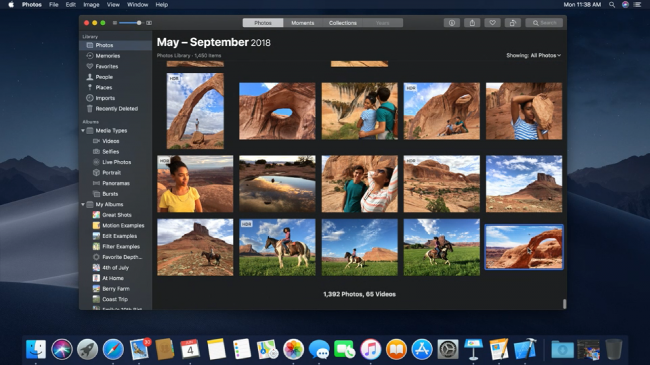
Apple’s macOS Mojave introduces a system-wide dark mode, which will extend to every first-party program on your Mac.

Even Xcode gets a full makeover, completely in black, making those extended programming sessions more comfortable for your eyes.

Third party programs will also be adopting this new theme, with changes happening automatically for any app that uses standard colors through AppKit.


Stacks

Anyone who uses a Mac will know that the desktop can start to get cluttered during a full day of work.

With Stacks, macOS Mojave will sort similar files together so that you have a less cluttered desktop – photos with photos, pdf with pdf – it’s a godsend.

You’re even able to scrub through thumbnails with a two-finger scroll so that you can make sure the file you’re looking for is actually in the stack.


Gallery View

In macOS 10.14 Mojave, Apple has added a new Gallery View to Finder. This will let you quickly browse through, annotate and edit files. No matter what kind of file you select, you'll be able to quickly and easily find exactly what you're looking for.

This is made even easier, thanks to Apple adding a very detailed metadata display to the Preview pane. This makes it easier than ever before to take note of all the information of any file on your Mac.

And, with Quick Actions in the Preview pane, you won't even need to leave Finder to work on files. You'll be able to edit images, add protection to files and more. You can even assign Automator tasks as Quick Actions to make browsing through files even easier.


Continuity Camera

Have you ever found yourself working on a project, and you needed to implement a document or a photo? Well, with Continuity Camera, it’s easier than ever to do just that.

Across a multitude of different apps, like Numbers and Pages, you’ll be able to simply Control + Click in the body of the document, and select “Take Photo” or “Scan Documents.” It’ll then open the camera on your iPhone or iPad, where you’ll be able to take a photo and instantly pop it right into what you’re working on.

It’s smooth, it’s convenient, and it’s going to be a boon for anyone that needs to save some time while doing schoolwork or that next big project.


Markup in Quick Look and Screenshots

Quick Look is already an easy way to look at files quickly, and in macOS Mojave, you'll be able to quickly and efficiently use Markup to edit files you open in Quick Look.

Markup is also implemented into screenshots. You'll be able to quickly bring up any screenshot and zoom or edit any content within. This is possible thanks to improvements to the way macOS handles screenshots. Once you capture a screen, a preview image will open in the corner of your screen, much like iOS. You can then click on this preview to edit your Screenshot.

That's not all though, Screenshots are still a simple shortcut away, but with macOS Mojave, a new easy-to-use menu includes screen-recording tools, so that you can capture animated content. And, perhaps most importantly, you can choose to save the screenshot to your clipboard, saving time if you just need to send someone a quick screenshot.


Apps

Apple News, Stocks, Voice Memos and Home are all brought over from iOS to macOS Mojave, with special care given to reformatting them to fit your computer.

These apps leverage the power of the best Macs to deliver an awesome experience. Voice Memos, for instance, will automatically transfer any memos you take between your iOS and macOS devices – rewarding anyone who utilizes the ‘Apple Ecosystem’.

This isn’t a full iOS app migration, however, but Apple did say it’d be bringing more iOS apps to the Mac in 2019, so we’ll just have to wait.


Security

Apple is concerned about your device security, and now macOS Mojave asks for permission with more features, now including the camera and microphone. Mojave’s security also provides more robust protection for your file system.

Safari also has its own share of security enhancements, shutting down cookies that track you across websites, making sure Safari asks permission before it allows cookies of any kind to access your browsing data. This even includes those annoying social buttons that mysteriously appear on every page – Facebook and Twitter can’t track your activity outside of their own websites unless you grant them permission to.


New Mac App Store

The App store has been a macOS staple for years now, but it always seemed a little out of place. That all changes with macOS Mojave. Apple has completely refreshed the Mac App Store, and it’s now designed exclusively for the best Macs.

Not only does it look very good, but it also lets you browse through apps depending on what you’re looking for. So, if you’re looking for an affordable alternative to Logic Pro X, you can quickly and efficiently find the best app for you.

The new Mac App Store also adopts the iOS App Store’s approach to editorializing its content. It’ll now have a much more modern interface with featured apps getting tutorials, spotlights, and other such content. It really does bring the Mac App Store into the modern age.

There are also a wide variety of third-party app developers, like Microsoft and Adobe, that are bringing their programs to the Mac App Store, so that you won't have to go through some dodgy websites to download the apps you need.


SOURCE TechRadar: